The Money Edit
The Subscription Sweep
Not everything that takes money from your account every month still deserves to.
Money, Organised · 16 min read
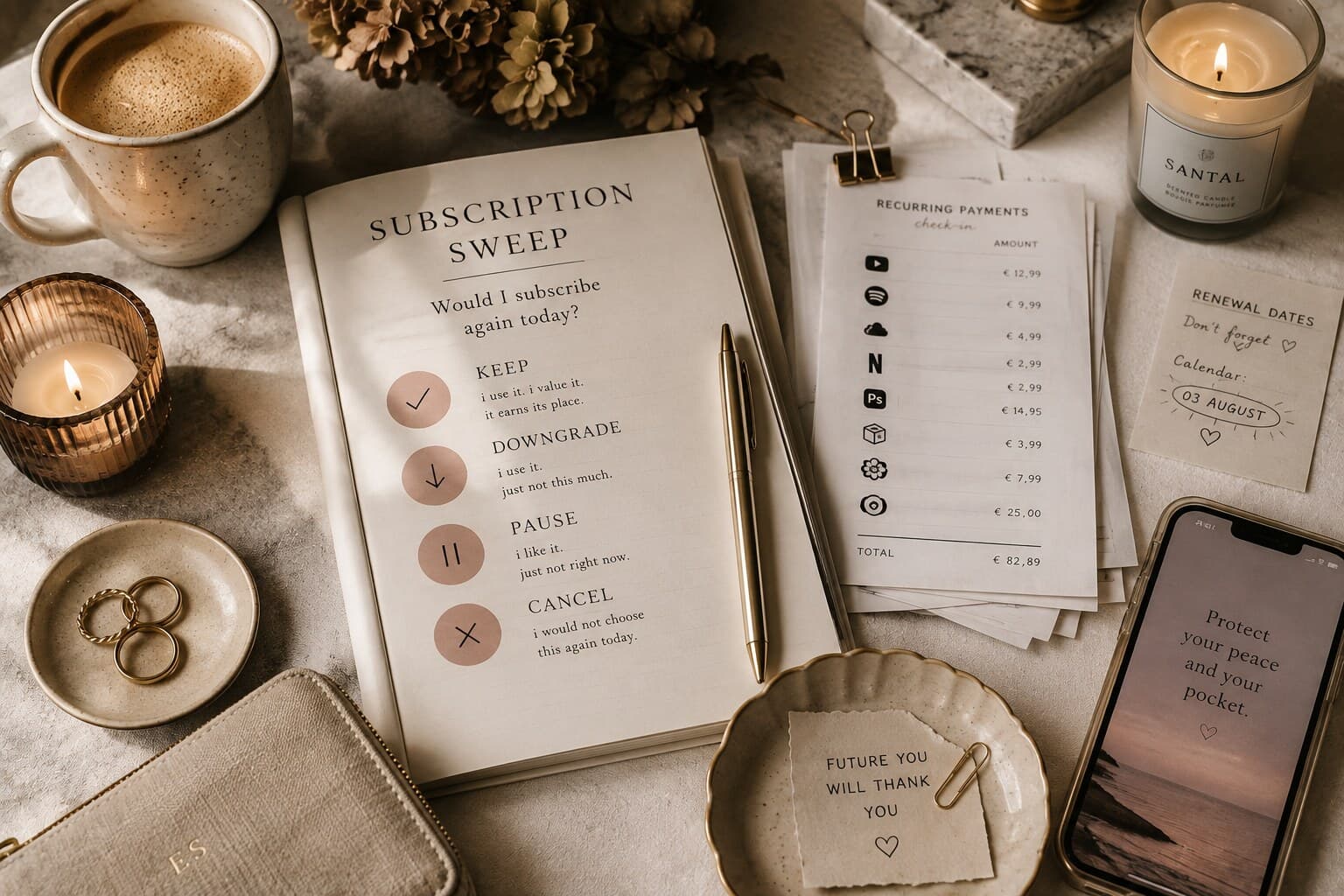
“A subscription is a decision you made once that keeps spending your money until you make another decision.”
I accidentally bought myself a year of Duolingo.
Technically, of course, it wasn’t an accident.
I signed up for the free trial, fully intending to decide later whether I wanted to keep it.
Then Later Esther failed to appear before the cancellation deadline and Present Esther discovered she was now learning Italian for the year.
Fortunately, I actually like learning Italian.
But that really wasn’t the plan.
This is the peculiar thing about subscriptions.
The decision to spend and the moment the money leaves your account can be weeks, months or even years apart.
You decide once:
Yes, I want this.
And then the subscription quietly keeps making that decision for you.
Each billing cycle.
Until you tell it otherwise.
That is why, every so often, I think it is worth doing a Subscription Sweep.
Not because subscriptions are bad.
Not because we’re going to cancel Spotify, live without cloud storage and congratulate ourselves on cutting a monthly payment.
But because:
A subscription is a decision you made once that keeps spending your money until you make another decision.
Sometimes that decision is still absolutely right.
Sometimes it isn’t.
Let’s find out.
What is a Subscription Sweep?
A Subscription Sweep is a periodic review of your recurring payments to decide whether you still want, use and value what you’re paying for.
What is a Subscription Sweep?
A Subscription Sweep is a periodic review of your recurring payments to decide whether you still want, use and value what you’re paying for.
The goal is not to have as few subscriptions as possible.
It is to make sure every recurring payment is still attached to a decision you would make today.
Some will stay.
Some might become cheaper.
Some may be useful only at certain times of year.
And some will make you stare at your bank statement and say:
What on earth is that?
Those are particularly interesting.
First: subscriptions are not the enemy
Before we start cancelling things, I want to establish this.
I like subscriptions.
There are things I happily pay for every month because they make my life better.
Entertainment I genuinely use.
Software that makes work easier.
Services that save time.
Digital things I would immediately miss if they disappeared.
A subscription can offer excellent value precisely because you use it repeatedly.
And this is where I think some money-saving advice gets a little silly.
The existence of a recurring payment does not automatically make it wasteful.
A €20 subscription you use constantly may be excellent value.
A €4.99 subscription you haven’t thought about since February may be poor value.
The smaller number isn’t automatically the more financially sensible one.
I would rather knowingly spend €20 than unknowingly spend €5.
The problem isn’t recurring spending.
It’s recurring spending that has become invisible.
What We Actually Keep Paying For
Bas and I keep our streaming services and Spotify running. We no longer watch traditional scheduled television, so streaming is part of how we actually spend our evenings.
I also have two magazine subscriptions. Bas has a PlayStation subscription, and I pay for Duolingo, ChatGPT, Claude Cowork and hosting for my website.
That is quite a range of recurring payments, serving different purposes. We look at them each month: are we using them, and do they still meet our needs? If a service no longer does, we decide to cancel it.
| What belongs here | |
|---|---|
| Watching and listening | Our streaming services and Spotify. |
| Reading and gaming | My two magazine subscriptions and Bas’s PlayStation subscription. |
| Learning | Duolingo, including the annual renewal I described above. |
| Digital tools and the website | ChatGPT, Claude Cowork and website hosting. |
Find everything first
Before deciding what stays or goes, we need to know what exists.
And your bank account alone may not tell the whole story.
Have a look through your current account; credit cards; PayPal or similar payment services; Apple App Store or Google Play subscriptions; other app accounts; annual renewals; and anywhere else you regularly pay from.
Then look beyond the obvious streaming services.
Subscriptions can hide in all sorts of categories:
Entertainment
Streaming, music, gaming.
Apps & software
Cloud storage, editing tools, productivity apps, AI tools, photo storage.
News & reading
Newspapers, magazines, newsletters, digital publications.
Food & convenience
Delivery memberships, meal services, coffee subscriptions.
Beauty & wellbeing
Beauty boxes, fitness apps, wellness platforms.
Home
Security services, smart-home services, storage or maintenance plans.
Work & professional
Software, professional memberships, industry publications.
Hobbies & learning
Courses, language apps — hello, Duolingo — creative platforms and hobby memberships.
There will be categories here that don’t apply to you.
Good.
This is not a scavenger hunt where the person who finds the most subscriptions loses.
We just want the complete picture.
Don’t forget the annual ones
Monthly payments are relatively easy to notice.
Annual subscriptions are sneaky little things.
They disappear for eleven months and then suddenly:
€89.99
Oh.
Hello again.
And because a year has passed, you may barely remember what the original decision was.
So when you find an annual payment, don’t just ask whether you recognise it.
Ask:
Would I choose to pay this again for the next twelve months?
That is a very different question.
The question that changes the default
Subscriptions have a built-in default.
Keep paying unless I cancel.
For this sweep, I want to reverse it.
Imagine the subscription disappeared tonight.
Tomorrow you discover it is gone.
Would you pay to get it back?
Yes?
Excellent.
Keep it.
Not sure?
Now we have something worth looking at.
Absolutely not?
Well.
I think we’ve found one.
This question works because it forces a new decision.
Not:
Is this expensive enough to bother cancelling?
Not:
Have I technically used it sometime this year?
But:
Would I subscribe again today?
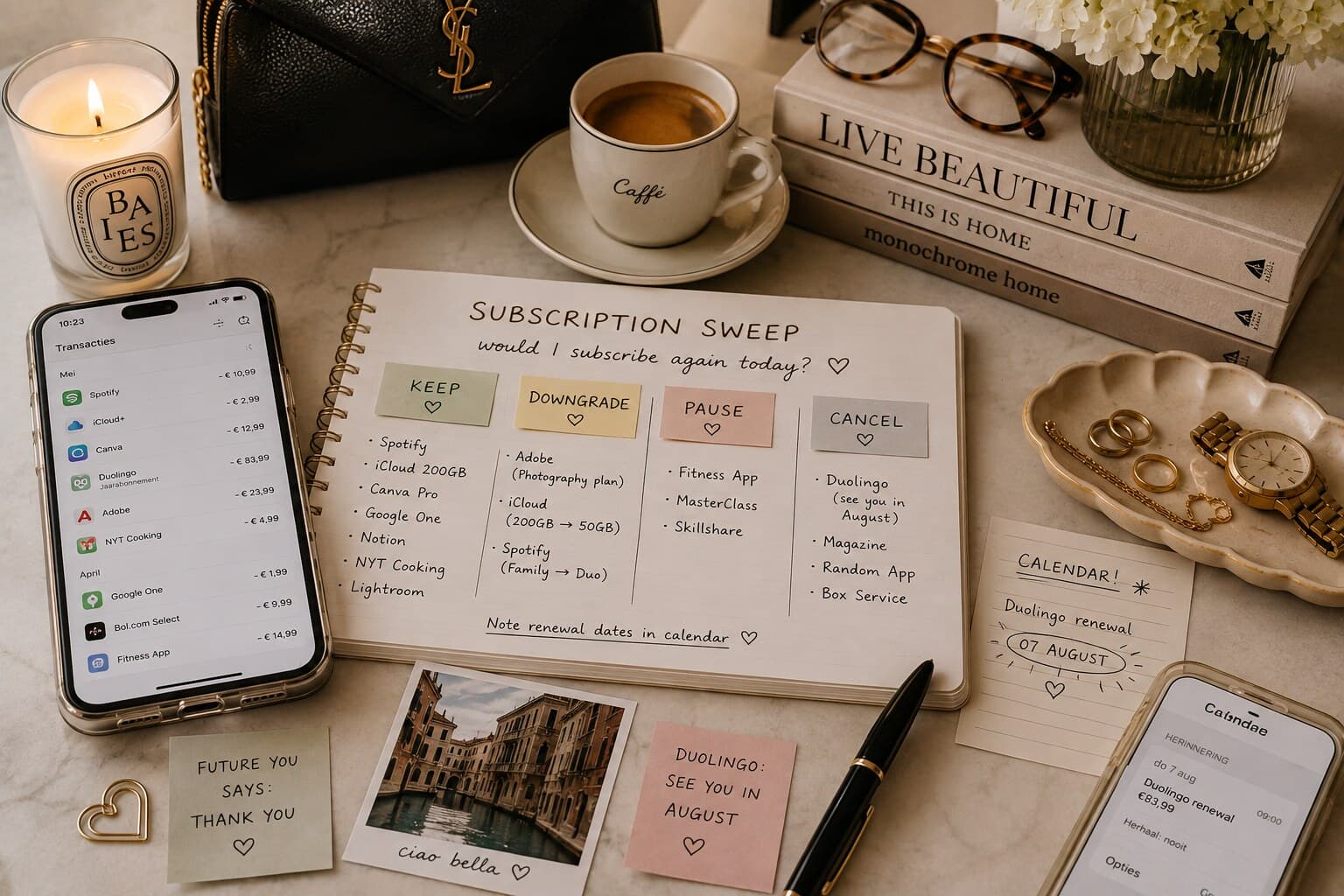
KEEP · DOWNGRADE · PAUSE · CANCEL
Every subscription now gets one of four decisions.
Nothing more complicated than that.
KEEP
You use it.
You value it.
It does something useful or enjoyable in your life.
You would notice if it disappeared.
Keep it.
Please don’t start trying to optimise something you genuinely love simply because we’re doing a money exercise.
This connects directly to what I call Return on Life.
A recurring payment can give you time; quality; use; comfort; experience; or simply joy.
If you’re getting enough back for what you’re paying, the subscription is doing its job.
No guilt required.
Put KEEP next to it and move on.
DOWNGRADE
This is for:
I use it, but perhaps I don’t need quite this much of it.
Maybe you’re paying for the premium tier while using only basic features.
Maybe you have far more cloud storage than you need.
Perhaps you’re paying for extra users who no longer use the service.
Maybe a professional tool made sense for a project that has now finished.
Or you subscribed to the top package because you were absolutely, definitely going to use all those advanced features.
You did not.
That’s fine.
The product can stay.
The unnecessarily expensive version doesn’t have to.
Check whether there is a smaller plan that still gives you what you actually use.
PAUSE
I think this category is underrated.
Because sometimes:
I don’t use this right now
doesn’t mean:
I never want this again.
Some subscriptions are seasonal.
Most of our services stay running. F1 TV is the exception: we cancel it when the Formula 1 season finishes.
It has a clear place in our year, which makes it easier to recognise when we no longer need it for that season. We do not apply the same pattern automatically to every streaming service.
For your own subscriptions, a break might mean using a provider’s pause option or cancelling renewal. Those are different actions. Check the terms for your particular plan, including when access and payments end; do not assume cancellation produces an immediate refund or an immediate saving.
If the service allows pausing or easy rejoining, there is nothing wrong with letting it go dormant.
You don’t have to pay all year to prove that you still like something.
CANCEL
And then there are the easy ones.
You don’t use it.
You don’t particularly value it.
You had forgotten it existed.
You wouldn’t notice if it disappeared.
And if somebody offered it to you today at the same price, you would say no.
Cancel it.
Not because €4.99 is going to transform your financial future.
Because there is no particular reason to keep giving €4.99 a job you never consciously assigned it.
Money doesn’t have to be enormous before it deserves intention.
Frequency is not the same as value
There is one trap I want to avoid.
You don’t use this often, therefore cancel it.
Not necessarily.
Some things are valuable precisely because they sit quietly in the background.
Cloud backup.
Certain security services.
Professional tools.
Things you only need occasionally but really need when the occasion arrives.
So usage frequency is useful information.
It is not the verdict.
Instead ask:
If I use this infrequently, is the value I get when I do use it still worth the recurring cost?
Sometimes the answer will absolutely be yes.
Keep.
The free-trial trap
And now we return to my accidental year of Italian.
Free trials are particularly good at separating the moment you make a decision from the moment you start properly paying for it.
You sign up on Tuesday.
The trial ends three weeks later.
Future You is expected to remember that Previous You made an arrangement.
This is an unreasonable amount of faith in Future You.
The FTC specifically advises checking how a free trial converts into a paid subscription, what it will cost and how and when you need to cancel.
I would add one extremely simple rule.
The moment you start a free trial, put the renewal date in your calendar.
Not:
I’ll remember.
Calendar.
Add it a few days before the actual deadline if you want time to decide.
Future You has enough going on. Give her the notification.
This advice has been brought to you by one accidental year of Italian.
Cancellation should not become a hobby either
There is another way to get carried away with this.
You discover that moving from one plan to another will save you €1.37 a month.
But it requires logging into an account; finding a password; resetting the password; reading four plan descriptions; starting a chat; waiting for customer service; and apparently providing your mother’s maiden name and a handwritten declaration that you truly wish to leave.
At some point:
your time counts too.
I’m not suggesting you keep bad subscriptions because cancelling them is annoying.
I am suggesting that optimisation has diminishing returns.
Spend your effort where the difference matters.
Saving €30 a month on something you don’t use?
Absolutely worth ten minutes.
Spending forty-five minutes trying to save 62 cents?
Perhaps close the laptop.
If they make cancelling difficult
Unfortunately, some businesses make joining significantly easier than leaving.
If you cannot find a clear way to cancel, start with the company’s official account or cancellation instructions and keep confirmation of any cancellation.
Check what the terms say about renewal dates and notice periods.
If a business continues charging after a valid cancellation or you believe the terms were misleading, consumer-protection options vary depending on where you live, so use the official consumer guidance applicable in your country.
You do not need to turn your Subscription Sweep into a legal investigation.
But you also do not have to assume that a charge must be correct simply because a company managed to collect it.
Make the next sweep easier
Once everything has been reviewed, there are a few tiny things you can do for Future You.
Put annual renewals in the calendar
Especially the expensive ones.
A reminder a few weeks before renewal gives you time to decide rather than react.
Put free-trial deadlines in immediately
We have covered why.
Extensively.
Use one recognisable place for recurring payments where practical
Not because every subscription has to leave the same account.
But the easier they are to see, the easier they are to review.
Record the Next Decision, as Well as the Next Payment
A payment date tells you when money leaves. A decision date gives you time to check whether you still want that to happen.
Here is a small suggested review sheet. It is a tool you can use, rather than a copy of our own records.
Use the provider’s actual notice period to choose a review date with enough time to act. A calendar reminder is not a completed cancellation; keep the confirmation when you make a change.
If you compare costs over a year, keep the payment pattern visible. A fictional €10 monthly subscription costs €120 over twelve months at an unchanged price. A fictional €120 annual subscription has the same monthly equivalent, but the full €120 is paid at once. They are not the same cash-flow commitment.
For a seasonal service, use the periods you actually expect to pay for. An annual renewal you have already paid is not new money freed up today simply because you decide against renewing next year.
Please do not build a twelve-tab subscription management system unless twelve-tab subscription management systems bring you genuine joy.
A Small Review Sheet
| Actual charge and billing interval | Next payment | Review or cancellation deadline | Decision and action status | |
|---|---|---|---|---|
| Keep / downgrade / pause / cancel; action still needed or confirmed | ||||
| Keep / downgrade / pause / cancel; action still needed or confirmed | ||||
| Keep / downgrade / pause / cancel; action still needed or confirmed |
What should you do with the money you save?
You cancel three things.
Congratulations.
Now what?
This is where subscription sweeps sometimes end with:
You just saved €384 a year!
Fine.
But I think there is a better question.
What would you rather that money did?
Maybe it goes to savings.
Maybe your emergency fund.
Maybe investing.
Maybe your travel pot.
Maybe nothing formal at all.
Perhaps you simply prefer having an extra €20 available every month for something you actually enjoy.
Money does not have to be rescued from Netflix and immediately marched into a pension account to prove that cancelling Netflix was worthwhile.
The point is that you get to decide again.
That is what we were trying to recover in the first place.
The Subscription Sweep
If you want to do this now, here is the whole thing.
FIND
Look across your accounts, cards, app stores and payment services. Find the recurring payments. Monthly and annual.
ASK
For each one: Would I subscribe again today? Then decide.
KEEP - I use it. I value it. It earns its place.
DOWNGRADE - I use it. I just don’t need this much of it.
PAUSE - I like it. Just not right now.
CANCEL - I would not choose this again today. Let it go.
And for anything you’re keeping:
What is the Return on Life?
If you know the answer, wonderful.
You don’t need to justify it any further.
This isn’t really about subscriptions
It is about something slightly bigger.
Subscriptions are unusual because they allow yesterday’s decisions to keep spending today’s money.
Most of the time that is incredibly convenient.
Until the old decision no longer fits.
Then convenience becomes inertia.
A Subscription Sweep simply interrupts that inertia for an hour.
It asks:
Do I still choose this?
Yes.
Yes.
Downgrade.
Definitely yes.
What is that?
Cancel.
Yes.
Why am I paying for two of these?
Cancel.
And then you’re done.
The goal is not to have as few subscriptions as possible.
It isn’t to save the largest theoretical amount.
And it certainly isn’t to make you feel guilty about the services you genuinely enjoy.
The goal is much simpler.
Every recurring payment should still be attached to a decision you would make today.
And if it isn’t?
Make a new one.
Preferably before Duolingo decides you’re learning Italian for another year.
Frequently Asked Questions
What is a subscription audit?
A subscription audit is a review of the recurring payments leaving your accounts so you can decide whether each service still deserves to stay. At Essy’s, we call this a Subscription Sweep: find the recurring payments, ask whether you would subscribe again today, then keep, downgrade, pause or cancel each one.
How do I find all my subscriptions?
Check the accounts and payment methods you regularly use, including your current account, credit cards, PayPal or similar services, and subscriptions managed through Apple, Google or other app platforms. Remember to look for annual renewals as well as monthly charges.
How often should I review my subscriptions?
Bas and I check ours each month as part of our money meeting, mainly asking whether we still use them and whether they meet our needs. You can choose a rhythm that suits your household, with separate reminders before trial deadlines, annual renewals and any notice period that requires an earlier decision. A quick monthly check does not need to become a full account-by-account audit every time.
Should I cancel subscriptions I don’t use very often?
Not automatically. Frequency is not the same as value. Some services, such as backup, security or professional tools, may still be valuable even when you use them infrequently. Ask whether the value you receive is worth the recurring cost.
How can I avoid forgetting to cancel a free trial?
Before signing up, check when the trial ends, what it will cost afterwards and how cancellation works. Then put a reminder in your calendar before the renewal deadline so you have time to decide whether you want to continue.
“Every recurring payment should still be attached to a decision you would make today.”
A Small but Important Disclaimer
This article is intended for general educational and organisational purposes. Subscription terms, cancellation rights, renewal rules and consumer protections differ between providers and countries. Check the applicable provider terms and official consumer guidance where you live if you have a cancellation or billing dispute.
Sources & Further Reading
- Federal Trade Commission (FTC) — Getting In and Out of Free Trials, Auto-Renewals, and Negative Option Subscriptions
- ACM ConsuWijzer — Abonnement opzeggen
Continue The Money Edit

Written by Esther
Esther is the founder of Essy’s Essentials. She had to learn how to manage money properly, and Bas played a huge part in that - without him, she says, she would still be broke. Money is important and often deadly dull, so she writes about it honestly, with a sense of humour and no pretence of being a financial expert.
·
More about Esther →