The Money Edit
The Money You’re Allowed to Enjoy
Being good with money was never supposed to mean becoming exceptionally good at not spending it.
Spending, Intentionally · 17 min read
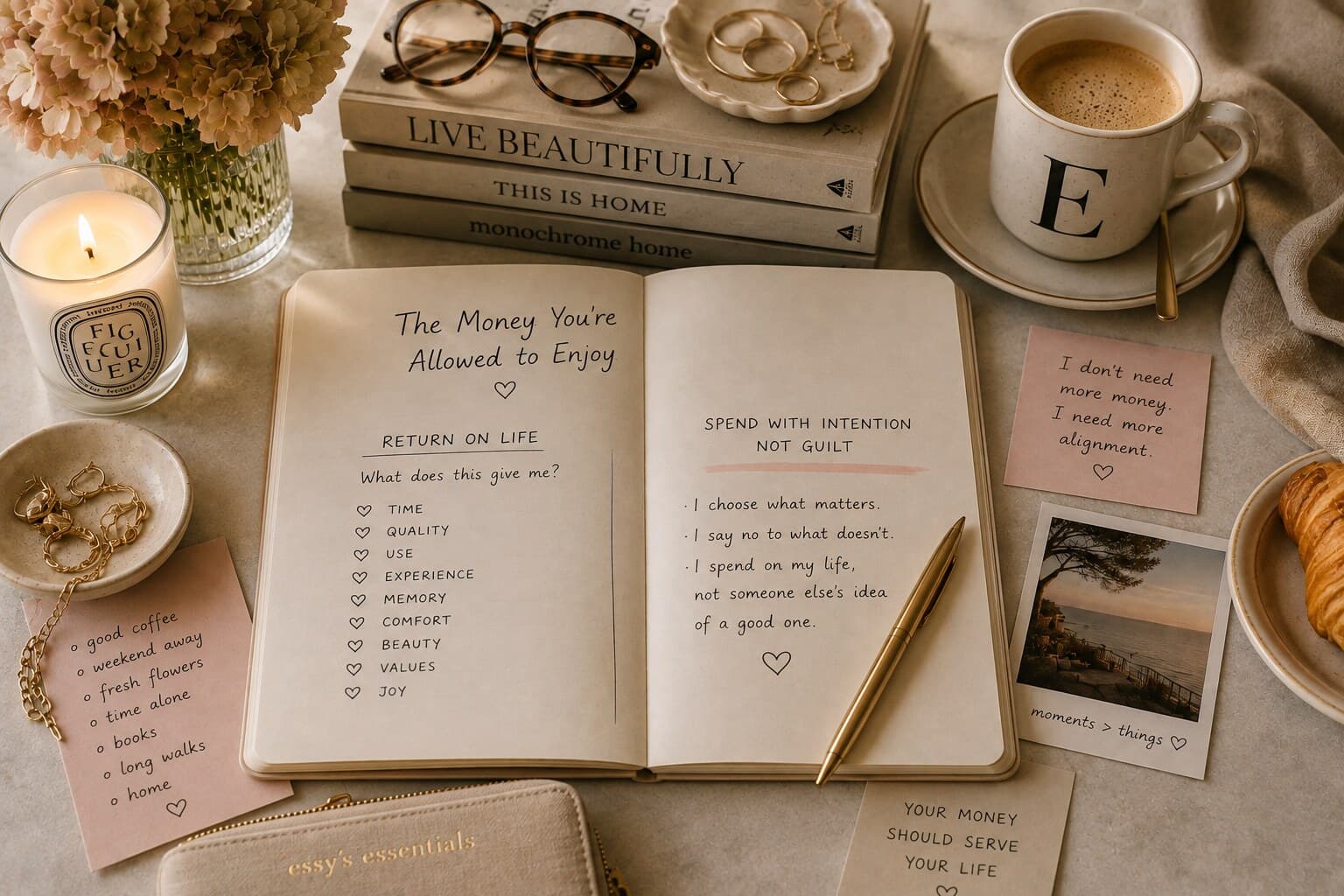
“Know what deserves the expensive version in your life.”
We talk an awful lot about what we’re supposed to do with money.
Save it.
Invest it.
Budget it.
Build the emergency fund.
Prepare for retirement.
Cancel the subscriptions.
Don’t waste it.
Don’t buy coffee.
Apparently make coffee at home for the next forty years and eventually become a millionaire.
Fine.
Some of that is genuinely important.
I like having savings. I like knowing there is money for unexpected things. I invest. Bas and I have a money meeting every month. We save for things before we need them.
Having money properly organised gives me an enormous amount of peace.
But there is another side of being good with money that I think we talk about much less.
At some point, you’re allowed to enjoy it.
Money isn’t only there to protect Future You.
It is also there to give Present You a life you actually like living.
And those two things don’t have to be enemies.
Financial security is not the finish line
One of the things I find interesting about the way we talk about personal finance is how easily the goal becomes more.
A bigger buffer.
More savings.
More invested.
Spend less.
Optimise more.
And there is absolutely value in financial security.
But even the Consumer Financial Protection Bureau’s definition of financial well-being goes beyond simply having money saved. It includes having control over everyday finances, being able to absorb a financial shock, being on track for financial goals and having the financial freedom to make choices that allow you to enjoy life.
I like that last part.
Because otherwise, what exactly are we organising all this money for?
The point of managing money well isn’t to become exceptionally good at keeping every euro.
It is to make sure your money is available for the life you actually want it to support.
I like nice things
We may as well establish this early.
I like luxury.
I like a very good hotel.
I like a nice car.
I like beautiful things in my home.
I like good shoes, good bags, good food, beautiful perfume and make-up that feels lovely to use.
I do not camp.
This is not the place where I reveal that my idea of luxury travel is actually a charming little tent and a reusable coffee cup.
It isn’t.
Give me a very good four- or five-star hotel and I am delighted.
Travel is one of the things Bas and I are very willing to spend money on.
And I don’t feel particularly guilty about that.
But there is an important bit of context.
I can make some expensive decisions relatively easily today because my income allows me to.
That matters.
What counts as comfortable spending changes enormously with income, responsibilities, commitments and circumstances.
Being able to comfortably afford the expensive option doesn’t automatically make it a good purchase.
It simply changes which options are realistically available to you.
The interesting question comes next.
Which of those options is actually worth your money?
Cheap isn’t automatically clever
There is a strange moral quality we sometimes attach to price.
The cheaper choice is sensible.
The expensive choice is indulgent.
Except life doesn’t work quite that neatly.
We once bought a fitted cabinet for our house.
It was awful.
Crooked. Poor quality. Impossible to get right. The finished thing looked nothing like something I wanted in our home.
Then came the discussions with the company.
Then the arguments.
Then the stress.
Eventually I donated it, which at least meant somebody else could enjoy it.
But it was still a terrible purchase for us.
The number on the original invoice didn’t capture the full cost.
There was also the time.
The frustration.
The effort trying to fix it.
The mental space it occupied.
And eventually the fact that we still needed a different solution.
The price isn’t always the full cost.
Something cheap that you replace three times isn’t necessarily cheaper.
Something that creates hours of aggravation has a cost too.
And something expensive isn’t automatically better simply because somebody put it in beautiful packaging.
Price is information.
It isn’t a verdict.
Expensive isn’t automatically good either
I love premium beauty.
Give me a beautiful luxury make-up product and I am very susceptible.
But I will also happily try something from e.l.f. if I think it looks good.
I don’t need my entire make-up bag to pass some imaginary luxury threshold.
The label isn’t the value.
If the €10 product is brilliant, it’s brilliant.
If the €70 product is mediocre, the fact that it came in a lovely weighted compact doesn’t make it financially superior.
This is why I don’t particularly like buy cheap or buy expensive as philosophies.
I’d rather ask:
What am I actually getting back?
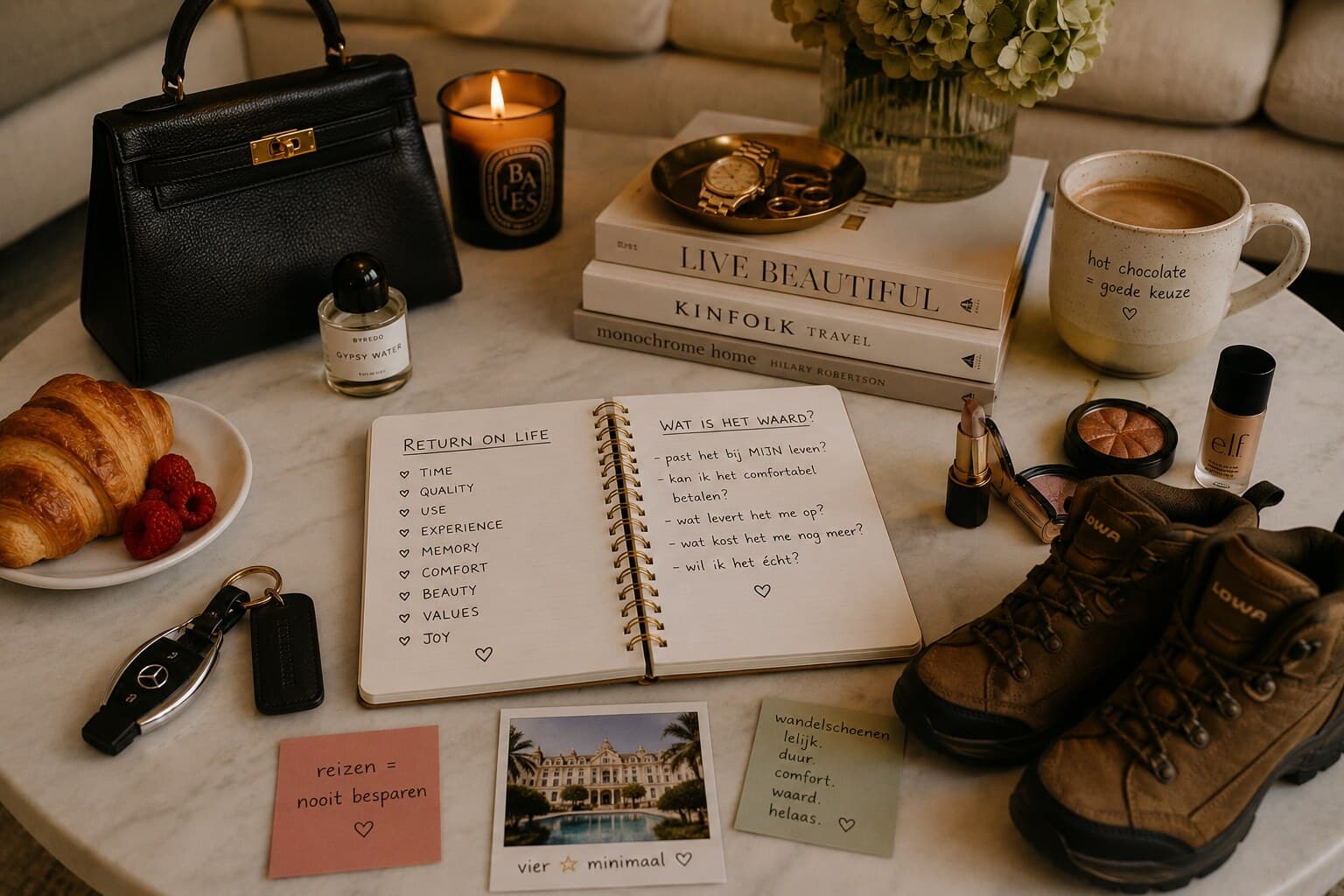
The Return on Life
We know Return on Investment.
I think some spending deserves a different calculation.
Return on Life.
Not everything we buy needs to make us money.
Some things return something else.
TIME
Perhaps paying someone else means you get an afternoon back.
Perhaps you order dinner because you have come home late and cooking is the very last thing you want to do.
Yes, making dinner yourself would probably cost less.
But cheaper and better are not always the same question.
QUALITY
Bas and I try to buy as much of our food as possible from farm shops around where we live.
It costs more.
I know it costs more.
But much of it is local, we can buy organic, and I genuinely think the quality and taste are better.
That matters to us.
So the extra cost is not an unfortunate side effect I have failed to optimise away.
It is part of the choice.
USE
Something can be expensive and still offer extraordinary value because you use it constantly.
The coat you wear for years.
The kitchen appliance you use four times a week.
The chair you sit in every evening.
Cost per use isn’t a perfect measure of value, but it can be wonderfully clarifying.
EXPERIENCE
Travel is an obvious one for me.
I would rather take fewer trips that feel special than make every trip as inexpensive as possible.
Someone else may feel exactly the opposite.
Neither of us is wrong.
The point is knowing which one you are.
MEMORY
Some spending disappears from your bank account but stays in your life.
The dinner you still talk about.
The hotel you remember years later.
The trip with someone you love.
The completely unnecessary thing you did because it made an ordinary weekend brilliant.
Research into experiential purchases has repeatedly found that experiences can produce more enduring satisfaction than material purchases on average.
That doesn’t mean possessions are bad.
It means that sometimes what remains after the money has gone is part of what you bought.
COMFORT
I own a pair of walking boots.
This sentence alone would have surprised a younger version of me.
When we moved to our current house, we suddenly lived beside a forest.
Apparently this meant I was now a person who needed walking boots.
I had never owned walking boots in my life.
I also think walking boots are spectacularly ugly.
Mine cost somewhere around €300.
They remain spectacularly ugly.
But they are comfortable.
They are waterproof.
I can walk through the forest without wet feet.
And I actually use them.
So were they expensive?
Yes.
Were they poor value?
No.
Annoyingly, the ugly shoes win.
BEAUTY
I want this one on the list.
Because we have a habit of allowing practical things to justify their price while beautiful things are expected to apologise for theirs.
Sometimes I buy something because I think it is beautiful.
A bag.
Something for our home.
A pair of shoes.
A perfume.
That is allowed to be part of the return.
We live inside our homes.
We wear our clothes.
We smell the perfume.
Beauty is an experience too.
VALUES
Sometimes where the money goes matters.
Local food.
A small business.
Better materials.
A company whose work you want to support.
A product made in a way you prefer.
You don’t have to turn every purchase into an ethical research project.
But choosing to spend more because something aligns better with your values is still a return.
JOY
And sometimes:
I love it.
That’s it.
No spreadsheet.
No cost-per-use calculation.
No twelve-point justification.
You love it.
You can comfortably afford it.
Your important financial priorities are still being taken care of.
You buy it.
Not every purchase needs a business case.
Know what deserves the expensive version in your life
This might be the most useful question in this entire article.
Because very few of us can — or should — buy the premium version of absolutely everything.
And I don’t think that would necessarily make life better anyway.
So:
What deserves the expensive version in your life?
For me, travel is high on the list.
So are certain things for our home.
My car matters to me.
I like good bags and shoes.
Food quality matters.
There are beauty products where I will happily pay for the luxury version.
And there are plenty of other categories where I couldn’t care less whether the product costs €12 or €70 as long as the €12 one works.
Your list may be completely different.
Perhaps you couldn’t care less about hotels but own a bicycle that costs more than my first car.
Perhaps clothes mean nothing to you but your kitchen knives are magnificent.
Perhaps you fly economy and spend the difference on restaurants.
Perhaps your great luxury is paying someone to clean your house every week.
Perhaps it is having Fridays off.
This is why somebody else’s budget can only teach you so much.
A budget tells you where their money went.
It doesn’t tell you what deserves yours.
Are you buying for your actual life?
There is another category of spending that I think deserves suspicion.
Not expensive spending.
Fantasy-self spending.
Buying for the person you imagine yourself becoming rather than the person who will actually use the thing.
The elaborate kitchen equipment for the version of you who apparently makes fresh sourdough every morning.
The clothes for a social life you don’t actually have.
The supplies for a hobby you enjoy shopping for significantly more than you enjoy doing.
The beautiful notebook that will finally transform you into a woman who journals for forty-five minutes at sunrise.
Sometimes the purchase really does introduce something wonderful into your life.
But sometimes what we actually bought was the fantasy.
So one of my favourite Return on Life questions is:
Does this fit the life I actually live?
My walking boots, tragically, pass this test.
Paying for time counts
I think this deserves more attention than it usually gets.
Because traditional saving advice often assumes that doing something yourself is automatically the financially superior option.
Cook instead of ordering.
Clean it yourself.
Drive instead of taking the faster train.
Spend three hours comparing prices to save €18.
Technically, yes.
You may save money.
But what did saving the money cost?
Time is not infinitely renewable.
Neither is energy.
Neither is patience.
There are absolutely situations where doing something yourself is worth it.
And there are situations where I will very happily pay somebody else.
Ordering food after a long day isn’t always evidence that you failed to meal-plan.
Sometimes it is simply dinner arriving at the door when you needed dinner to arrive at the door.
Convenience can be wasteful.
Convenience can also be incredibly valuable.
The difference is whether you’re choosing it consciously.
Less of this. More of that.
This is where this article connects to something I wrote about in I Never Wanted Less. I Just Wanted Better.
I am not particularly interested in having less simply for the achievement of having less.
I am interested in becoming more selective.
Because every euro spent on something you don’t particularly care about is a euro that cannot go towards something you do.
That doesn’t mean staring suspiciously at every coffee.
It means noticing patterns.
The things you buy automatically.
The things everybody else seems to have.
The little purchases you don’t really enjoy.
The version of something you keep replacing.
The categories where spending has quietly increased without adding anything meaningful.
Cutting those things doesn’t have to make your life smaller.
It can create room.
Less of what doesn’t matter.
More of what does.
That is a very different proposition.
Money you’re allowed to spend without explaining yourself
Bas and I have combined finances.
We save together.
We invest together.
We make the bigger financial decisions together.
And every month we also give ourselves an amount of money that is simply ours.
Adult pocket money, essentially.
There is no approval process.
No explanation.
No:
What did you spend €83 on?
If I want something, I can buy it.
If Bas wants something, he can buy it.
That separation is small, but I think it matters.
Because sharing a financial life with someone does not have to mean surrendering every bit of financial autonomy.
Not every personal purchase needs to become a committee decision.
Having a clear amount of genuinely free-to-spend money means we can enjoy it without wondering whether we have accidentally spent the money intended for something else.
The important things already have their place.
So this money can have a different job.
Its job is to be spent if we want to spend it.
Guilt-free does not mean consequence-free
There is one thing I don’t like about the phrase guilt-free spending.
It can sound as though feeling good about a purchase automatically makes it financially fine.
It doesn’t.
Guilt-free does not mean consequence-free.
A beautiful €2,000 holiday that you saved for and can comfortably afford is one financial decision.
The same holiday funded with expensive debt when next month’s essential bills are uncertain is a completely different one.
Return on Life doesn’t override reality.
Financial security matters.
Your commitments matter.
Future You matters.
That’s precisely why I like organising money in the first place.
The buffer.
The savings pots.
The investing.
The money meetings.
The planning.
All that rather unglamorous infrastructure gives us something enormously valuable:
choice.
First protect the life.
Then use some of the money to make the life good.
So, is it worth the money?
I don’t think there is a formula.
But when I’m unsure, these are the questions I find useful.
What is the return?
Does this give me time, quality, use, experience, memory, comfort, beauty, alignment with my values or simply genuine joy?
What is the real cost?
Not only the price.
What else does it require from me?
Time? Maintenance? Space? Stress? Debt? Giving something else up?
Does it fit my actual life?
Will I use it?
Or am I buying for Fantasy Me?
Can I comfortably afford this version?
Not technically pay for it.
Comfortably afford it while the other things that matter remain intact.
And finally:
Do I actually want it?
Not:
Is it on sale?
Does everybody have one?
Will it look good in a photograph?
Is this what someone with my job/house/age/lifestyle is apparently supposed to buy?
Do I want it?
Sometimes the answer will be no.
Wonderful.
Keep the money.
Sometimes the answer will be:
Yes. Very much.
Wonderful.
Spend it.
Money is allowed to have more than one job
Money can protect you.
It can prepare you.
It can grow.
It can give you options.
It can help someone you love.
It can buy back time.
It can make your home more comfortable.
It can take you somewhere you’ve always wanted to go.
It can buy the beautiful coat.
It can pay for the ridiculously good dinner.
It can buy the ugly waterproof walking boots.
It can sit safely in an emergency fund for years and do absolutely nothing except make you feel secure.
All of those are legitimate jobs.
The point isn’t to find the objectively perfect way to spend money.
There isn’t one.
The point is to build enough financial awareness that you can tell the difference between money disappearing and money being used.
I don’t want to spend less on everything.
I want to spend less often on things that add very little, and feel completely comfortable spending properly on the things that add a lot.
Maybe that’s the real luxury.
Not being able to buy everything.
Knowing what is worth buying.
Because the goal was never to become excellent at keeping every euro.
It was to become good at deciding which ones were worth letting go.
Frequently Asked Questions
What does it mean to spend money intentionally?
Intentional spending means deciding where your money adds meaningful value to your life rather than automatically choosing either the cheapest or most expensive option. That value might come from quality, time, frequent use, comfort, an experience, a memory, beauty, personal values or simply genuine enjoyment.
How can I spend money without feeling guilty?
Start by making sure the financial things that matter to you — such as essential costs, appropriate savings and important future commitments — have a place. Money that is genuinely available after those priorities do not necessarily need another justification. Enjoying some of what you earn can be part of a healthy financial life.
Is it better to buy cheap or buy quality?
Neither is automatically better. A cheaper product can offer excellent value if it works well, while a more expensive item may be worth the difference if it lasts longer, performs better or meaningfully improves your life. Consider the total value and total cost rather than price alone.
What is Return on Life?
At Essy’s, Return on Life is a way of thinking about what a purchase gives back beyond financial return. That might be time, quality, use, experience, memory, comfort, beauty, alignment with your values or joy. Not every purchase needs to deliver all of them.
Does guilt-free spending mean I should buy whatever makes me happy?
No. Guilt-free does not mean consequence-free. A purchase still needs to fit your actual financial circumstances and commitments. The aim is not to justify overspending, but to make more conscious choices about which things are genuinely worth spending on.
“The goal was never to become excellent at keeping every euro. It was to become good at deciding which ones were worth letting go.”
A Small but Important Disclaimer
This article is intended for general educational and editorial purposes, not individual financial, investment, tax or legal advice. What is affordable or appropriate depends on your own income, commitments, goals and circumstances.
Sources & Further Reading
- Consumer Financial Protection Bureau (CFPB) — Why financial well-being?
Continue The Money Edit

Written by Esther
Esther is the founder of Essy’s Essentials. She had to learn how to manage money properly, and Bas played a huge part in that - without him, she says, she would still be broke. Money is important and often deadly dull, so she writes about it honestly, with a sense of humour and no pretence of being a financial expert.
·
More about Esther →