The Money Edit
The Beautifully Organised Savings System — How I Use Sinking Funds for Holidays, Repairs and Lovely Things
A calmer way to save: how separate savings pots help me prepare for emergencies, holidays, repairs and fun - without making money management joyless.
Saving, Beautifully · 15 min read
“Your money does not need one perfect strategy. It needs a thoughtful collection of jobs.”
One of the questions I get asked most often - after "where is that candle from" - is how I organise my savings.
Not the big philosophical version of that question. The practical one.
How do you actually keep money for a holiday separate from money for emergencies, separate from money for something lovely you are planning to buy, separate from the money that quietly exists for the day your washing machine decides it has had enough?
The answer is embarrassingly simple, and it changed the way I think about saving entirely: I give my money jobs.
In personal finance, this is usually called a sinking fund. I like to call mine savings pots, because "sinking fund" sounds like something that happens to a boat, and I would rather it sound like something that happens to a candle-lit Sunday evening with a notebook and a cup of tea.
Here is how it actually works, and why I think it belongs in a beautifully organised life as much as any candle or ritual does.
One savings account was never the whole story
For a long time, I had exactly one savings account.
Everything lived in it. My emergency money, my holiday money, my "I would love a new coat this winter" money, all pooled together into one number that told me almost nothing useful.
I could see how much I had.
I had no idea how much of it I could actually spend without quietly wrecking something else I was also saving for.
Was that €4,000 my emergency buffer? My upcoming holiday? Half of a new laptop I genuinely needed? All three, badly overlapping?
One number, doing far too many jobs at once, is not really a system. It is a guess wearing a system’s clothing.
What a savings pot actually is
A savings pot is simply a portion of your savings that has been mentally, and ideally literally, separated for one specific purpose.
It can be a genuinely separate sub-account, if your bank offers that. It can be a shared savings account split by category in a notebook or spreadsheet. It does not need to be complicated technology. It needs to be clear.
The idea itself is not new; in personal finance it is often called a sinking fund - money set aside gradually, in advance, for a specific future expense, rather than scrambled together at the last moment or placed on a card.
What I changed was less the mechanism and more the mindset. Each pot has a name, a purpose and, ideally, a target.
The pots I actually use
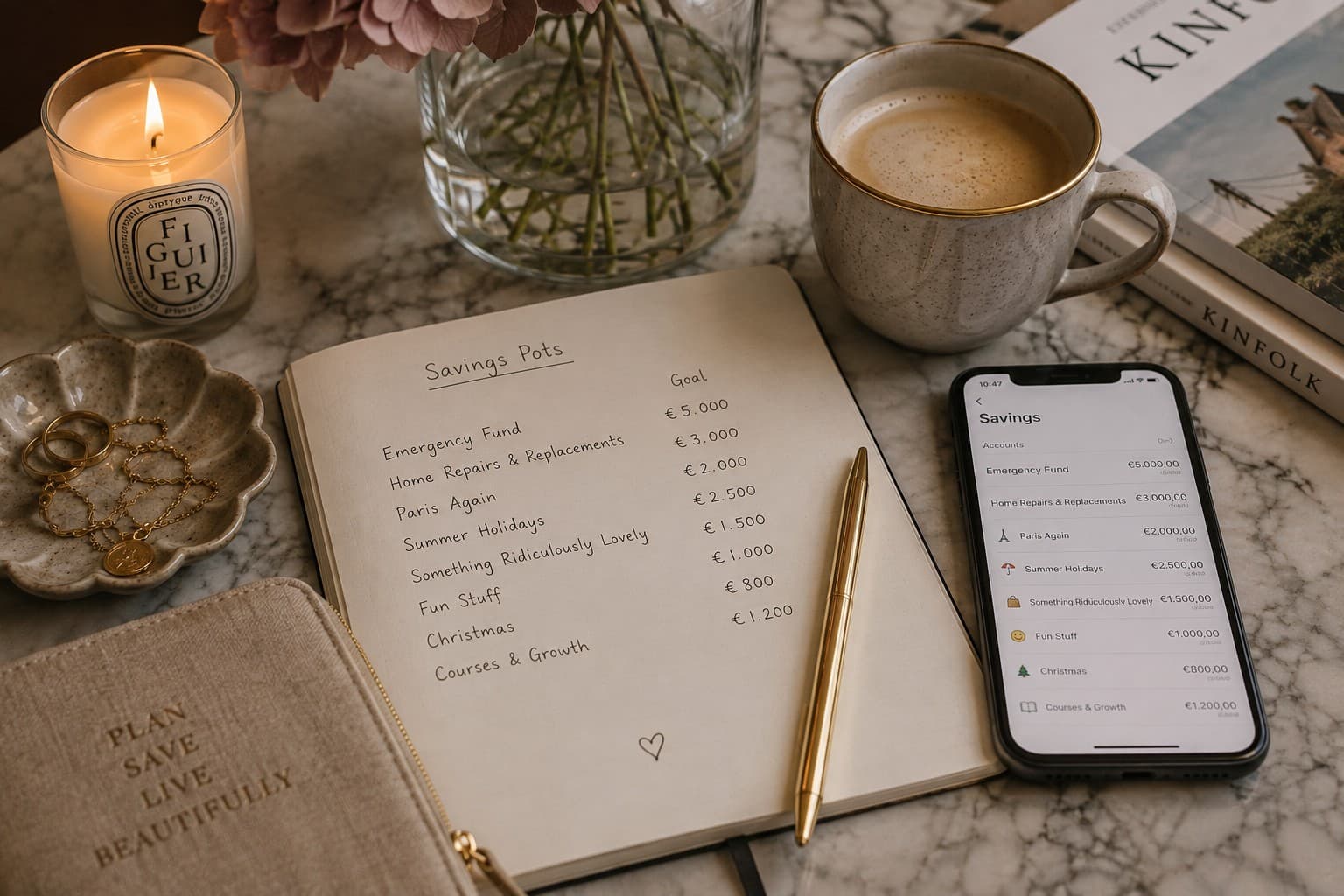
Mine currently look something like this.
An emergency fund, for genuinely unexpected costs - the boiler, the car, the kind of thing that does not ask permission before happening.
A home repairs and replacements pot, for the things that are not emergencies exactly, but are entirely predictable if you zoom out far enough - appliances wearing out, furniture needing replacing, the home slowly asking for maintenance.
A travel pot, for the trip I already know I want to take.
A summer holiday pot, kept separate from general travel, because summer holidays in our house tend to be planned and paid for months in advance.
A "something ridiculously lovely" pot - yes, really - for the entirely non-essential, purely joyful purchase I am not ashamed to be saving towards on purpose, rather than buying impulsively and feeling strange about it afterwards.
A smaller fun-stuff pot, for the little everyday indulgences that add up if I do not account for them somewhere.
A Christmas pot, so December does not quietly undo months of otherwise careful saving.
And a courses-and-growth pot, for things I invest in myself, whether that is a course, a workshop or simply expanding a skill.
None of these amounts are enormous. That is not really the point. The point is that each one has a name, and none of them are secretly borrowing from each other without my noticing.
A buffer pot always comes first
Before any of the lovelier pots, there is the buffer.
Nibud, the Dutch National Institute for Family Finance Information, describes a financial buffer as money set aside for larger, sometimes unexpected but not entirely surprising expenses - a broken appliance, a car repair, essential home maintenance - and offers a calculator to help estimate a sensible amount for your own household. If you live outside the Netherlands, the exact figures will differ, but the underlying idea - a calculated buffer sized to your own household, rather than a number borrowed from someone else’s life - travels well anywhere.
I write about this pot in more detail elsewhere in The Money Edit, because I think it deserves its own space. But structurally, it always sits at the top of the list. The other pots exist because this one exists first.
How I actually fund them
Each pot has a monthly amount attached to it, decided in advance rather than whatever is left over at the end of the month.
Some months, that amount is modest. Life is not always generous. But even a small, consistent amount moving into the right pot each month adds up in a way that occasional large deposits, made only when I happen to remember, never quite manage to.
I review the amounts every few months, usually during a seasonal reset, and adjust them if something has changed - a bigger trip coming up, a home project on the horizon, an emergency pot that has finally reached a level I am comfortable with.
It is not a rigid system. It is closer to a living document than a locked vault.
Why this feels different from "budgeting"
I know the word budgeting can feel restrictive, even a little joyless, for a lot of people. Mentally, savings pots feel like the opposite of that to me.
A budget often tells you what you are not allowed to do.
A savings pot tells you what you are actively working towards.
When I see the "something ridiculously lovely" pot slowly growing, it does not feel like restriction. It feels like a small, ongoing act of looking after my future self and my present joy at the same time.
That distinction matters more than it might sound. It is the difference between saving feeling like deprivation and saving feeling like intention.
This system is not about hitting every target perfectly
Some months, a pot gets skipped. Some months, money moves between pots because life asked for something the plan had not accounted for.
The system is not meant to be a moral scoreboard. It is meant to be a clear picture of where my money is going and why, so that when I do dip into a pot, it is a decision, not an accident.
That, to me, is the entire point. Not perfection. Clarity.
Where this fits into a beautifully organised life
I think savings pots belong in the same category as a well-kept notebook, a seasonal wardrobe edit or a thoughtfully planned week. They are not glamorous on their own, but they quietly hold everything else together.
A trip feels lighter when it has already been paid for slowly, over months, rather than anxiously, over a single credit card statement.
A broken appliance feels like an inconvenience rather than a crisis when there is already a pot with its name on it.
And a lovely, non-essential purchase feels genuinely lovely, rather than faintly guilty, when it was something I was deliberately saving towards.
That, more than any spreadsheet or app, is what this system has given me: the ability to want things, plan for things and occasionally spend on things, without any of it feeling chaotic.
Your money does not need one perfect strategy.
It needs a thoughtful collection of jobs.
Editor’s Note
The exact pots, amounts and names in this article are mine - they reflect my own life, my own priorities and my own household, not a template everyone should copy exactly.
The structure - a buffer first, then named pots for known and hoped-for expenses - is the part I think travels well. The specifics are meant as an example, not an instruction.
A Small but Important Disclaimer
This article describes a personal savings system and general information about sinking funds and financial buffers for educational and editorial purposes. It is not personal financial advice.
How much to save, and for what, depends on your own income, expenses, obligations and goals. If you would like guidance tailored to your own situation, consider speaking with a qualified financial adviser in your own country.
Sources & Further Reading
- Nibud (Dutch National Institute for Family Finance Information) — BufferBerekenaar - financial buffer calculator
- OECD — Financial education (OECD/INFE)
Continue The Money Edit

Written by Esther
Esther is a photographer and storyteller, and the founder of Essy's Essentials - a seasonal home for stories, rituals, recipes and everyday luxuries.
More about Esther →