Storage & Everyday Organisation
A Home for Everything
A practical approach to storage that supports daily life without turning the home into a system of endless containers.
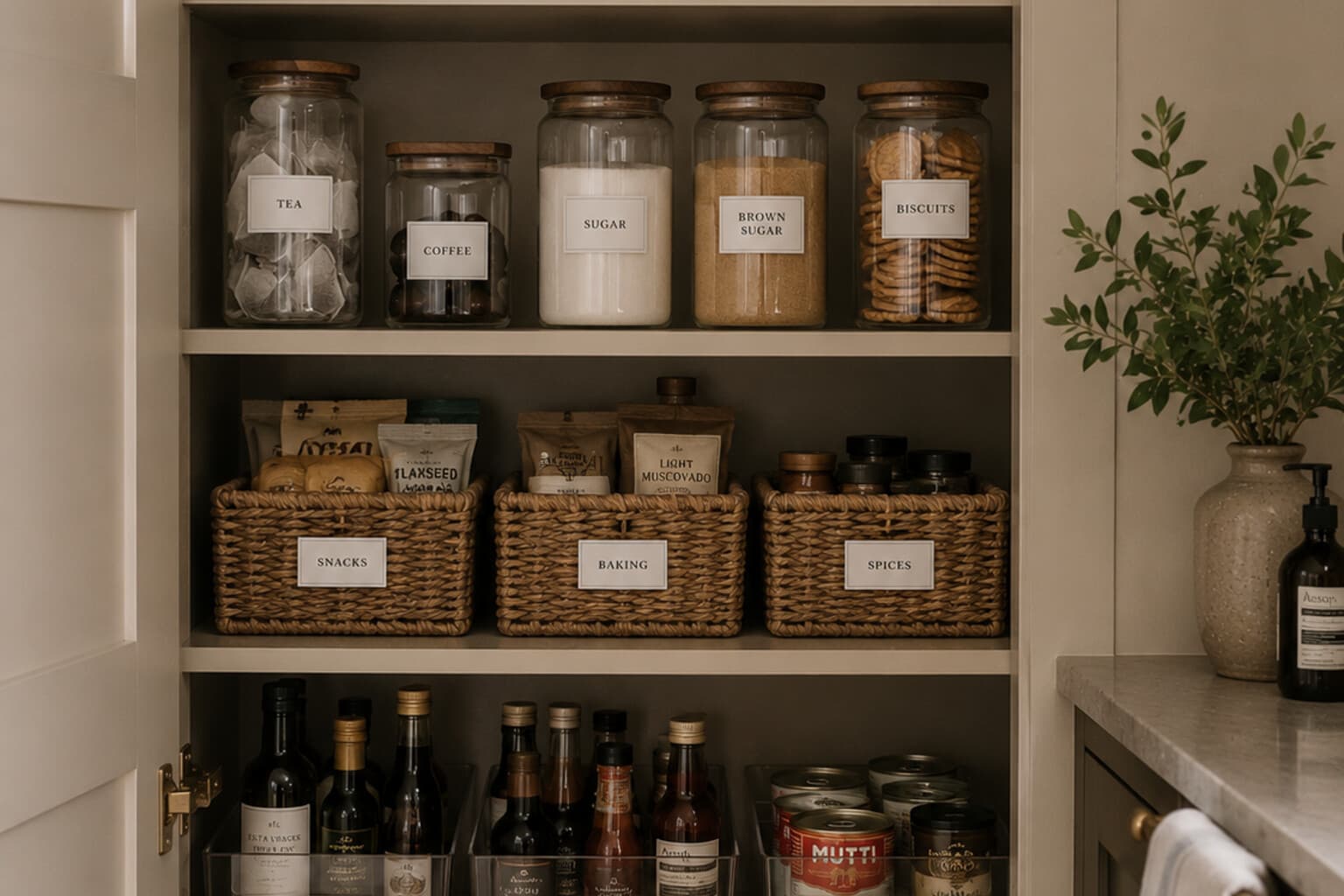
Storage is often treated as a matter of fitting more into the available space. More boxes. More baskets. More shelves. More organisers.
But useful storage begins before anything is purchased. It begins with deciding what belongs in the home, where it is used and how easily it needs to be reached.
A well-organised home is not one in which every possession is hidden. It is one in which the things used regularly are easy to find, easy to return and stored in a way that makes sense. The purpose of storage is not to preserve every object indefinitely. It is to support everyday life.
Begin with Use, Not Category
Traditional organising often groups similar objects together - all candles in one place, all cleaning products in one cupboard, all notebooks on one shelf. This can work, but location should also reflect where an item is used.
A small cleaning kit in each frequently used bathroom may be more practical than one large collection elsewhere. Table linens may belong near the dining area rather than with bedroom textiles. Guest essentials may be stored in the guest room rather than in a general household cupboard.
Ask: where is this used? How often is it needed? Who needs access to it? What happens when it is put away? Storage should reduce movement and decision-making.
Create Primary and Secondary Storage
Not every item needs equally accessible space. Primary storage is for objects used regularly - it should be easy to reach, easy to see, easy to return.
Secondary storage is for seasonal items, backups, occasional equipment, archives, guest supplies and sentimental possessions. Place these items higher, further back or in less accessible areas.
Do not give the most convenient storage to things used once a year.
Use the One-Motion Principle
The easier an item is to put away, the more likely it is to be returned. A one-motion system may mean dropping scarves into one basket, placing keys on a tray, hanging a coat on an open hook, sliding a pan into a vertical divider, or putting post into one inbox.
Systems become less reliable when they require opening several boxes, moving other items first, folding something precisely, remembering a complicated category, or using storage no one else in the household understands.
Choose the simplest system that keeps the area functional.
Give Everyday Items Visible Boundaries
Objects often become clutter when they have a general area but no defined limit - post on the kitchen counter, shoes in the entrance, toiletries around the basin, chargers beside the sofa, blankets on chairs.
Give each category a clear boundary - a tray, a drawer, one basket, a shelf section, a hook. The boundary should be large enough for normal use, but not so large that the category expands indefinitely.
Store by Frequency
A useful order is daily, weekly, occasional, seasonal, archive. Daily items belong within the easiest reach. Weekly items may sit slightly higher or lower. Occasional items can move into secondary storage. Seasonal and archive items should not occupy prime space.
Review each cupboard according to this order.
Avoid Organising Unnecessary Possessions
Storage cannot solve an excess of items that are no longer useful. Before creating a system, ask: do I still use this? Would I choose to keep it if I saw it in a shop today? Does it fit the life I currently live? Is it being kept because it is useful or because deciding feels difficult? Could someone else use it now?
Removing something may be more effective than buying a container for it.
Let the Storage Match the Room
Storage should support the visual language of the home - warm wood, woven fibre, linen-covered boxes, smoked glass, ceramic bowls, antique brass hooks, closed cabinetry.
Use decorative storage selectively. Not every object needs to be placed in a visible basket. Closed storage creates visual rest. Open storage works best for items that are used often, easy to keep orderly, visually coherent and pleasant enough to remain visible.
Label Only Where It Helps
Labels are useful when several people use the storage, categories are not obvious, items are stored in opaque containers, or the storage is reviewed infrequently.
Labels are less useful when they create unnecessary visual noise or describe what is already clear. Choose discreet, consistent labels, using language everyone in the household understands.
Pair It With
A home for everything does not mean finding somewhere to hide every possession.
It means creating a clear relationship between what is owned, where it is used and how easily it can return to its place.

Written by Esther
Esther is a photographer and storyteller, and the founder of Essy's Essentials - a seasonal home for stories, rituals, recipes and everyday luxuries.
More about Esther →