Seasonal Storage Without the Overflow
A practical system for storing clothing, decorations and household items between seasons.
At a Glance
- Review before storing
- Clean everything first
- Choose the right location
- Use broad categories
- Label clearly
- Create an inventory for hidden storage
- Use matching containers selectively
- Store by retrieval order
- Create the transition box
Seasonal storage often expands quietly - winter coats, garden cushions, holiday decorations, blankets, travel equipment, summer shoes and occasion items. Objects leave daily use but remain part of the household inventory.
Without a clear system, seasonal storage becomes difficult to access and even harder to review.
The aim is not to preserve every seasonal item. It is to store clean, useful possessions in a way that makes the next transition easier.
Review Before Storing
Do not store an item simply because the season has ended. Ask: was it used? Is it still in good condition? Does it still fit? Will it be useful next season? Does it require repair first? Would someone else use it more?
Storage postpones decisions. Make as many decisions as possible before the item disappears from view.
Clean Everything First
Store only items that are clean, dry, repaired where practical, and empty. This applies to clothing, shoes, blankets, outdoor textiles, picnic equipment, luggage, decorations and garden accessories.
Dirt and moisture become harder to address after several months in storage.
Choose the Right Location
Seasonal items may be stored in wardrobes, under-bed storage, high shelves, lofts, basements, garages or external storage.
Consider temperature, moisture, pests, sunlight, access and fragility. Do not store sensitive textiles, paper, candles, electronics or valuable items in unsuitable conditions - protect the category according to the environment.
Use Broad Categories
Possible categories include winter clothing, summer clothing, outdoor dining, garden textiles, holiday decoration, travel, seasonal bedding and occasion items.
Avoid creating too many small boxes - broad categories are easier to remember and review.
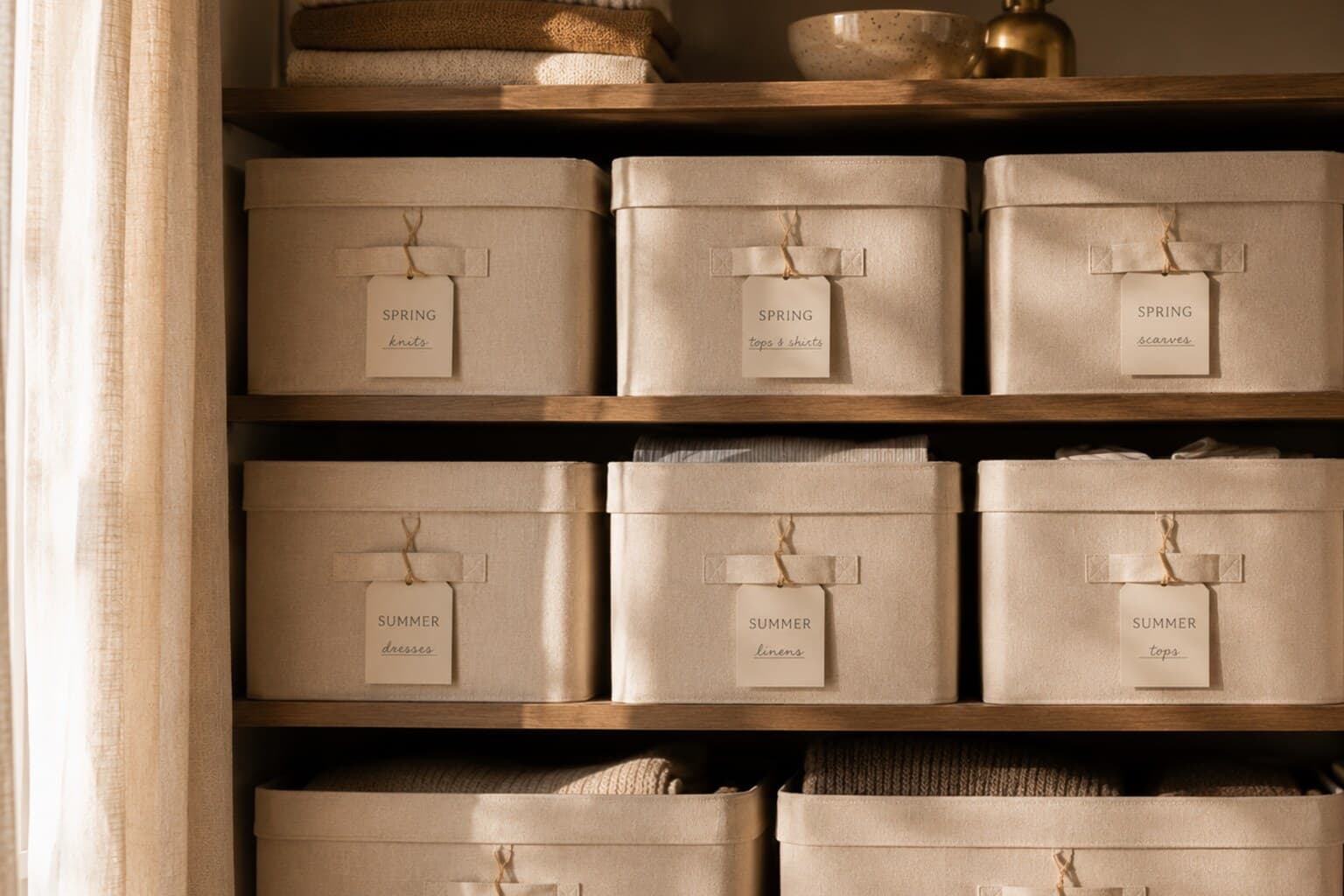
Label Clearly
Include category, season, room or person where useful, and fragile status - for example "autumn and winter scarves - entrance" or "winter gathering décor - fragile".
Labels should be readable without opening or moving several containers.
Create an Inventory for Hidden Storage
For larger storage areas, maintain a simple list - container name, general contents, location, review date. A photograph of the open container may also help.
Do not create a detailed inventory that requires more maintenance than the stored items deserve.
Use Matching Containers Selectively
Uniform containers can make stacking easier, but use containers based on function first - weight, ventilation, visibility, protection, stackability and handle placement.
Avoid containers so large that they become unsafe or difficult to move.
Store by Retrieval Order
Items needed first next season should be easiest to reach - early-autumn layers in front of heavy winter equipment, outdoor dining items before specialist summer travel gear, basic holiday lights before less-used decorations.
Do not stack a frequently needed box beneath several heavy containers.
Create the Transition Box
Keep one small seasonal transition box accessible - one lighter or warmer blanket, a seasonal table linen, a small décor item, crossover clothing accessories, one atmospheric home detail.
This allows a gradual transition without opening the entire storage area.
The Checklist
- Items reviewed before storage
- Damaged pieces repaired or removed
- Everything cleaned and dried
- Categories kept broad
- Containers suitable for the environment
- Labels visible
- Hidden storage inventoried
- Retrieval order considered
- Heavy containers safely placed
- Transition box accessible
Pair It With
Good seasonal storage does not simply make the current season disappear.
It prepares the next transition so that useful things return clean, visible and ready to be enjoyed again.
Enjoyed this?
The Seasonal Letter brings more stories, recipes and rituals like this one - a few times a season, never more.

Written by Esther
Esther is a photographer and storyteller, and the founder of Essy's Essentials - a seasonal home for stories, rituals, recipes and everyday luxuries.
More about Esther →