Fragrance & The Essence Library
The Art of Wearing Fragrance
A considered approach to choosing, applying and living with fragrance as part of everyday personal style.
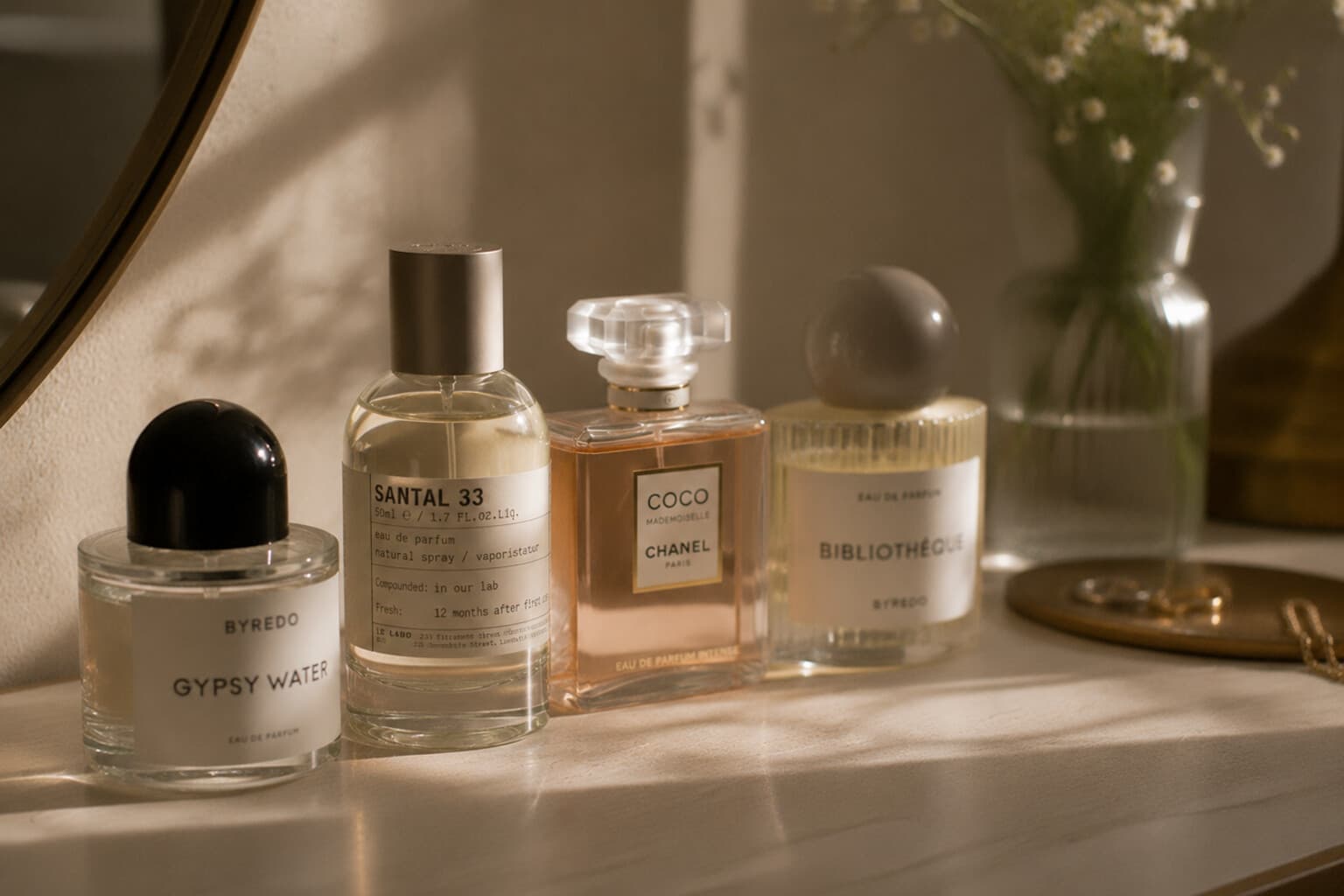
Fragrance is one of the most intimate elements of personal style. It cannot be seen. It moves with the body. It settles into scarves, coats and rooms. It can belong to a season, a place or a period of life long after the details have faded.
Yet fragrance is often approached as a search for one perfect bottle - a signature scent, a compliment-gathering fragrance, a perfume that communicates an entire identity. A more useful approach is quieter: fragrance can be treated as a wardrobe, a small collection of scents for different moods, seasons and moments. Not many - only enough to support the life being lived. The art lies less in owning fragrance and more in wearing it with awareness.
Begin with the Feeling
Before studying notes, families or trends, ask how the fragrance should feel. Possible directions include clean, warm, soft, green, polished, comforting, quietly sensual, fresh, woody, powdered, sun-warmed or atmospheric.
These words may be more useful than deciding immediately that a fragrance must contain a particular flower, fruit or wood.
Test on Skin
Fragrance changes after application - the first impression is not the entire scent. Allow time for the opening, the heart and the dry-down. Test one or two fragrances at a time and wear each for several hours.
Notice how it behaves indoors, outdoors, in warm weather, on clothing and at the end of the day. A fragrance may be beautiful on paper and less suitable on skin, or the reverse.
Apply with Restraint
Useful application points may include wrists, inner elbows, neck, chest, behind the ears, and hair or clothing only where the product is suitable.
Avoid rubbing the wrists together aggressively, as this can alter the way the fragrance develops. Begin with a small amount - it is easier to add than to remove.
Consider the Setting
Fragrance should suit work, travel, restaurants, public transport, healthcare environments and shared spaces. Some situations require more restraint than others.
A scent can still feel present without being projected across a room.
Respect Sensitivity
Fragrance can trigger discomfort for some people. Be considerate around colleagues, guests, children, people with migraines, people with respiratory sensitivity, and healthcare settings.
Apply less where the environment is close or shared.
Let Scent Become Personal
A fragrance may become meaningful through repetition - one scent for Sunday mornings, one for travel, one for autumn evenings, one for important workdays, one for summer holidays.
Meaning develops through association. It does not need to be built into the marketing story.
Understand the Main Fragrance Families
Citrus
- Bright, fresh, clear and energetic.
- Possible notes: bergamot, lemon, mandarin, neroli, grapefruit.
- Can feel immediate and uplifting, though lighter compositions may not remain as long on the skin.
Floral
- Possible directions: soft rose, airy white flowers, powdered iris, green florals, creamy blossom.
- Floral does not automatically mean sweet or traditional - the supporting notes determine whether the scent feels fresh, warm, clean, deep or vintage.
Green
- Leafy, crisp, herbal, natural and slightly bitter.
- Possible notes: fig leaf, galbanum, tea, tomato leaf, herbs.
- Often suits people who enjoy freshness without a strongly citrus character.
Woody
- Grounded, dry, warm, polished and quiet.
- Possible notes: cedar, sandalwood, vetiver, patchouli, oak.
- May feel clean and restrained or deep and enveloping, depending on the composition.
Amber
- Warm, resinous, smooth, sensual and comforting.
- Possible notes: vanilla, benzoin, labdanum, tonka, spices.
- Often suits cooler weather, evening, or anyone drawn to depth and warmth.
Aromatic
- Herbal, fresh, structured and clean.
- Possible notes: lavender, rosemary, sage, mint, coumarin.
- Can feel crisp, classic or softly nostalgic.
Gourmand
- Edible, sweet, warm, playful and comforting.
- Possible notes: vanilla, coffee, caramel, cocoa, almond.
- May be subtle and textured or distinctly dessert-like.
Pair It With
Fragrance becomes personal when it stops being worn for effect alone.
A little on the skin. A familiar note in the air. A scent that quietly belongs to the day.
If you want to experiment beyond wearing one fragrance at a time, read The Art of Scent Stacking - a practical guide to perfume layering, body oils and note combinations.

Written by Esther
Esther is a photographer and storyteller, and the founder of Essy's Essentials - a seasonal home for stories, rituals, recipes and everyday luxuries.
More about Esther →