The Beautiful Open-Shelf Edit
A practical styling and storage guide for shelves that feel collected without becoming crowded or difficult to maintain.
At a Glance
- Begin with what deserves to remain visible
- Create a clear palette
- Group by visual weight
- Vary orientation
- Create groups, not rows of unrelated objects
- Repeat shapes and materials
- Leave negative space
- Use containers carefully
- Include something personal
- Consider maintenance
Open shelving serves two purposes. It stores objects. And it displays them. This makes it visually influential but less forgiving than closed storage - every item remains part of the room, even when it is not being used.
A successful open shelf combines practical access, visual rhythm and enough empty space to let individual objects be seen.
Begin with What Deserves to Remain Visible
Open shelves are suitable for books, frequently used ceramics, glassware, collected objects, framed art, small lamps, plants and beautiful everyday tools.
They are less suitable for mixed paperwork, product packaging, large quantities of small items, private or sensitive documents, items difficult to keep orderly, and objects vulnerable to dust, heat or sunlight. Use closed storage for visually inconsistent categories.
Create a Clear Palette
Choose a limited relationship between wood, books, ceramics, glass, metal, textiles and colour. The shelf does not need to be monochrome, but repeated tones and materials create cohesion - for example warm cream ceramics, walnut shelves, smoked glass, brown, olive and neutral book covers, and antique brass details.
Group by Visual Weight
Place heavier objects lower, near the ends and balanced across the shelf. Lighter objects can sit higher, in smaller groups, beside open space.
Avoid placing every substantial object on one side - the shelf should feel stable rather than top-heavy.
Vary Orientation
Books may be stored vertically, stacked horizontally, or used to raise a smaller object. Do not create too many small stacks - one or two changes in orientation per shelf are usually enough.
Create Groups, Not Rows of Unrelated Objects
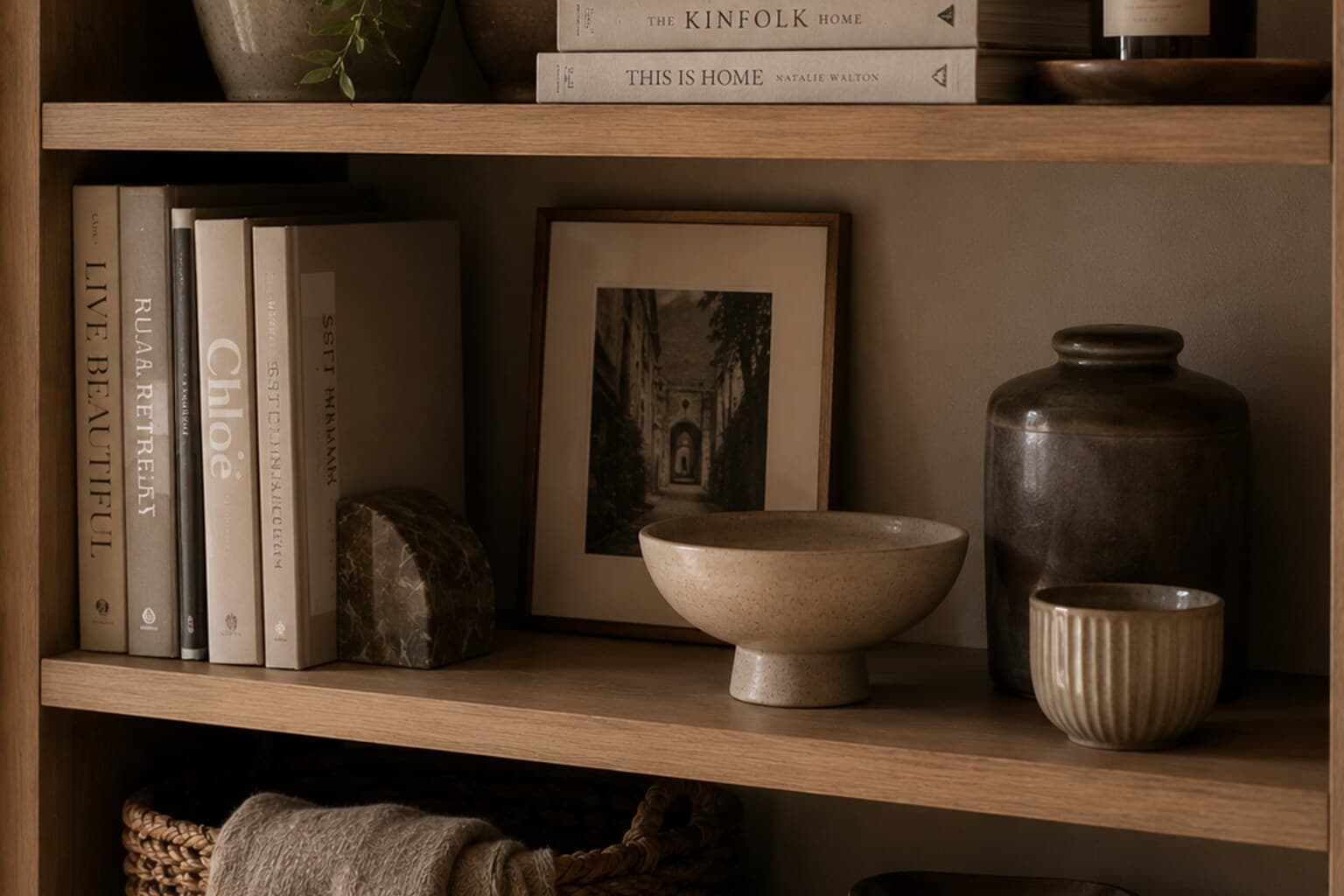
A simple group may include three books, one ceramic bowl and one framed image. Another may include a lamp, a small stack and a sculptural object. Each group should read as one composition.
Avoid spacing every item equally - variation creates a more natural rhythm.
Repeat Shapes and Materials
Use repetition to connect separate shelves - a round bowl on two different levels, several objects in smoked glass, dark frames repeated, cream ceramics distributed throughout, brass appearing in two or three places.
The repeated element helps the shelving feel intentional.
Leave Negative Space
Open space is part of the design - allow part of a shelf to remain empty, air around a framed piece, space above a low object, and a pause between groups.
Do not fill the shelving to prove its storage capacity. When more storage is genuinely required, combine open shelves with boxes or closed cabinetry.
Use Containers Carefully
Visible containers may hold small technology, matches, writing tools, remote controls or craft supplies. Choose lidded boxes, opaque baskets or decorative vessels.
Keep containers consistent in material or colour - avoid placing many mismatched storage products on one shelf.
Include Something Personal
Possible personal elements include a travel object, a meaningful photograph, a favourite book, a handmade ceramic, a family piece or artwork.
The shelf should not resemble a generic showroom - one or two personally significant pieces give it character.
Consider Maintenance
Open shelves collect dust and require regular care. Avoid styling them so densely that cleaning becomes difficult.
Keep fragile objects stable, and do not place valuable or heat-sensitive items near cooking areas, direct sunlight, radiators or unstable edges.
The Checklist
- Useful and display-worthy items selected
- Visual palette defined
- Heavy objects balanced
- Book orientation varied
- Objects grouped
- Materials repeated
- Negative space retained
- Small clutter contained
- Personal item included
- Shelf remains easy to clean
Pair It With
The most effective open shelves do not display everything a person owns.
They reveal a careful selection of what is useful, beautiful or meaningful enough to remain in view.
Enjoyed this?
The Seasonal Letter brings more stories, recipes and rituals like this one - a few times a season, never more.

Written by Esther
Esther is a photographer and storyteller, and the founder of Essy's Essentials - a seasonal home for stories, rituals, recipes and everyday luxuries.
More about Esther →