Home & Living
Wood-Look vs Real Wood Kitchen Worktops: What We Chose and Why
We wanted the warmth of wood in our new-build kitchen without a solid-timber upkeep routine. Our choice, the questions to ask before you buy and what a wood-look label does not tell you.
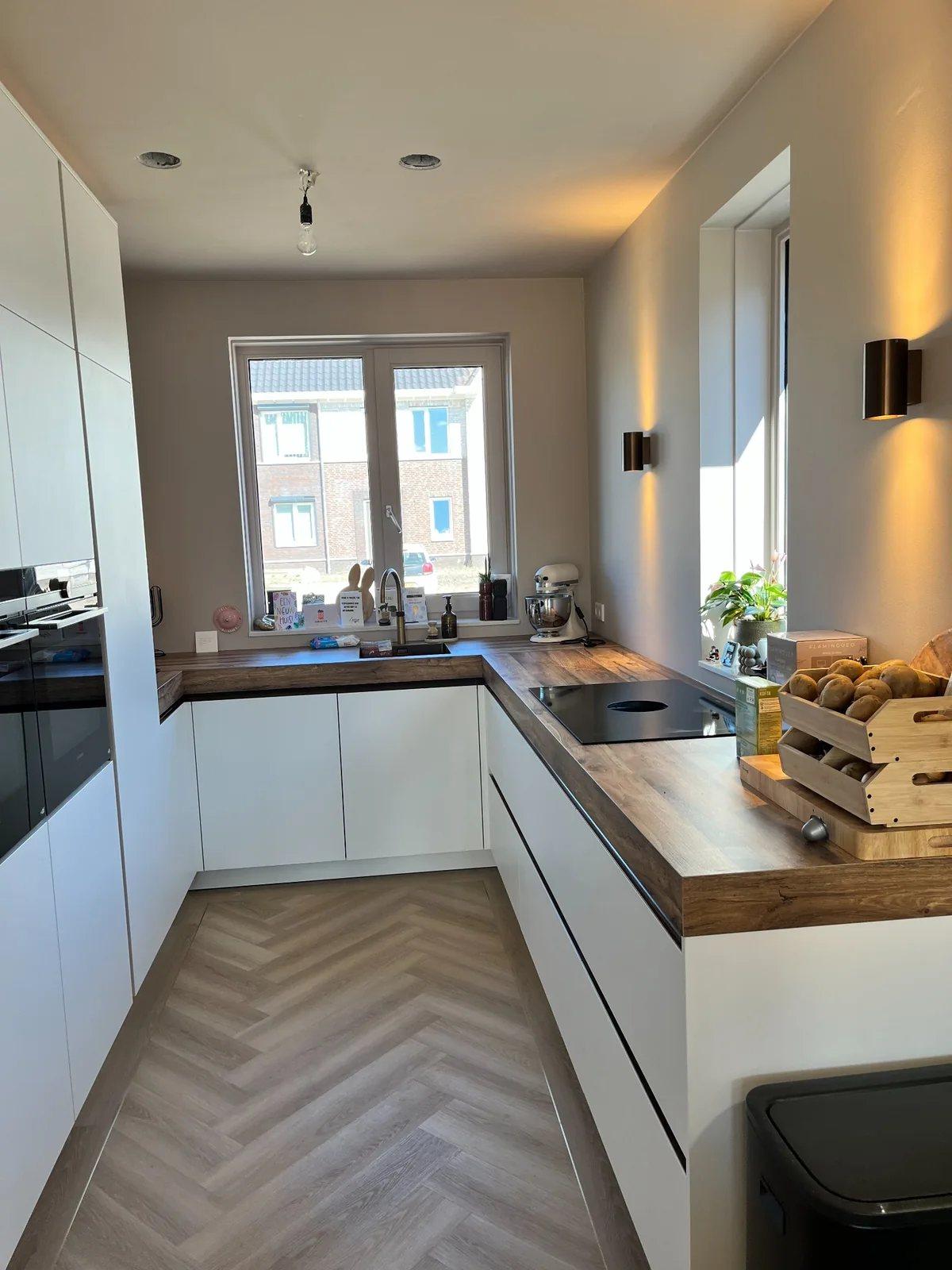
Our kitchen: the worktop is what stops the white cabinetry feeling clinical.
The short answer
Neither is universally better. Real timber has natural grain and can often be refinished, but its finish usually needs ongoing care. A wood-look worktop gives similar warmth with a different maintenance profile, which depends on what it is actually made from. We chose a thick wood-look worktop for our own kitchen, and I would choose it again.
For our new-build house, we chose a thick, wood-look worktop instead of solid wood.
It was a conscious decision, not an attempt to make a cheaper material look like something else. I wanted that warm tone against the white cabinets, the champagne-toned details and the brass-toned sink and Quooker. I also wanted a kitchen that worked in ordinary life: cooking, washing up, coffee and the occasional mess.
In a showroom, everything is beautiful. The more useful question is what you want to live with once the showroom lighting is gone and it is your own kitchen to clean.
One honest note before we start: I am describing what we chose and why, not testing the product. I have not confirmed the exact manufacturer or construction of our worktop for this article, so I am deliberately not putting a material name on it. Everything in the general sections is a question to ask, not a claim about ours.
The short comparison
“Wood-look” is an appearance description, not a material specification. Different engineered products do not all perform identically, so ask the supplier for the exact product sheet.
| Solid wood | Wood-look / wood-effect worktop | |
|---|---|---|
| Appearance | Real grain and natural variation | An engineered wood-style finish; visual quality varies |
| Maintenance | Depends on the finish; typically periodic care or re-oiling | Depends on the underlying material and the manufacturer’s instructions |
| Water at joins and the sink | Needs attention to the protective finish and moisture | Also needs attention: water can damage joins, edges and some cores |
| Heat | Trivets are sensible; scorching can occur | Trivets are sensible; heat resistance varies substantially |
| Repair | Many solid wood surfaces can be sanded or refinished | Depends on construction; some chips or burns are difficult to disguise |
| Texture | Natural tactile character | Can have embossed grain; some feel more convincing than others |
| Cost | Depends on species, thickness, finish and installation | A very wide range, from budget to premium finishes |
Why we didn’t choose real wood
I love wood. It is one of the reasons the whole house feels warm rather than stark.
But I didn’t want a kitchen surface that I would constantly be worrying about. The area around the sink, the worktop where we prepare food, the spots that get wiped every day: I wanted to use them without thinking too hard about whether we were following an oiling schedule.
The solution for us was not to lose the warmth, but to choose it differently. Our thick wood-look surface gives the kitchen that grounded, welcoming feeling, and it works especially well with the otherwise clean, modern shapes: white cabinetry, integrated tall units, the BORA cooktop and the darker sink.
Would I choose it again? Yes, for the look and the day-to-day practicality we wanted from this kitchen. I’m glad we didn’t let the idea that “real” must be more luxurious make the decision for us.
That does not mean real wood is a poor choice. For someone who enjoys the ageing and upkeep of natural materials, solid timber might be exactly right.
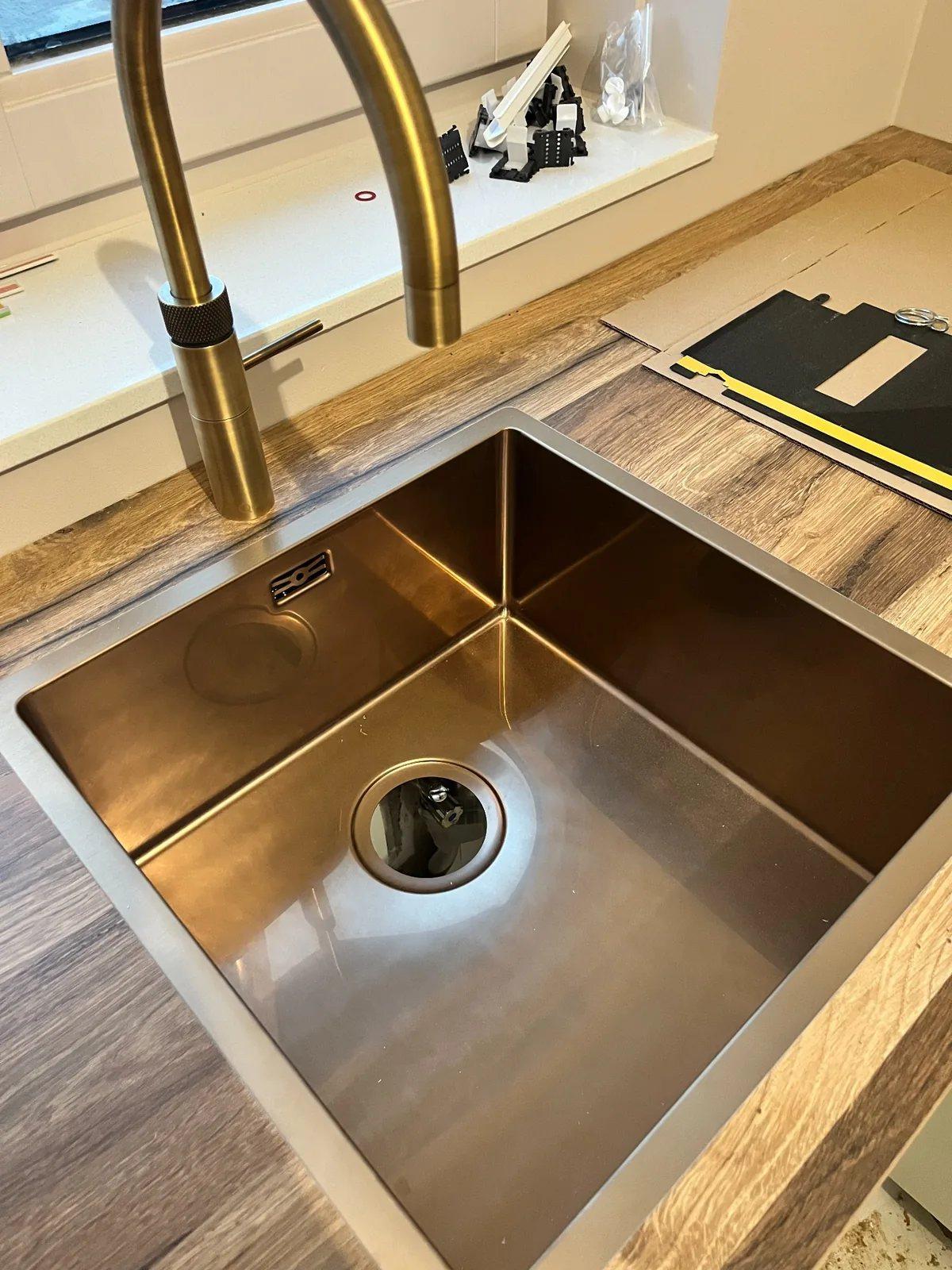
How wood-look changes the feeling of a white kitchen
White kitchens can be beautiful, but if everything is white, hard and reflective, the room can feel a little clinical.
Our worktop was one of the decisions that prevented that. The wood tones bring warmth across a large horizontal surface, and the depth of the worktop gives it presence rather than feeling like a thin line beneath the cabinets. We took the same approach through the rest of the house: warm colours, tactile finishes and lighting that looks good in the evening, not only at midday. You can see the wider picture in how our new build became home.
What I like about a wood-effect surface is that it lets the rest of the kitchen be quieter. The cabinet fronts don’t need decorative detailing; the worktop supplies enough texture.
If you are choosing your own, don’t hold a tiny sample in front of a white cupboard and consider the decision finished. Ask to see a large sample or an installed example. A grain pattern that looks convincing at 10 centimetres may repeat too obviously across several metres.
1. What exactly is the material?
This is the first question, and the one that product descriptions make surprisingly difficult.
“Wood-look” can describe several different constructions, with different edge treatments, thickness limits and care instructions. Ask for the product name, the full specification, installation details and written maintenance advice. Don’t rely on words like “durable”, “premium” or “easy care” without context.
2. Can I see the grain at full scale?
Look at photographs of real installations or a full-size sample. Does the grain repeat? Does the surface look too orange, too grey or flat in your lighting? Is the texture smooth, deeply embossed or somewhere in between?
Our aim was warmth that worked with taupe walls and brass-toned details. Your ideal finish might be cooler, lighter or much darker.
3. How does it finish at the edges and joins?
A beautiful surface can lose much of its appeal at a visibly mismatched edge. Ask to see corner joins, end panels and the finish around the sink.
This matters most if you want a thick-looking top. A thick appearance does not by itself tell you how the material is built.
4. What happens when it gets wet?
No material benefits from water sitting at vulnerable joints or openings. The exact risk varies, so ask what protects the sink cut-out, joins and edges, and what counts as improper care under the guarantee.
With our Quooker beside the sink and everyday washing-up, that is a practical question rather than a technical curiosity.
5. What happens if a hot pan touches it?
Don’t assume wood-look materials can take a hot pan. Some can mark, discolour or suffer permanent damage. Ask for the exact heat guidance and use trivets regardless. An induction hob doesn’t make cookware cool.
6. Can it be repaired?
Solid wood can often be refinished. A decorative surface that is burned, chipped or damaged may be harder to repair invisibly. Ask the installer what can be done if the surface is damaged and whether replacement sections will match.
7. What cleaning products are recommended?
I would always choose ordinary, manageable maintenance over an impressive-sounding coating I don’t know how to live with. Check the manufacturer’s guidance for cleaning, stain removal and protecting the edges. Aggressive abrasive cleaners can damage even surfaces sold as easy to maintain.
What is real wood like as a kitchen worktop?
A solid wood worktop is a different proposition, with genuine strengths.
The character is real rather than printed. The grain varies, the feel is unique and the surface may gain character over time. Many solid-wood worktops can be sanded and refinished, which is attractive if you want to keep them for many years.
But material and finish matter. Some timber tops come pre-oiled; others need treatment over time, particularly around sinks and cooking areas. How often depends on the finish, how you use the kitchen and the manufacturer’s instructions.
For people who find that process satisfying, it may be a reason to choose wood. I know myself well enough to prefer a lower-maintenance route for this particular room.
Are wood-effect worktops waterproof, heatproof or scratchproof?
Do not assume so. These words are often used too casually.
Some products resist everyday splashes well while remaining vulnerable at joints and cut-outs. Heat resistance depends on the finish and the base material. Scratch performance varies too, and even a robust surface can be marked by knives, abrasive pads or heavy objects dragged across it.
When comparing samples, ask for documentation for the specific product. A generic claim about a whole category tells you very little about one particular worktop.
My practical rule is simple: chopping board, trivet, wipe up spills and follow the manufacturer’s care guidance. That doesn’t turn the kitchen into a museum; it simply protects what you’ve chosen.
Our kitchen decisions that work together
We didn’t choose the worktop in isolation. Our kitchen has full-size appliances integrated into tall cabinetry, proper drawer storage, a Quooker, a BORA hob and lighting designed to soften the atmosphere. Those are all decisions about how we actually cook and live. If you want the detail, we wrote about the Quooker and the BORA separately, and about planning the kitchen around how we use it.
The worktop connects them. It stops the room feeling overly white, gives the brass-toned finishes a warmer setting and suits the herringbone flooring. The sink was chosen to work visually with the Quooker, not added as a last-minute afterthought.
We use our kitchen a lot. If a surface only looks good untouched, it probably isn’t the one for us.
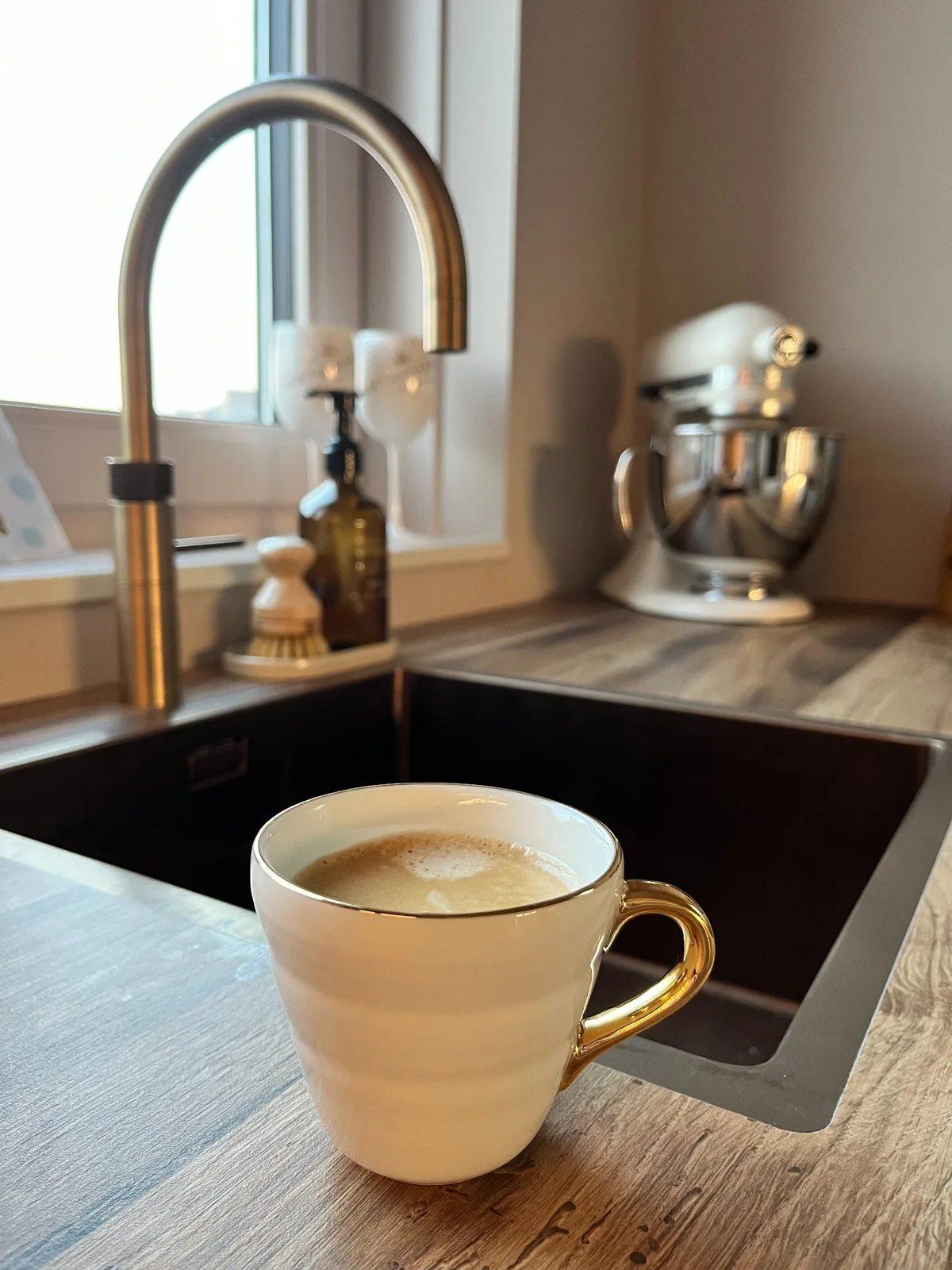
What I would check again before ordering
I would take a large finish sample into the actual room and look at it in morning and evening light. I would check the cabinet colour and sink finish beside it, ask the kitchen supplier for a full product specification and written cleaning instructions, and ask to see how the edge and sink cut-out will be finished.
Then I would think about routines: how often I cook, whether we leave small appliances out, where wet dishes go and which areas will be used constantly.
The very thick, warm wood-look worktop in our kitchen is not the only correct answer. It was the answer to how we wanted our kitchen to feel and work.
The Essy’s verdict
I love the idea of a kitchen that looks considered, but I want the reality to be easy to live with.
Our worktop was a good example of choosing the life we actually lead rather than the most romantic-sounding material in the showroom. I wanted the appearance of wood, the warmth it brings to an otherwise sleek kitchen and a surface that fits our routines.
I don’t think luxury has to mean more maintenance. Sometimes the luxury is a beautiful room that you can simply get on with using.
This is independent editorial. We paid for our home and kitchen decisions, and no worktop maker has commissioned this comparison. Claims about our own installation are deliberately limited to what we can confirm.
More From Our New-Build Kitchen
Frequently asked questions
Is a wood-effect kitchen worktop cheaper than solid wood?
Often, but not always. Price depends on material, manufacturer, thickness, edge treatment, installation and design. Some premium engineered finishes can cost more than some solid timber choices. Compare complete installed quotes rather than general categories.
Is wood-look the same as laminate?
No. Wood-look describes the appearance. Laminate is one possible construction, but other engineered surfaces and veneers can also look like wood. Verify the product specification.
Are real wood worktops difficult to maintain?
They require care, and many finishes need periodic retreatment, particularly near water. The exact routine varies by species and finish; follow the manufacturer’s instructions.
Which works best around a sink?
Either can work with the right material and correct installation. Pay special attention to sealed openings, joints, water exposure and manufacturer guidance. There is no universal waterproof wood-look guarantee.
Can I put a hot pan on a wood-effect worktop?
Use a trivet. Heat resistance varies, and very hot cookware can permanently mark certain finishes.
Can a wood-look worktop look luxurious?
Yes. A convincing finish, a considered edge profile, complementary cabinetry and careful installation can create a beautiful result. A real-life large sample is more useful than a tiny swatch.
Can you sand a wood-effect worktop?
Not necessarily. Many decorative surfaces cannot be sanded like solid timber without damaging the finish. Only use repair methods approved for the exact product.
Which would you choose again?
For our own modern, warm kitchen, I would choose the wood-look finish again. I like the appearance and the maintenance trade-off we chose. Another household may prefer the natural character and repairability of real timber.

Written by Esther
Esther is a photographer and storyteller, and the founder of Essy's Essentials - a seasonal home for stories, rituals, recipes and everyday luxuries.
More about Esther →