Home Styling
How to Style a Console Table
A balanced formula for creating an entryway or living-room surface that feels elegant, useful and uncluttered.
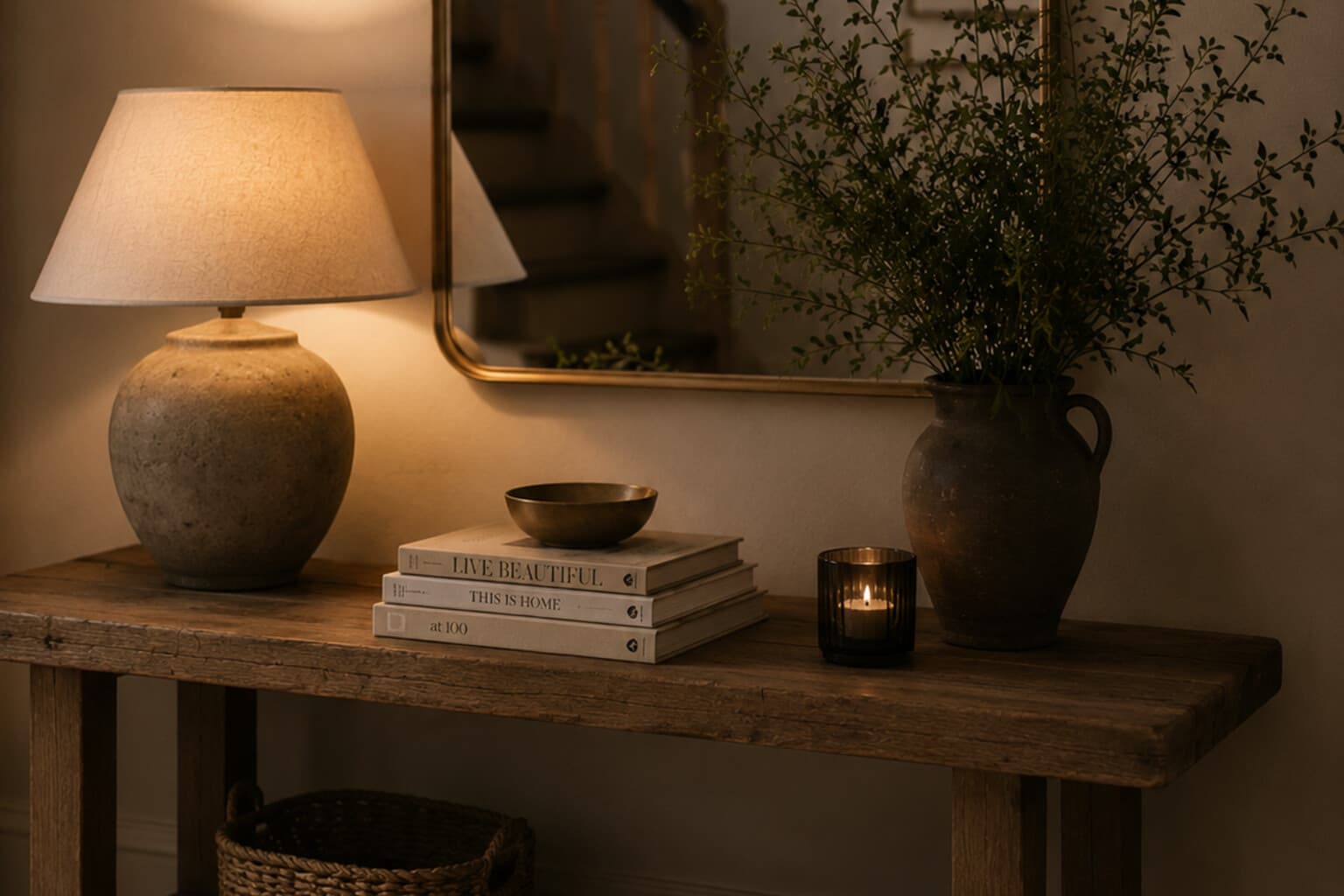
A console table often sits in a visible but transitional part of the home - an entrance, a hallway, behind a sofa, or against an empty wall.
It can provide storage, lighting and a place for daily objects. It can also become a surface where unrelated items accumulate.
A well-styled console combines practical function with a small number of visually balanced elements.
Begin With the Wall
The area above the console helps determine the scale of everything below. Possible focal points include one large artwork, a mirror, two coordinated prints, a small gallery arrangement, or a sculptural wall object.
Choose a piece or arrangement that relates to the width of the console. Artwork that is too small may feel disconnected. Several small items can work, but they should read as one composition.
Add Height
Use one object to create vertical structure - a table lamp, a tall vase, branches, a large candlestick, or a sculptural object.
A lamp is particularly useful because it provides both height and evening atmosphere.
Create a Lower Grouping
Balance the taller element with a smaller arrangement - a stack of books with a bowl, a tray with a candle and small object, a low ceramic vase, or a framed photograph with a box.
Keep the grouping compact. Several unrelated small objects spread across the surface may appear untidy.
Include Something Useful
Depending on the location, add one practical element - a tray for keys, a lidded box, a small bowl, a drawer organiser, a basket underneath, or a lamp.
The practical object should support the space without dominating it.
Use Odd Numbers Selectively
Groups of three can feel natural - for example, a lamp, a stack of books and a bowl.
However, balance is more important than following a formula. Two substantial objects may work better than five small ones.
Vary Height and Shape
Combine tall and low, round and rectangular, soft and structured, matte and reflective. A round bowl may soften a rectangular console and framed artwork. A lamp with a fabric shade may balance a glossy tray.
Leave Open Surface
Do not style the console edge to edge. Leave enough empty space for the composition to breathe and for the table to remain functional.
The surface should still be easy to clean and use.
Consider the Space Below
The area beneath a console may remain empty or hold one or two baskets, a bench, a low stool, a large ceramic vessel, or a stack of substantial books.
Do not fill the space simply because it exists. Use the lower area only when it improves function or visual balance.
Console Styling Formula
One wall focal point, one source of height, one lower grouping, one practical item, one natural or seasonal element, and enough empty space.
Seasonal Changes
Spring
- Fresh branches.
- A pale ceramic bowl.
- One lighter book.
Summer
- Garden flowers.
- Clear or smoked glass.
- A woven tray.
Autumn
- Chestnut branches.
- A darker candle.
- A warm-toned book.
Winter
- Evergreen foliage.
- Brass candleholders.
- A small bowl with seasonal details.
Pair It With
Keep the main structure the same each season and change only one or two accents.
A console table should not look like a display assembled for a photograph.
It should feel like a small, useful composition that belongs naturally to the room.

Written by Esther
Esther is a photographer and storyteller, and the founder of Essy's Essentials - a seasonal home for stories, rituals, recipes and everyday luxuries.
More about Esther →