Home & Living
How to Make Your Bed Feel Like a Luxury Hotel (Without Making It Impractical)
A practical guide to a hotel-style bed at home: the right fit, percale or sateen, a duvet chosen for warmth, a simple layering routine and a five-minute reset.
The short answer
A hotel-style bed usually combines a clean and comfortable mattress surface, smooth fitted bedding, a generously draped duvet, well-shaped pillows and a neat finish. Start with fit and feel, not an expensive shopping list. Choose cotton percale if you like a crisp, cool touch, or cotton sateen if you prefer a smoother, softer finish. Keep the decorative layers restrained, and make sure the bed is comfortable for the people who sleep in it.
There is a particular pleasure in walking into a beautiful hotel room and seeing a freshly made bed. But recreating that feeling at home should make your evenings easier, not give you twelve decorative cushions to relocate every night.
If you ask me what makes a hotel room feel immediately inviting, the bed will usually be somewhere near the top of my list.
Not necessarily the enormous headboard or the most expensive sheets. It is the sense that everything is ready. Fresh bedding. Smooth layers. Pillows that look generous but actually have a purpose. Nothing waiting on the mattress that needs to be removed before you can get into it.
I love a beautiful interior, but I also like a home that works on an ordinary Tuesday. And the difference matters here. I want some of that lovely hotel-bed feeling without turning our bedroom into a room that is only beautiful when nobody is using it.
The good news? You can get surprisingly close with a few deliberate choices: bedding that fits, fabrics you enjoy touching, a duvet suited to your bedroom and a simple method of making the bed.
Here is how I would build that feeling, one layer at a time.
1. Start With the Mattress, Not the Cushion Arrangement
A beautiful duvet cover cannot rescue a mattress that doesn’t suit you. Before buying new bedding, check whether your current mattress is comfortable and whether the surface is even and supportive for your needs.
You don’t need to replace a perfectly good mattress to create a better-looking bed. But you do need a reliable foundation.
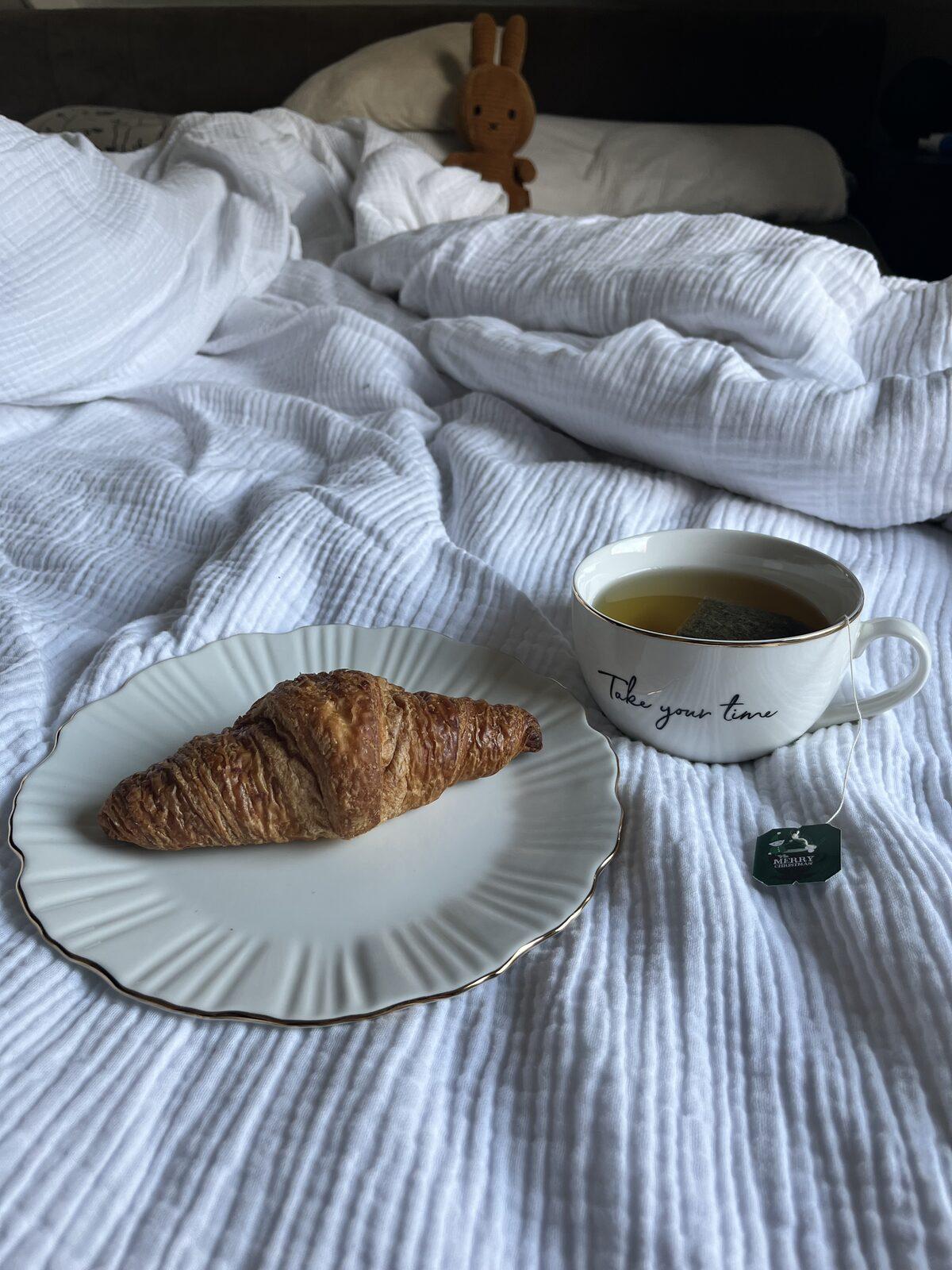
A washable mattress protector is worth considering, especially if you enjoy coffee in bed as much as I do. Choose one that fits the depth of your mattress and doesn’t bunch up beneath the sheet. A protector that’s too small can pull at the corners; an oversized one can wrinkle.
A mattress topper is optional. It can change the feel of the surface, but it is not a substitute for addressing a worn-out mattress. If you already love how your bed feels, don’t add a topper simply because hotels sometimes use them.
My rule: nothing goes on the bed unless it makes it more comfortable, easier to care for or more pleasant to look at.
2. Buy the Right Size Sheets Before Thinking About Thread Count
This is an unglamorous detail that has a surprisingly big effect.
The fitted sheet should match the mattress width, length and depth. Measure the mattress, including any topper. Then check the sheet’s listed pocket depth rather than assuming all ‘king’ or ‘super king’ labels mean the same thing.
Sizes vary between the UK, continental Europe and other markets. A Dutch 180 × 200 cm bed and a UK king are not the same thing. If you shop internationally, always compare centimetres rather than relying on the name printed on the packet.
The same principle applies to the duvet cover. A duvet that floats inside its cover or barely fits at the corners will not give you the smooth, substantial look you want.
For a more generous hotel-style drop down the sides, some people prefer a duvet larger than the mattress. That only works if the duvet and cover match each other and the overhang is practical in your room. Measure before buying; do not assume ‘one size up’ will always look right.
Percale or sateen: which feels more like a hotel?
Both can feel luxurious, but they are different weaves, not different grades of quality.
I wouldn’t choose purely by photographs. If you love the sensation of crisp sheets, percale may appeal. If you prefer something smoother against the skin, look at sateen. Both come in different qualities and price ranges.
And please don’t become hypnotised by enormous thread-count claims. Fabric construction, fibre quality, how the sheet feels and how it survives washing matter more than a single number on the packaging.
Percale or sateen: which feels more like a hotel?
| How it generally feels | Best if you prefer | |
|---|---|---|
| Cotton percale | Crisp, matte, light and airy | A fresh, cool-sheet feeling |
| Cotton sateen | Smooth, supple, softly lustrous | A silkier feel and softer drape |
| Linen | Textured, relaxed and naturally rumpled | A lived-in appearance rather than a crisp hotel finish |
3. Choose a Duvet for Warmth, Then Make It Look Generous
The most inviting hotel beds have a certain fullness to them. That doesn’t mean they need the warmest possible duvet.
A duvet’s tog rating describes insulation, not prestige, weight or thickness. A higher tog is warmer. What works depends on the temperature of your bedroom, the season and whether you tend to feel warm or cold at night.
As a rough UK shopping guide, low-tog duvets are often sold for summer, mid-range ones for transitional seasons and higher-tog versions for colder rooms. These are starting points, not instructions to tolerate an uncomfortable duvet because the calendar says ‘winter’.
Feather, down, synthetic and other fillings have different feel, care requirements and prices. Read the label for washing and drying instructions; some fills are more demanding to launder than others.
The bed should look beautiful because it is comfortable, not because the bedding is so thick that you wake up overheated.
The easiest way to create a fuller silhouette:
Shake the duvet after putting on its cover, align the corners properly and smooth the surface from the centre outwards. Let it fall evenly over the sides. A duvet with enough room to drape naturally can look more sumptuous than one pulled tightly across the mattress.
No complicated trick required.
| What to consider | |
|---|---|
| Warm bedroom or someone who sleeps hot | A lighter duvet and an easily removable extra layer |
| Temperate room throughout the year | A versatile mid-range duvet, adjusted to personal comfort |
| Cold bedroom in winter | More insulation or a modular all-seasons system |
| Two people with different preferences | Separate duvets or layers, even if a single cover looks more symmetrical |
4. Use the Hotel Layering Order — Then Edit It for Real Life
Professional hotel bed-making often follows a clear order: prepare the mattress, fit the bottom sheet, position the top sheet if used, add the duvet or blanket, then finish with pillows.
At home, I would simplify that into a routine you can do even on a busy morning.
A practical seven-step hotel-style bed:
- Clear and air the bed briefly. Follow your usual bedding-care routine; when changing linen, check the mattress and protector.
- Smooth the mattress protector. Make sure it sits flat, especially at the corners.
- Fit a correctly sized sheet. Pull each corner into place and smooth the centre with your hands.
- Add an optional flat sheet. If you enjoy the hotel feel of a top sheet, centre it with an even drop on both sides. If not, skip it.
- Position the duvet. Align the top edge, shake it gently and allow the sides to fall evenly. Fold back a narrow section at the head if you like that finished look.
- Plump and position the pillows. Put your actual sleeping pillows where you need them and add only one or two extras if they genuinely earn their place.
- Finish with one useful layer. A throw folded across the foot of the bed is enough if you like a little extra texture. Leave it within reach rather than treating it as a museum exhibit.
If you like a tucked-in flat sheet, you can fold neat mitred or ‘hospital’ corners. But no rule says you must sleep under tightly tucked layers. A bed that traps your feet is not necessarily a luxurious one.
What about that crisp, pressed look?
Hotel laundry is often processed differently from domestic bedding. For a similar visual effect, start with the correct sheet size and avoid leaving clean sheets crumpled in the laundry basket. Smooth them as you make the bed. If you’re particularly fond of crisp edges, press the visible pillowcase hems or top fold — rather than ironing every inch of bedding every week.
That would be my definition of effort well spent.
5. Arrange Pillows for Both Comfort and Proportion
Pillows do an enormous amount of visual work. They also need to support the people who actually sleep on them.
Start with the number and type of sleeping pillows you both prefer. There isn’t a single correct firmness or height for everyone. Don’t buy decorative pillows that look grand but make your neck uncomfortable.
For a double or larger bed, I like the simple visual idea of a pair of sleeping pillows with one larger back cushion or one small accent cushion if you want to sit up and read.
Keep any extra cushions to a number you can move in a few seconds. If they end up in a pile on the floor every night, they probably don’t belong on the bed.
The hotel look: deliberate proportions. The grown-up version: no cushion evacuation plan at bedtime.
6. Use a Quiet Colour Palette and Let Texture Do the Work
You don’t need an entirely white bedroom to borrow a little hotel elegance.
Bright white bedding is a classic option, but ivory, oat, soft stone, warm taupe and gentle greige can be every bit as calm. The secret is usually a restrained palette with different surfaces rather than lots of competing patterns.
In our own new-build home, warm neutral finishes are a major part of the atmosphere. That experience has made me particularly interested in what happens when fabric, wood, metal and lamplight are considered together rather than chosen in isolation.
If your walls are already warm in tone, a slightly creamy white may feel more at home than a very stark blue-white. If you want contrast, add it through a deeper throw, bedside furniture or one upholstered texture.
A hotel-style bed doesn’t have to feel anonymous. It should feel like your room, just with a little more intention.
7. Make the Whole Bedside Feel Like a Hotel Arrival
Sometimes the hotel feeling doesn’t come from the duvet at all. It comes from what surrounds it.
A clear bedside table. A lamp within easy reach. Water somewhere stable. Charging cables that have a proper home. Curtains that close comfortably. A room that doesn’t greet you with unfinished chores.
I would prioritise those details before buying another decorative cushion.
Use warm, comfortable light in the evening, but keep enough focused light to read safely. Make sure switches are easy to reach. And leave room for the book you’re actually reading, not a stack chosen because the spines match the paint.
If you’re interested in how soft lighting changes the room, our Layered Lighting Guide explains the principle; the companion 2700K vs 3000K guide goes further into colour temperature.
8. Keep the Luxury Feeling After Laundry Day
There is little point creating a beautiful-looking bed that requires an entire afternoon to maintain.
I find it more useful to build a repeatable system. Keep enough bedding sets for your household’s laundry rhythm, rather than collecting beautiful pieces you rarely use. Follow the care label for every textile. Dry bedding thoroughly before storing it, and avoid overfilling the washing machine if the load needs room to move.
For duvet and pillow care, check the manufacturer’s instructions: fills and constructions vary widely. A fresh pillowcase can do more for the sense of comfort than an expensive decorative addition.
And if you want the bed to look presentable in the morning, two minutes of smoothing, straightening and clearing the bedside is a perfectly respectable routine.
A five-minute hotel-bed reset:
- Smooth the fitted sheet where it has come loose.
- Shake and centre the duvet.
- Plump the pillows you actually use.
- Fold back the top edge of the duvet if you like the look.
- Put the useful throw in place.
- Remove empty glasses and anything that doesn’t belong beside the bed.
The point is not perfection. It’s the pleasure of returning to a room that already feels prepared for you.
9. Where to Spend — and Where to Save
I would put the money towards the things closest to your body and the things you use every night: a comfortable sleep surface, good-fitting sheets, suitable pillows and a duvet you enjoy.
You can save on the finishing touches. One well-chosen throw can be plenty. You may already own a bedside lamp that does the job beautifully. There is no need to replace everything at once, and there is absolutely no requirement to buy a matching bedding set from a luxury hotel brand.
If you’re working with a limited budget, change one part at a time. Start by checking the fit of your existing bedding. Then decide whether your next investment should be a better pillow, a fresh duvet cover or a second set of sheets.
A thoughtful bedroom is more convincing than a shopping basket full of things you don’t really need.
10. Hotel Bed Versus a Bed You Actually Want to Live In
This is the distinction I care about most.
Hotel beds are prepared to look immaculate when a guest arrives. A bed at home needs to work through getting up late on a Sunday, reading in the evening, doing the laundry and all the unphotogenic moments in between.
That is why our Autumn Bed, Properly Lived In deliberately takes a different perspective. It is about seasonal warmth and a bed arranged around real life, rather than a perfect hotel presentation.
I don’t think the two ideas contradict one another. Borrow the clean lines and considered comfort from a lovely hotel. Keep the human details that make your own bedroom feel like home.
The Essy’s Verdict
I don’t want our bedroom to look like a hotel that nobody has checked into.
I want the pleasure of walking into a lovely room, seeing a bed that is ready and knowing that everything on it has been chosen because it makes ordinary life feel a little better.
That might mean beautiful sheets. It might mean a properly comfortable pillow. Or simply making the bed before the day gets away from us.
Luxury, to me, isn’t the number of layers.
It’s how lovely they are to live with.
Pair It With
- The Autumn Bed, Properly Lived In
- The Linen and Towel Edit
- The Layered Lighting Guide
- 2700K vs 3000K: Which Lighting Is Best for Your Home?
Frequently asked questions
How do I make my bed feel like a five-star hotel bed?
Start with a comfortable mattress surface and fitted sheets in the correct size. Add a well-covered, evenly draped duvet, supportive pillows and a neat finish. The ‘hotel’ effect comes as much from clean, smooth bedding and good proportions as it does from expensive materials.
What type of sheets do luxury hotels use?
Hotels use a range of bedding, but cotton sheets are common. Percale often has a crisp, matte feel, while sateen feels smoother and drapes differently. You don’t have to copy a specific hotel supplier: choose the weave and quality that feel best to you.
Is a higher thread count always better?
No. Thread count alone is not a reliable guarantee of softness, durability or overall quality. Fibre quality, weave, construction, fit and how the sheets feel after washing all matter.
How do you make a duvet look fluffy on a bed?
Use a duvet and cover that fit each other, align the corners, shake the duvet into place and let it drape evenly over the sides. Choose warmth for the sleeper first; an excessively warm duvet isn’t a good trade-off for a fuller appearance.
Do I need a flat sheet to make a hotel-style bed?
Not necessarily. A flat top sheet can create the classic turned-down hotel look, but many people prefer sleeping directly under a duvet cover. Both approaches can look tidy and feel comfortable.
How many pillows should be on a hotel-style bed?
There isn’t a universal number. Begin with the pillows actually used for sleeping, then consider one or two additional pillows for reading or proportion. Avoid a decorative pile that needs removing every night.
Can I make a hotel-style bed on a budget?
Yes. Start by using correctly sized bedding and making the bed carefully. Clean pillowcases, a centred duvet, smooth sheets and an uncluttered bedside can make a visible difference without buying an entirely new set.
What’s the difference between a hotel-style bed and a cosy bed?
A hotel-style bed usually emphasises crisp presentation and symmetry. A cosy, lived-in bed prioritises personal comfort, warmth and everyday usefulness. You can combine the two by borrowing the neat layering while keeping your preferred fabrics, practical pillows and relaxed atmosphere.
Further reading and practical sources: The Layered Lighting Guide · The Autumn Bed, Properly Lived In · The Linen and Towel Edit · Which? duvet buying guide · Sleep Foundation’s percale versus sateen guide

Written by Esther
Esther is a photographer and storyteller, and the founder of Essy's Essentials - a seasonal home for stories, rituals, recipes and everyday luxuries.
More about Esther →