A story from Cortelume
The House Above the Piazza
A quiet balcony, an old house and the kind of morning view that makes the whole village feel like a secret.
Set at Casa Alta
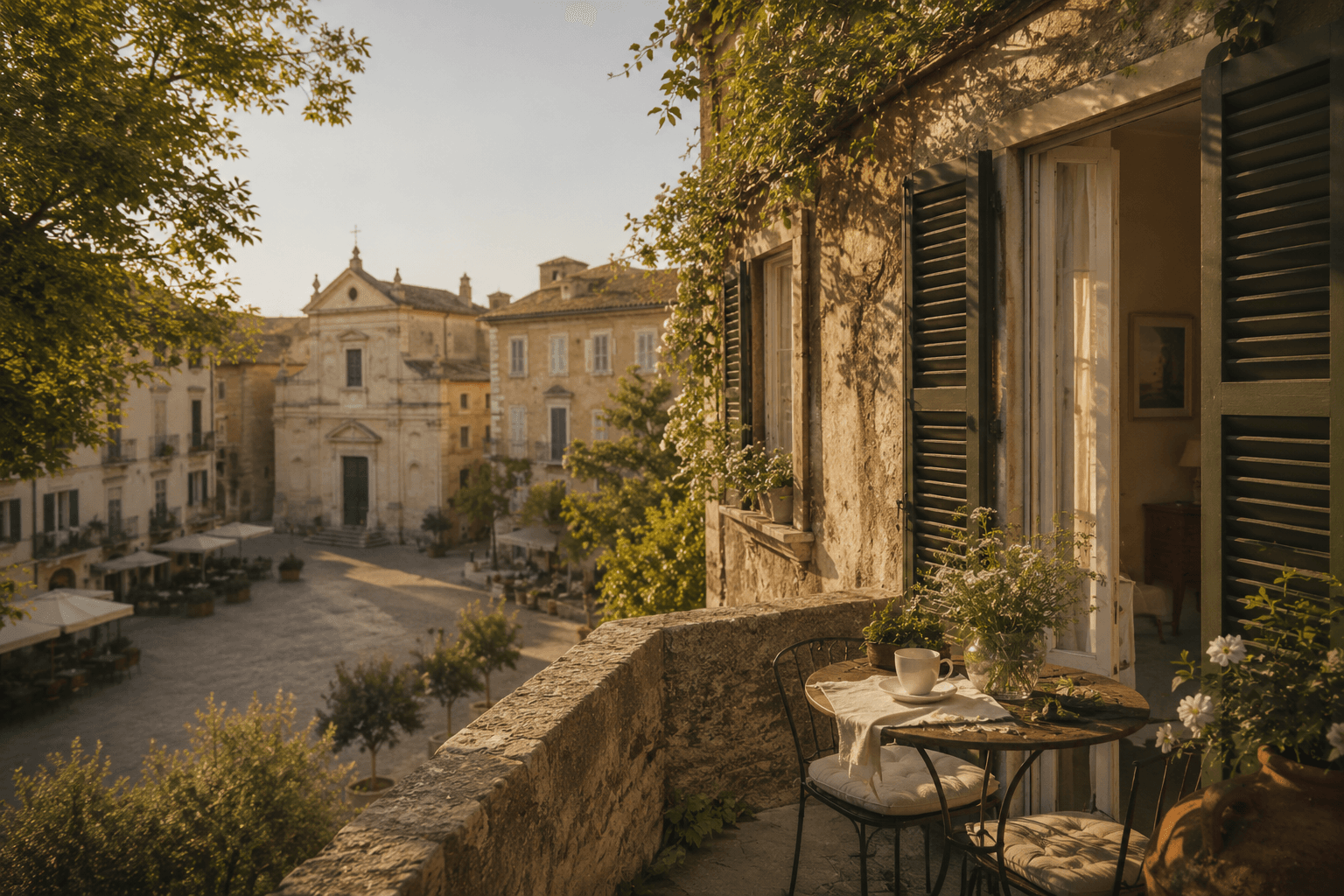
“The first morning is always for looking. Do not unpack too quickly. Sit where the light finds you.”
By the time the bells rang nine, the shutters of Casa Alta were already open.
From the piazza below, Esther could see them if she stood beside the fountain and looked up past the church steps, past the bougainvillea, past the narrow turn where Via Pietra began its slow climb through Cortelume.
Most visitors did not notice Casa Alta at first.
Cortelume pulled the eye downward: to the striped umbrellas, the bowls of lemons outside Bottega Basso, the tiny boats at Il Porto Piccolo, the warm trays disappearing through the side door of Forno Nica. But Casa Alta watched from above, pale and quiet, with linen curtains moving in the open windows as if someone had just passed through the room.
Esther had arrived with one linen bag, one notebook, and the sort of tiredness that comes from months of being useful to everyone except yourself.
At the bottom of the hill, a woman in a blue apron had pressed a key into her hand.
"Casa Alta," she said, as if introducing her to a person.
The key was wrapped in brown paper. Inside was a card.
For the house above the piazza. The shutters are already open.
No name.
Esther climbed slowly. Via Pietra curved as if the village had no interest in efficiency. Halfway up, a man emerged from Forno Nica, dusting flour from his hands.
"You are for Casa Alta," he said.
"I think so."
"Then you need bread."
Before she could answer, he placed a warm paper-wrapped loaf into her bag.
At Casa Alta, the sage-green door opened with one soft turn of the key.
Inside, the house smelled of stone, linen and sun-warmed wood. On the entry table stood a bowl of lemons, a small mirror and three stems of white flowers in a narrow glass vase. Beyond the sitting room, the terrace doors were open.
On the terrace table waited a moka pot, still warm.
Two cups.
One clean. One with the faint trace of coffee at the bottom.
Esther stood very still.
Down in the piazza, someone laughed. The fountain kept speaking to itself. A dog barked once and stopped.
She told herself someone must have prepared the house. A housekeeper. The woman in the blue apron. The baker. Someone practical and kind.
Still, the second cup felt like an unfinished sentence.
Beneath a jar of honey, she found another card.
Dear friend,
The first morning is always for looking. Do not unpack too quickly. Sit where the light finds you. Listen for the fountain. By evening, you will know which street wants you next.
At the bottom of the card was a tiny lemon branch.
Esther sat.
She poured coffee into the clean cup, tore the bread, spread it with butter and honey, and ate slowly while the terrace filled with the sound of the village. For the first time in weeks, she did not check the time.
Only later, upstairs, did she find the guestbook.
It lay on a small desk beneath a window overlooking the sea. The first pages were filled with names, dates, pressed flowers, weather notes and sketches of the piazza.
On the most recent page, dated three summers earlier, someone had written:
Casa Alta likes to be noticed. Open the shutters even if they are already open. Water the lemon tree if the day has been cruelly hot. Never ignore the second cup. It is not always for a person. Sometimes it is for the life you are trying to return to.
The signature was only one word.
Livia.
Esther looked toward the lower village, where Casa Livia stood somewhere among warm walls and terracotta pots.
In the bathroom, beside a folded linen towel, stood a bottle of Maison Margiela Replica Under the Lemon Trees, its label catching the pale morning light. Esther lifted the cap for a second and smiled. Even the perfume seemed to know where it was.
She returned to the terrace.
The second cup was still there.
For a while, she did nothing. Properly, deliberately nothing.
Then she picked up her pen and wrote on the back of the card:
Dear Livia, I noticed.
She tucked it into the guestbook upstairs, between the pressed flower and the note about lemons.
Later, she would go down to the piazza. She would buy figs. She would follow the smell of almonds. She would stand too long outside Atelier Sera pretending not to be curious.
But not yet.
The first morning was for looking.
And when the bells rang ten, the second cup caught the light.
For one brief moment, it looked full.

Written by Esther
Esther is a photographer and storyteller, and the founder of Essy's Essentials - a seasonal home for stories, rituals, recipes and everyday luxuries.
More about Esther →