A story from Cortelume
The Honey Jar at Bottega Basso
A small jar of local honey becomes the beginning of a story no one expected to find.
Set at Bottega Basso
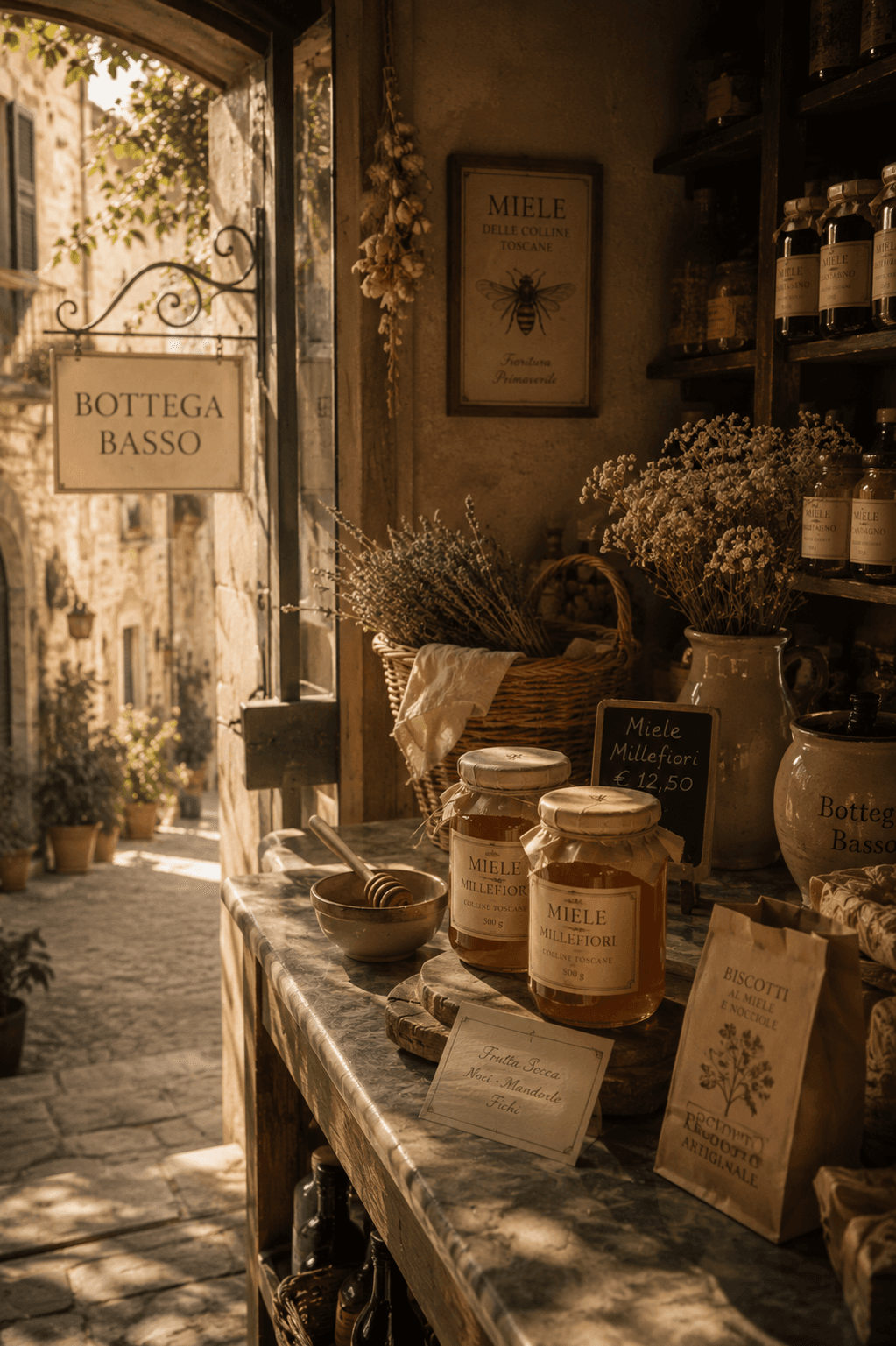
“That jar arrives where it is needed. It is usually inconvenient.”
Bottega Basso was less a shop than a collection of reasons to stay.
Outside, jars of honey stood in the window, each one catching the light differently. Inside, olive oil bottles lined one shelf, paper-wrapped biscuits another. A stack of postcards rested in a wooden tray beside linen napkins, old keys, candles, string, matches, and a small brass bell no one seemed to ring.
Behind the counter stood Basso himself: short, square-shouldered, with kind eyes and the expression of a man who had misplaced nothing in forty years.
Esther placed the honey jar from Casa Alta on the counter.
"I think this belongs to you."
Basso looked at it.
Then at her.
Then back at the jar.
"No."
"Oh. I'm sorry. I thought—"
"It does not belong to me."
"But you recognise it."
"Yes."
He took a cloth from his pocket and polished an invisible mark from the glass.
"That jar was never sold."
The shop seemed to grow quieter.
From the back room came the low hum of a refrigerator, then the soft, mechanical pause of something cooling. Esther glanced through the open doorway. Beneath a wooden shelf, dusted lightly with flour, stood a cream stand mixer, its bowl resting in place as if it had just finished making something tender and important.
Basso followed her gaze.
"Nica borrows my back room when her oven is full."
"Does everyone borrow from everyone here?"
"Only the things that return better."
He set the honey jar on a small saucer and placed a spoon beside it. The spoon reflected the entire shop in a curved, golden miniature.
"This jar," he said, "arrives where it is needed."
"That sounds convenient."
"It is usually inconvenient."
Esther smiled despite herself.
"Livia used it?"
Basso's hand paused on the counter.
"Livia understood it."
"What does that mean?"
"It means she never tried to keep it."
He turned and lifted a box from a lower shelf. Inside were postcards, all showing Cortelume from different angles: the harbour, the piazza, La Scala Bassa, Casa Alta above the fountain. Some were new. Some were old enough to have softened at the edges.
He selected one and slid it toward her.
The front showed Casa Alta with its shutters closed.
Esther stared.
"I've never seen them closed."
"No one liked that summer."
"What happened?"
Basso took too long to answer.
"Heat. Silence. Things left unsaid."
"That is not very specific."
"Specifics are rarely where a story begins."
On the back of the postcard was a line in familiar dark ink.
If the jar returns empty, the house has begun listening.
Esther touched the words.
"When was this written?"
"Three summers ago."
"By Livia?"
Basso did not answer.
A woman entered the shop, bought matches and did not look at Esther once. After she left, Basso wrapped the postcard in tissue and tied it with string.
"You should keep this."
"Why?"
"Because you brought the jar back."
"I thought I was supposed to."
"You were. Most people don't."
He pushed the honey jar toward her again.
"I just returned it."
"No. You showed it to me. That is different."
Esther looked down at the jar. A small amount of honey still clung to the bottom, slow and gold.
"What do I do with it now?"
"Put it on the table."
"At Casa Alta?"
"Where else?"
She carried the jar back through the village. At Fiora & Fig, the woman in the doorway saw it and nodded once. At Forno Nica, the baker gave her a paper bag without asking. Inside was an almond pastry still warm enough to make the bag translucent.
At Casa Alta, Esther set the honey jar on the terrace table.
For a moment, nothing happened.
Then a bee landed on the rim.
It walked slowly around the glass, as if reading something Esther could not see.
She opened the postcard again.
Casa Alta. Shutters closed.
She looked up.
All the shutters were open.
Except one.
At the far end of the upper floor, the smallest window had remained shut. Esther had not noticed it before.

Written by Esther
Esther is a photographer and storyteller, and the founder of Essy's Essentials - a seasonal home for stories, rituals, recipes and everyday luxuries.
More about Esther →