A story from Willowmere
The Ferry She Almost Missed
Nora has one earring in and a ferry to catch. Signe has promised a small fabric sale. Neither has mentioned the phone call that could change their spring.
Set at Willow Quay
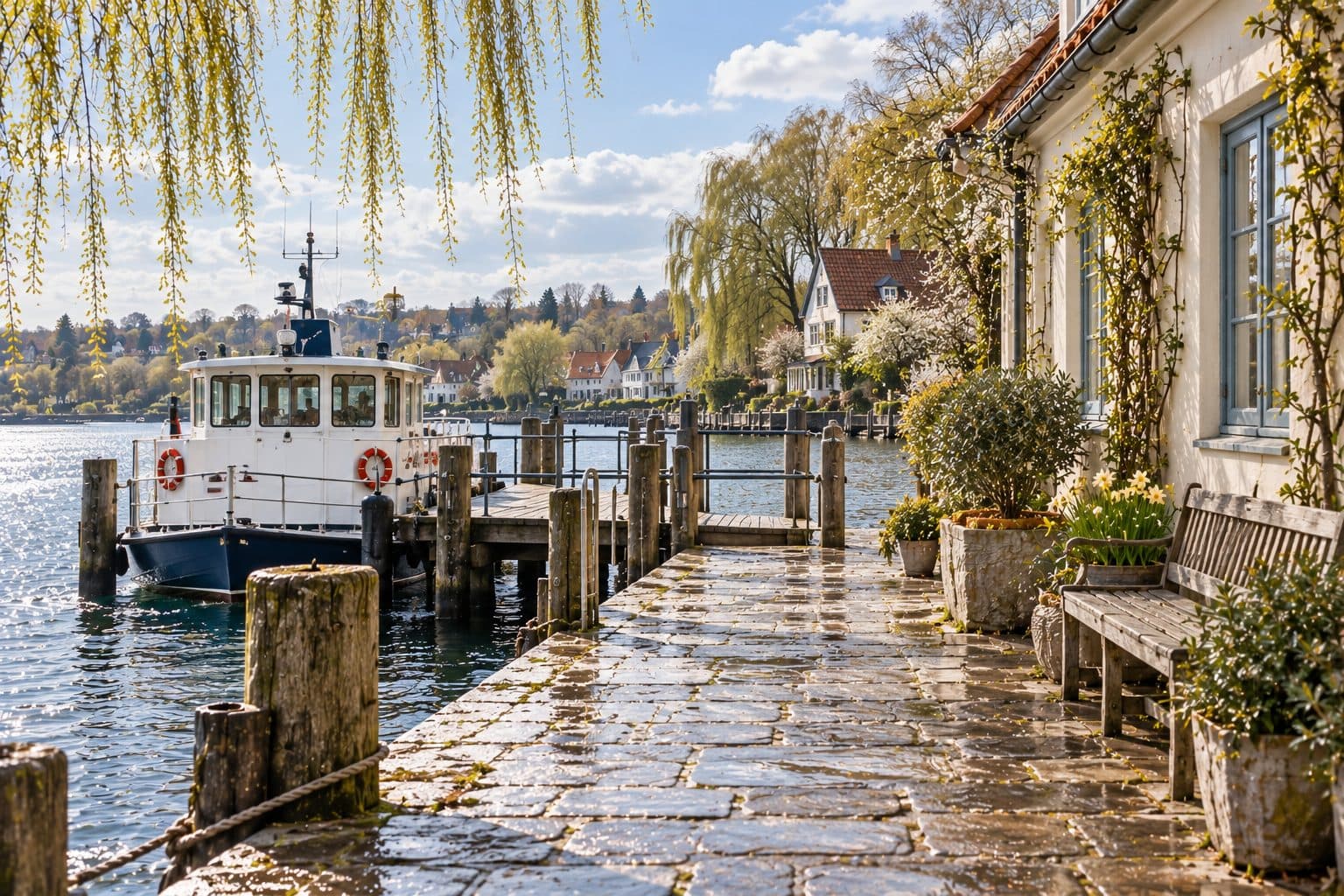
At nine twenty-six, Nora was halfway down Willow Quay with one earring in, a piece of toast in her mouth and the distinct impression that Signe was enjoying herself.
“There's plenty of time,” Signe called from the ferry ramp.
Nora could see the ferryman beside her, looking at his watch.
This seemed a fairly public disagreement about the meaning of plenty.
She swallowed the toast and quickened her pace.
The baker emerged from The Morning Room with a paper bag.
“For the crossing.”
“Can't stop.”
“I noticed.”
She held it out. Nora took it without breaking stride. Behind her, the dog gave a single bark, as though commenting on her technique.
Nora reached the ramp just before the ferryman closed the gate.
“Morning,” he said.
“Yes,” she managed.
Signe took her elbow and guided her towards a seat.
“You look nice.”
“I look unfinished.”
“It's a very good earring.”
The second earring was in her coat pocket, where she had put it while answering a message from a publisher. She found it beneath a receipt, fastened it, then checked her reflection in the dark window beside their seat.
Better.
The ferry pulled away from Willowmere. The blue door of her house slipped behind a row of masts; the bakery window flashed in the sun. Above the quay, the willows were beginning to look properly green.
Nora opened the paper bag.
Two small buns, wrapped separately. On one wrapper the baker had written For the one who had breakfast.
On the other: For the one who said she had breakfast.
Signe selected the second.
“She's terribly suspicious.”
“She's known you longer.”
They ate while the river widened around them.
Nora had been on this ferry dozens of times. Usually she stood near the gate with a work bag, checking a connection or a message or whether she had remembered her charger. Today her phone was in her pocket, and her only obligation was to accompany Signe to what had been described as a small fabric sale, followed by lunch.
“How small?” she asked.
“The sale?”
“The lunch I can assess for myself.”
Signe brushed sugar from her coat.
“One shop. They're clearing a storeroom.”
“And how large is the storeroom?”
“You're asking some very difficult questions for a woman I've just fed.”
The shop stood on a narrow street beyond the landing, behind a window full of folded linen and a faded curtain that Nora immediately wanted for a room she did not have.
Inside, there were three other women, a man measuring velvet and enough fabric to conceal an unpopular building.
Signe went very still.
Nora recognised the expression. She had once worn it in a shop selling old printing blocks.
“I'll give you a moment,” she said.
“Thank you.”
For the next half hour, Signe became wonderfully specific.
She checked seams, held cloth towards the window and asked questions that made the woman behind the counter disappear into the back and return looking pleased. Nora followed at a respectful distance, occasionally entrusted with something described as just hold this that turned out to be several metres long.
It was a pleasure to watch somebody know exactly what she was doing.
Then Signe emerged from behind a roll of striped cotton holding a length of rose-coloured silk against her coat.
“Too much?”
“For what?”
“Undecided.”
“Then I think it's precisely enough.”
Signe smiled and added it to the pile.
Nora bought a remnant of blue linen. She had no plans for it. This seemed to be how it began.
At the counter, Signe's phone lit up. She glanced at the screen, turned it over and asked for a second bag.
Nora offered to carry one.
“You don't have to.”
“I'm beginning to think that was the reason for the invitation.”
“There were several reasons.”
Outside, Signe checked her phone again.
This time she didn't put it away quite so quickly.
They found lunch in a little place with green lamps and tables too small for their purchases.
Signe tucked the bags beneath the bench. Nora ordered an open sandwich, then changed her mind when a plate of warm potatoes went past.
“An excellent decision,” Signe said.
“I like to remain responsive to new information.”
They had just been given their drinks when Signe's phone rang.
She looked at Nora.
“Take it.”
Signe went outside.
Through the window, Nora watched her listen, laugh, then begin talking with one hand. A cyclist passed. Signe stepped aside without noticing him. She was smiling now, properly smiling, and Nora found herself smiling too.
When she came back, she sat down carefully, as though she had brought something breakable to the table.
“They've offered me the summer production.”
“The one in June?”
“Yes. But to run the wardrobe this time.”
Nora put down her glass.
“Signe.”
“I know.”
“The whole thing?”
“The whole thing. Team, fittings, budget, the possibility of a duke splitting his trousers in front of several hundred people. All mine.”
“That's brilliant.”
Signe looked down, smiling at the edge of the table.
“It is, isn't it?”
“Have you said yes?”
“I've asked them to send the details. I want to read the contract before I become unbearable.”
“Very sensible. Shall I order something sparkling in the meantime?”
“Yes, please.”
The waiter brought their food, then two fresh glasses. Signe moved the little vase between them so there was room.
“There's one thing,” she said.
“Of course there is. Tell me it's a difficult hat.”
“They need me earlier. In May.”
Nora paused with her hand on her glass.
“Oh.”
“A few weeks earlier than I thought.”
For a second, Nora pictured Signe's kitchen, the three of them looking for a corkscrew. The dress over the chair in The Glasshouse. Small things she had already begun to assume would keep happening.
Then she looked at Signe, who was watching her far too closely.
“Well,” Nora said, “we'll need to make the most of the time before you go.”
Signe's shoulders dropped.
“I'd like that.”
They touched glasses.
“To the whole thing,” Nora said.
“Even the budget?”
“Especially the budget. You have expensive taste in emergency silk.”
After lunch, they walked down to the water.
There was time before the next ferry. They found a bench facing the river and put their bags between them. Signe unbuttoned her coat. Nora turned her face towards the sun.
“Was that why you asked me?” she said.
“To carry the silk? Partly.”
“To be here for the call.”
Signe considered it.
“I knew they were deciding this week. I thought if I stayed at home I'd spend the entire day moving my phone from one surface to another.”
“You could have told me.”
“I could.” She looked along the water. “I'd told you all I was home until June. I liked saying it.”
“You are home.”
“I know. I also like leaving.”
She said the last part almost apologetically.
Nora nudged one of the fabric bags with her shoe.
“I gathered that from your alarming competence in the shop.”
Signe laughed.
“I missed it. Working with a whole room of people who understand why a cuff matters.”
“I understand why a cuff matters.”
“You do. But you'd reasonably prefer not to discuss one for six hours.”
“I'd need lunch.”
For a while they sat without talking. A boat passed, leaving a line of small waves that reached the steps below them.
“She'll miss you,” Nora said at last.
“I know.”
“So will I.”
Signe turned towards her.
“We've only just got started,” Nora added. “I haven't even seen the rest of your shoes.”
“You may need to clear a weekend.”
Nora smiled.
“Tell her when we get back.”
Signe nodded, then drew the rose-coloured silk from the top of a bag and let a little of it unfold across her knees.
In the sunlight, it was almost copper.
“I could make something for myself before I go.”
“Something for the first night?”
“Perhaps.”
Nora pictured it: Signe in a crowded theatre foyer, wearing that colour, looking for someone she knew.
“When do the tickets go on sale?” she asked.
Signe's hand stopped on the fabric.
“Would you come?”
“Send me the date.”
“I will.”
She folded the silk carefully back into the bag.
“You'd need to wear both earrings.”
On the return crossing, Signe sat by the window while Nora went outside.
The air was cooler on the open deck. Ahead, Willowmere was gathering itself into familiar shapes: the quay, the pale houses, the dark blue square of her door.
The ferryman came past to check something near the gate.
“Good day?” he asked.
“Very. Expensive for one of us.”
He looked through the window at the bags.
“Shall I get the trolley?”
“Best not. She'll take it as a challenge.”
He smiled and carried on.
When they stepped ashore, the baker was outside shaking crumbs from a cloth. The dog stood beside her, monitoring the landing.
“Well?” she called.
“A very small sale,” Nora said, lifting her bag.
“I see.”
Signe put down her purchases.
“I've got some news.”
The baker folded the cloth slowly.
Nora watched Signe tell her. Saw the quick glance towards the river when she mentioned May. Then the baker stepped forward and hugged her, hard enough to trap one of the paper handles between them.
“You clever thing.”
Signe closed her eyes for a moment.
The dog investigated the unguarded bags.
“Coffee,” the baker said, letting go. “Come inside. You can tell me everything.”
“I have the contract coming.”
“Bring that too.”
She opened the door and held it with her foot while they lifted their purchases.
“And Nora?”
“Yes?”
“Did you catch your ferry?”
Nora looked at her.
Signe began to laugh.
“Just,” Nora said, and followed them in.
Written by Esther
Esther is a photographer and storyteller, and the founder of Essy's Essentials - a seasonal home for stories, rituals, recipes and everyday luxuries.
More about Esther →