A story from Willowmere
A Table Among the Pots
Three women arrive at The Glasshouse with three different plans for the same table. There will be coffee. There may be a small misunderstanding.
Set at The Glasshouse
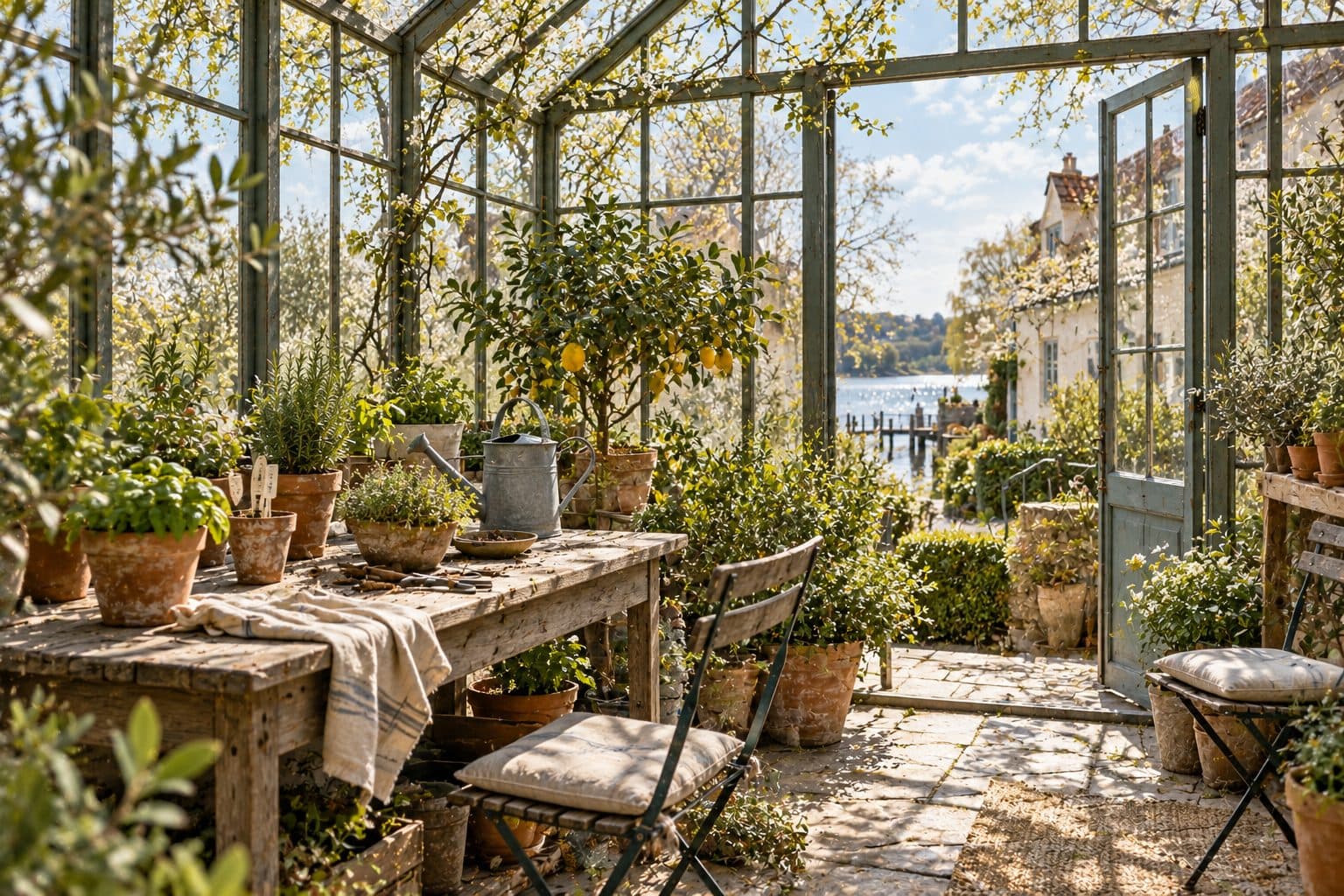
Nora realised they had misunderstood one another when Signe put a sewing machine beside the parsley.
“What's that doing here?” she asked.
“At the moment? Compressing a leaf.”
Signe lifted the machine. The baker rescued the parsley.
They looked at the table.
At one end stood twelve terracotta pots and a bag of compost. At the other, Nora had laid out a sheet of pale blue card, a cutting mat and a little brass ruler. Between them, Signe had placed a sewing basket, a green dress and an extension lead of improbable length.
“I thought we were doing the labels,” Nora said.
“We are,” said the baker.
“I thought we were doing a few repairs,” Signe said.
“We are.”
The baker glanced down at her plants.
“I may have said yes to everything.”
The idea had begun over takeaway the previous Saturday, in Signe's kitchen.
There had been noodles, two bottles of wine and a corkscrew that took longer to find than anyone wanted to admit. Signe had opened cupboards with increasing optimism until the baker reached into a drawer and produced it.
“You haven't moved anything,” she'd said.
“Apparently I've forgotten where I didn't move it.”
Later, Signe had mentioned the pile of clothes waiting to be mended. Nora had mentioned the handwritten signs in The Glasshouse, some of which could only be read by the person who had written them. The baker had mentioned the herbs crowding her kitchen windowsill.
“We could use the big table,” she'd said.
“Sunday?” Nora had asked.
“The following one. Two o'clock.”
An excellent arrangement. Specific. Sensible. Entered into three calendars.
What it lacked, Nora now appreciated, was an agreed purpose.
“We can fit,” Signe said.
She moved the dress onto the back of a chair and rearranged the sewing basket. Nora slid her cutting mat towards the end of the table. The baker put the compost on the floor.
The dog immediately sat on it.
“That's probably fair,” said Nora.
Outside, a fine rain had started, making soft little ticks against the roof. Inside, The Glasshouse was bright enough to work without a lamp. The lemon tree stood by the far wall, its single fruit still attached, beneath a new leaf that had appeared during the week.
Nora took off her coat. She had been looking forward to this.
On Friday she had finished a complicated set of cover revisions. On Saturday she'd bought the card, chosen a blue pencil and drawn a tiny border of willow leaves. Nothing a client had asked for. Nothing anybody needed to approve. Just something she wanted to make for a place she liked.
She laid out her first finished label.
Signe leaned over.
“Oh, that's lovely.”
It said Parsley in dark blue lettering, with a small illustration beneath it. Nora had left generous space around the word. She liked things to have room.
The baker came round to look, wiping her fingers on her apron.
“You drew that?”
“Yesterday.”
“Nora.”
There was enough pleasure in her voice to make the whole of Saturday worthwhile.
Then the baker picked up a pot.
“Where does it go?”
Nora indicated the little wooden stand she'd brought.
“Beside it.”
“And when I move the pot?”
“You move the label.”
“Right.”
It was a perfectly ordinary word. Nora would later feel that it had been responsible for quite a lot.
For twenty minutes, everything worked.
Signe threaded her machine. The baker eased little plants out of their old containers. Nora drew rosemary, which was considerably less cooperative on paper than it appeared to be in a garden.
The dog slept with his chin on the compost bag.
“Who owns the dress?” Nora asked.
“I do,” Signe said. “It has spent two years being almost wearable.”
“What was wrong with it?”
“Sleeves. I bought it for the pockets and ignored all available evidence about the sleeves.”
She held it up. It was a good green, soft and slightly faded, with an old-fashioned row of buttons down the front.
“Can you fix it?”
“I can. The difficulty was persuading myself I deserved the same service as a duke's trousers.”
The baker laughed and reached for the watering can.
Nora saw what would happen a moment before it did.
“Careful—”
A thin stream of water struck the table, ran beneath the parsley pot and reached the little blue card.
The corner darkened.
The baker put the can down.
“Oh.”
Nora lifted the label. Water had travelled up through the paper. One edge of the border was beginning to blur.
“I can make another.”
“I'm so sorry.”
“It's all right.”
She blotted it with a tissue. It looked worse.
The baker glanced at the remaining sheets.
“Perhaps they're a bit too lovely for this.”
Nora stopped blotting.
“For what?”
“For watering and dirt. You know.”
“I do know what a plant does.”
The sewing machine fell quiet.
Rain tapped the roof.
Nora wished, almost immediately, that she had said something else.
“That came out badly,” the baker said.
Nora set the card down.
“So did mine.”
Signe reached across the table, moved the remaining paper away from the pots, and placed a clean saucer beneath the wet label.
“There,” she said. “At least nothing else has to suffer while you sort it out.”
Nora laughed, a little unwillingly.
The baker pulled out a chair.
“I love them. I do. But I was picturing something I could stick in a pot and forget about.”
“You could have said that.”
“I thought I had.”
Nora looked at the card, the brass ruler, the tiny willow leaves. She had drawn them before asking a single useful question.
“You said labels,” she admitted.
“Yes.”
“And I heard an entire stationery collection.”
“It would be an excellent collection.”
“The parsley would need to stop being so damp.”
The baker smiled. Nora nudged her knee beneath the table.
“Show me what you need.”
What the baker needed turned out to be six small markers, readable from a standing position, that would stay with the plants when she moved them.
There were wooden plant sticks in the drawer under the workbench. There was a pencil on the windowsill, blunt enough to have been used for light excavation.
Nora examined it.
“I have some professional objections.”
“Can they be sharpened out?” Signe asked.
They could.
Nora wrote the plant names in firm, clear capitals. The baker stood back to test them. They made one word larger, turned another marker sideways and spent several minutes discussing where she would actually put the pots.
This part was familiar: finding out how somebody would use a thing. Nora enjoyed it enough to feel faintly ridiculous for having skipped it.
While they worked, Signe turned the green dress inside out and called Nora over.
“Pin this?”
Nora held the folded fabric in place.
“Like that?”
“A little higher. Thank you.”
Up close, the stitching was almost invisible. A narrow length of blue fabric lay inside the cuff.
“Will anyone see that?” Nora asked.
“I will.”
Nora smiled.
“Fair.”
Across the table, the baker pulled her apron over her head.
“Since you're doing repairs.”
Signe held it up. One pocket had detached itself at the corner. The other contained a receipt, three coins and a dog biscuit so old it appeared to have become structural.
“How long has it been like this?”
“Not long.”
“Was I here?”
“Possibly.”
Signe gave her a look and reached for her scissors.
By four, the rain had stopped and the table was a disgrace.
There were scraps of thread beside an empty pot, soil on Nora's tissue, two teaspoons nobody remembered bringing and a green sleeve draped over the back of a chair like an exhausted guest.
The plants, however, were thriving in their new arrangements. The apron had two functioning pockets. Signe stood in front of a darkened pane, trying on the dress over her clothes.
“Well?” she asked.
Nora considered her.
“The trousers underneath are a bold choice.”
Signe put both hands into the pockets and turned sideways.
“I'm keeping it.”
The baker had gone to fetch coffee. Left alone for a moment, Nora looked at the pale blue card drying in its saucer. The parsley illustration was intact. Only the lower border had blurred, a small cloud of blue where there had been leaves.
She trimmed off the damaged edge.
Then she turned over a clean sheet and began to draw.
When the baker returned, Nora held up a little sign.
The Glasshouse.
Beneath it, a few willow leaves. Plenty of room around the words.
“For the shelf,” she said. “Above the watering.”
The baker put down the tray.
“I know exactly where.”
She placed it between two empty pots on the high shelf, then stepped back to check it was straight.
“There.”
Signe took a photograph.
“Of the sign?” Nora asked.
“Of all of it. You said you forgot last time.”
She showed them the screen: the shelf, the plants, the table, the baker with a coffee in each hand. Nora stood at the edge of the picture, looking up at her work. Beneath the table, the dog had woken and was nosing an empty shoe.
It was Signe's.
She looked down at her stockinged feet.
“Don't start. I wore the gardening ones.”
The baker handed Nora a cup.
For a moment, they admired the photograph together.
Then Signe slipped her phone into one of the dress pockets and went to retrieve her shoe.

Written by Esther
Esther is a photographer and storyteller, and the founder of Essy's Essentials - a seasonal home for stories, rituals, recipes and everyday luxuries.
More about Esther →