A story from Willowmere
The Chair in the Sun
One coffee. One book. The best chair outside The Morning Room. Nora's Saturday is going beautifully—until someone comes to claim her seat.
Set at The Morning Room
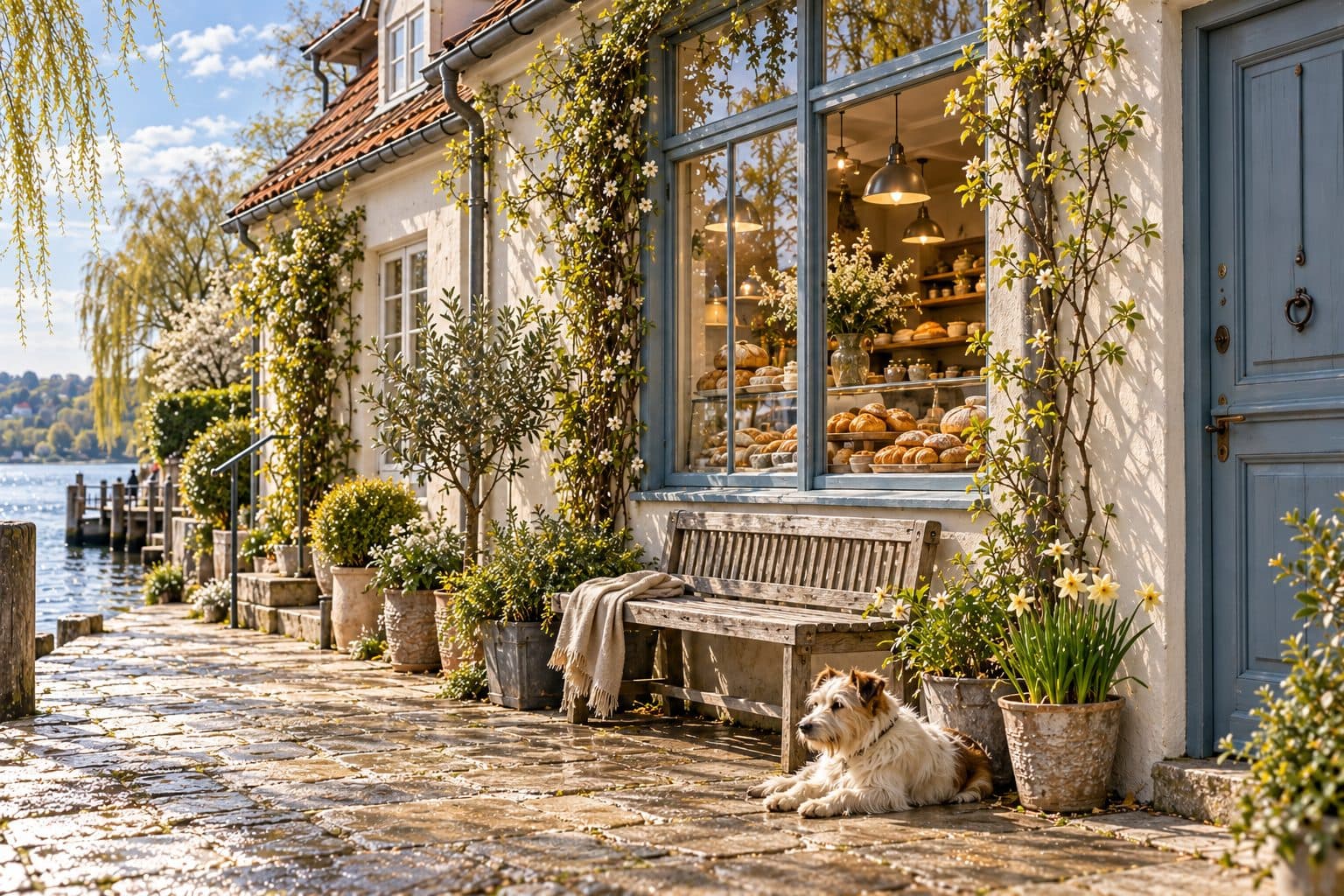
The trouble began with a woman in silver boots.
Until she arrived, Nora's Saturday had been going beautifully. She had helped move a bench, eaten an entire cardamom bun and secured the best chair outside The Morning Room. Her coffee was on the table. Her book was open. For the first time that year, she could feel the sun through her sleeves.
Then the woman stopped beside her and said, “Oh. You're in my chair.”
Nora looked up.
The boots were excellent. This was annoying, because she would have preferred to dislike everything at once.
“Am I?”
The woman glanced at the chair, a wooden one with faded yellow paint and a slightly uneven back.
“I think so.”
Nora had spent the morning lifting things. She had worn the wrong bra for it. She had earned this chair in ways this woman could not possibly understand.
“There's another one inside,” she said.
“Yes, but—”
The bakery door opened behind them.
“Oh, good,” said the baker. “You've met.”
Neither woman looked particularly convinced.
Two hours earlier, Nora had arrived at the garden behind The Glasshouse to find the bench considerably longer than advertised.
“Nothing heavy,” she reminded the baker.
“It isn't heavy. It's awkward.”
“That distinction is doing a lot of work.”
Between them, they had coaxed it out from behind the shed and into the garden, where one leg sank promptly into the soft ground.
They looked at it.
The dog climbed onto the higher end.
“He likes it,” said the baker.
“He likes the Titanic arrangement of it.”
They found two flat stones, levelled the bench and sat down to assess their work. Through the open Glasshouse door, last night's table stood cleared and wiped, the mismatched chairs tucked around it. The lemon tree had survived its first night without losing its final lemon.
“We should have taken a photograph,” the baker said.
“Of supper?”
“Everyone looked so lovely.”
“The ferryman had butter on his cuff.”
“Especially him.”
Nora smiled. She had liked that, too: the moment when he noticed, looked around for something to wipe it with, then quietly folded his sleeve.
The baker stood, brushed her hands on her trousers and offered Nora an arm up.
“Coffee?”
“And my bun.”
“I remember the terms.”
Back at The Morning Room, she put a whole cardamom bun on a plate and set it before Nora with the ceremony of presenting a small national award.
“There.”
“I'd like to thank my shoulders.”
The baker laughed and went back behind the counter.
Nora carried her breakfast outside. The yellow chair stood at the little table beside the window, exactly where the sun reached first. She had passed it all winter, often wet, occasionally overturned by the wind, always looking as though it belonged to a more enjoyable month.
Today it looked available.
She sat down.
For twenty glorious minutes, it was hers.
“Nora,” the baker said now, “this is Signe. Signe, Nora.”
Signe tucked her hands into her coat pockets.
“I didn't mean you had to get up.”
“You did open quite strongly,” Nora said.
“It's literally her chair,” the baker explained. “She lent it to me.”
There was a small pause.
Nora closed her book around a finger.
“Ah.”
“Two summers ago,” Signe said. “I said I'd collect it the following week.”
“I've stopped dusting your name off it,” said the baker.
Nora stood so quickly that her bag slid off her knee. Signe caught it before it reached the pavement.
“Please sit down,” Signe said. “I only wanted to see whether the paint was still holding.”
“Better than my manners.”
“Mine could have used a second coat.”
They looked at each other, then laughed.
The baker, satisfied that nobody would need separating, went inside and returned with another chair. It was blue, with a seat cushion that had once been striped and was now making a subtler claim.
“Coffee?” she asked Signe.
“Please.”
“Staying long?”
Signe pulled out the blue chair.
“I haven't decided.”
Signe had been away working on costumes for a theatre. She said this without ceremony, as though she might equally have been working on invoices.
Nora, who had spent the previous evening drawing blues on a napkin, immediately had questions.
“Period costumes?”
“Mostly. Although last month I made a nineteenth-century duke three identical pairs of trousers because he kept splitting them.”
“Was that part of the performance?”
“It became quite popular.”
Signe unbuttoned her coat. Beneath it, she wore a green cardigan with one pink button.
Nora tried not to stare at the button.
“Lost the original,” Signe said.
“I was admiring it.”
“Good. That's the official version.”
The baker brought her coffee and a bun, then hesitated beside the table.
Signe looked up.
“You can ask.”
“Are you home?”
The word sat between them for a moment. From inside came the hiss of milk steaming, followed by someone thanking someone else for holding the door.
“For a while,” Signe said. “I've got another production in June. Until then, I'd like to see what my garden has been doing behind my back.”
The baker's face changed so quickly that Nora had to look down at her cup.
“Well,” she said. “You'll need more than those boots.”
“I have others.”
“They all shine.”
“I like to give the weeds a sense of occasion.”
The baker laughed, squeezed her shoulder and went inside.
Nora watched her disappear behind the counter.
“She didn't know you were coming.”
“I wanted to surprise her.” Signe broke a piece off her bun. “Then I got nervous on the ferry, which was inconvenient. There's nowhere to pace.”
“You could have brought a tree. Keeps everyone occupied.”
Signe looked at her.
“I'll explain.”
By the time Nora had finished the story of the lemon tree, the dog had arrived beneath their table.
He inspected Signe's boots, appeared to recognise them and sat on one.
“Hello, darling,” she said, bending to scratch behind his ears.
“He was saving that greeting,” Nora said. “I got a stolen glove.”
“We have history.”
Signe told her about the chair. She had painted it in her kitchen with the windows open, knocked a tin of yellow paint over and spent the rest of the afternoon removing tiny paw prints from the hall.
“His?”
“He was visiting.”
Nora looked down. The dog looked back with a composure she could only admire.
“Of course he was.”
They talked about work, then shoes, then the peculiar confidence required to buy a coat online. Signe asked about Nora's book. Nora admitted she had been on page thirty-eight for most of the morning.
“Is it bad?”
“No. That's what's so frustrating. Everyone keeps being interesting.”
Signe grinned.
After a while, the bakery door opened and the baker came out carrying her own coffee.
She had taken her apron off.
Signe immediately moved her bag from the spare chair.
“You kept the yellow one,” she said.
“Obviously.”
“You hated that colour.”
“I said it was cheerful.”
“You said it was cheerful in a threatening way.”
The baker sat down.
“It grew on me.”
For a few minutes, Nora listened. The two women had the easy shorthand of people who had once known each other's days in detail. There was an old dispute about a birthday cake. A neighbour who apparently still owed Signe a ladder. Someone called Henrik whose wedding trousers had been let out three times before the ceremony.
“Nerves,” Signe said solemnly.
“Cheese,” said the baker.
Nora laughed into her coffee.
Then the baker turned to her.
“Tell her about your blue.”
“My blue?”
“For the cover. She'll understand.”
Signe leaned forward.
“How many did you try?”
Nora put her book on the table.
“Well.”
At some point, the sun moved.
Nora noticed when the shade reached her wrists. She shifted her cup into the remaining patch of warmth, then looked across the quay. There was still sunshine by the wall, several feet to their left.
Signe followed her gaze.
“Shall we?”
They lifted the little table. The baker brought the cups. Nora moved the blue chair; Signe took the yellow one. The dog waited until every piece of furniture was settled before placing himself exactly where the fourth chair would have gone.
“He's always had an eye for a room,” Signe said.
The baker looked towards the ferry landing, where a few passengers were gathering for the next crossing.
“Do you need to catch that?”
“No.” Signe settled into the yellow chair. “I've got my keys.”
The baker smiled into her cup.
Nora opened her book again. This time she made it to the bottom of the page before Signe spoke.
“What are you both doing tonight?”
Nora kept her place with a finger.
“That depends. Does it involve carrying anything?”
“Only takeaway. I have a kitchen, but I wouldn't make any promises about what's in it.”
“There's probably your ladder,” said the baker.
Signe laughed. “Seven?”
“Seven,” Nora said.
She reached into her bag for a bookmark, found her receipt and slipped it between the pages.
Thirty-nine.
A respectable morning's reading, under the circumstances.

Written by Esther
Esther is a photographer and storyteller, and the founder of Essy's Essentials - a seasonal home for stories, rituals, recipes and everyday luxuries.
More about Esther →