A story from Willowmere
The First Open Window in Willowmere
Nora has finished work for the week. Then a lemon tree arrives on the ferry, and her quiet Friday takes a rather lovely detour.
Set at The Blue Door
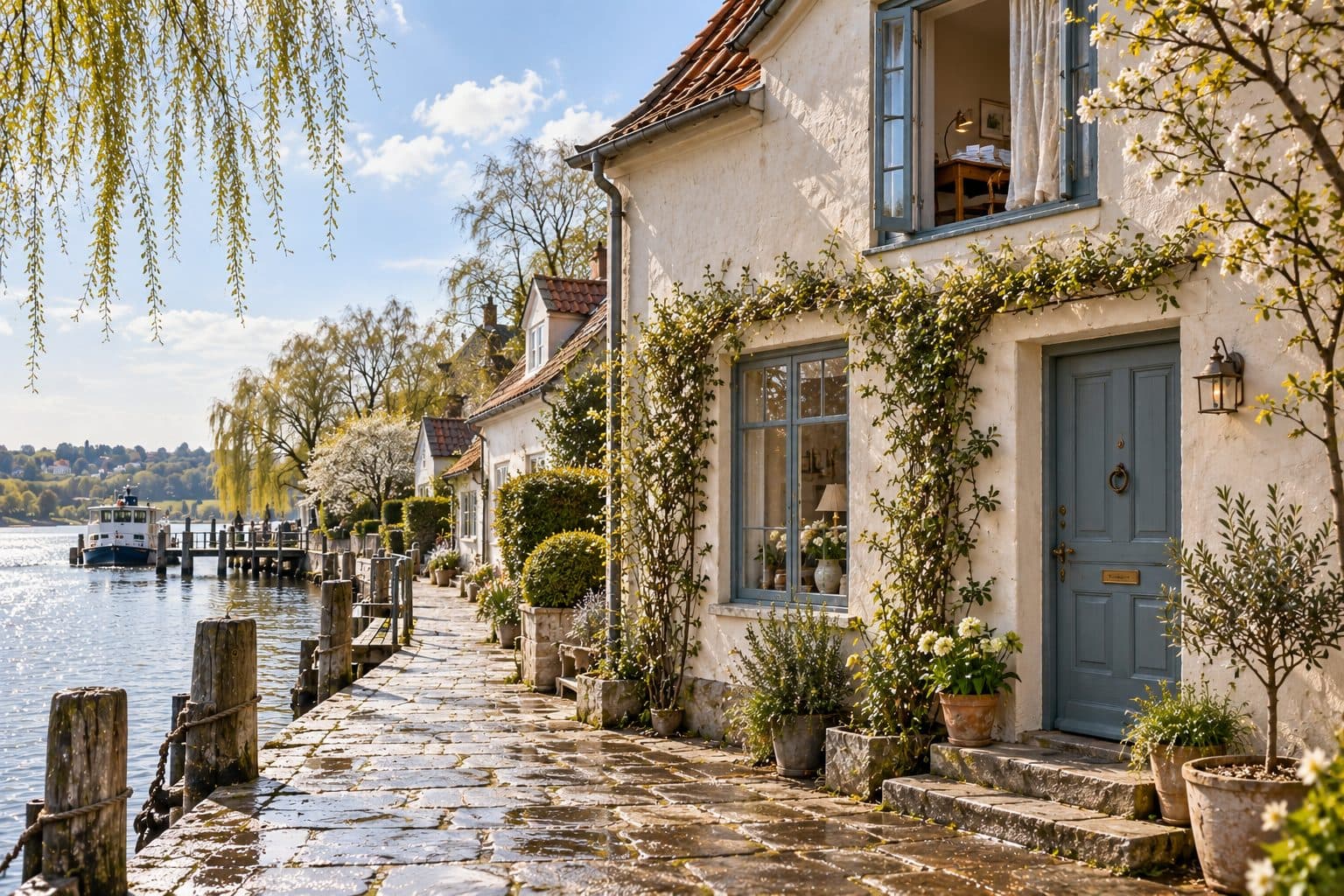
At four seventeen on Friday afternoon, Nora sent a book cover to Copenhagen, opened her window, and heard someone shout, “Mind the lemons.”
She leaned out.
Below, on Willow Quay, the owner of The Morning Room was walking backwards up the ferry ramp with a tree in her arms. At the other end of its enormous terracotta pot, the ferryman was making the face of a man reconsidering his profession.
“You said a small tree,” he said.
“It was small when I bought it.”
“When was that?”
“Does it matter now?”
Nora looked at her desk. Three versions of the same blue lay beside her keyboard. She had spent forty minutes choosing the right one and would cheerfully defend every minute. The author had just replied: That's it. That's my book.
A very good end to the week.
Outside, a lemon dropped into the river.
“Coming,” she called.
She changed out of her slippers, caught sight of herself in the hall mirror, and removed the pencil from her hair. After a moment, she put it back. There were limits to the transformation required for carrying shrubbery.
By the time she reached the quay, the tree was on dry land and the bakery dog had planted himself directly in its proposed route.
He was a small, rough-haired terrier with dark ears and an expression of mild administrative concern. Nora knew that expression. It usually meant someone had put a chair where he intended to sleep.
“Your dog is helping,” she said.
“He's supervising.” The baker shifted her grip. “Could you take this side?”
Nora took it.
The pot weighed approximately as much as her desk.
“Where are we going?”
“The Glasshouse.”
“Wonderful. I was afraid you might say somewhere nearby.”
They made it six steps before stopping.
Behind them, the ferryman rubbed his hands together with the satisfaction of someone whose involvement had legally ended.
“Try the trolley,” he said.
There was a trolley beside the ferry shed.
Nora looked at it. The baker looked at it.
“We were getting to that,” the baker said.
The way to The Glasshouse ran through a narrow passage behind the houses, past a stack of empty crates and a bicycle with a basket full of gardening gloves.
Nora steered. The baker walked ahead, holding back branches and offering encouragement that became less useful whenever the wheels met a stone.
“Nearly there.”
“You said that at the drainpipe.”
“It was true then, too.”
The dog trotted behind them carrying one of Nora's gloves. Nobody had seen him take it. Nobody had a free hand to negotiate.
Beyond the passage, the garden opened into afternoon light.
Nora stopped.
The Glasshouse had been shut through the winter. She had passed its cloudy panes often enough on her way to the river path, usually with her collar up and something else on her mind. Now the door stood open. Two roof vents were tilted towards the sky. Someone had washed the glass, swept the floor and set a row of little herb pots along the workbench.
Inside, sunshine fell across a wooden table long enough for eight.
“Oh,” she said.
The baker glanced back, suddenly less brisk.
“Too much?”
“What?”
“The table. I had to take the legs off to get it through the door.”
Nora wheeled the tree inside. It smelled of damp earth, clean timber and the sharp green scent of something newly watered.
“No,” she said. “Exactly enough.”
The baker smiled and immediately busied herself with a loose piece of string around a branch.
They settled the pot beside the far wall. One lemon remained attached. It hung at eye level, bright and magnificent, as though it alone had arranged the journey.
Nora retrieved her glove from beneath the dog.
“So,” she said. “What's the occasion?”
“Supper. Here. Tonight.”
“Tonight tonight?”
“Is there another sort?”
Nora inspected the table. There were three chairs around it and a fourth upside down in a corner.
“How many people?”
“Six, perhaps. I haven't asked anyone.”
“I admire the confidence of the tree purchase.”
The baker picked a dry leaf from the soil.
“I've been saying I'll open this place again since February. Then it needed cleaning. Then the weather was wrong. Then I thought I should have proper chairs.” She looked at the upside-down one. “Apparently I can keep finding reasons.”
Nora knew her as the woman who could take four coffee orders, rescue a tray of buns and remember whose mother preferred the end of the loaf. It was oddly touching to discover that she, too, could be defeated by an invitation.
“Ask me,” Nora said.
The baker looked up.
“Would you like to come to supper?”
“Yes. I'll bring two chairs.”
“Matching?”
“Let's not lose momentum.”
At The Morning Room, preparations began with coffee and half a cardamom bun each.
The baker cut it down the middle, considered the two pieces, and gave Nora the larger one.
“Payment for the tree,” she said.
“I'll send an invoice for the stairs.”
Outside the bakery window, the river flashed silver between passing coats. A woman stopped to untangle her scarf from the handle of her shopping basket. On the bench, the dog had found a strip of sun barely wider than himself.
The baker went out and moved his blanket into it.
“He could move the blanket himself,” Nora said when she returned.
“And put me out of a job?”
They wrote a supper list on the back of a flour delivery note. Bread. Potatoes. Something green. Butter appeared twice and was allowed to stay.
“I'll make the potatoes,” Nora said.
“Can you cook?”
“You have eaten at my house.”
“You assembled a very beautiful plate.”
“Those pears didn't slice themselves.”
The baker laughed, a proper laugh that made the woman at the next table glance over and smile without knowing why.
Then she turned the delivery note over again.
“I should ask the others.”
“You should.”
“What if they're busy?”
Nora pushed the last bite of her bun towards her.
“Then we have an alarming amount of bread and a private lemon.”
At half past six, Nora returned to The Glasshouse with warm potatoes, two folding chairs and earrings.
The earrings were unnecessary. She had worn them anyway.
The garden had cooled, but inside the glass still held a little of the day's warmth. The table was laid with plates from the bakery, jam jars of early garden cuttings and napkins that seemed to have come from several unrelated households.
The ferryman arrived with smoked fish.
“I understand there's a tree I can sit down near,” he said.
Two neighbours followed, one carrying a bowl, the other a chair she claimed was comfortable if you approached it correctly. Someone opened a bottle. Someone else went back for a jumper.
The baker stood at the end of the table with a loaf against her apron, counting heads.
“Six,” Nora said quietly.
“I can see that.”
“Just checking you weren't waiting for the proper chairs.”
The baker nudged her with an elbow.
They left the door open while the sun still reached the threshold. Outside, the willow tips stirred above the wall. A little farther away, the ferry bell rang across the quay.
Nora passed the potatoes. The ferryman took a second helping before anyone had taken a first, apologised, and passed them on with visible reluctance.
Conversation moved easily: a missing parcel, a disastrous haircut, whether the new ferry timetable was an improvement or a personal attack. Nora described the cover she had finished that afternoon, and the woman beside her asked what made one blue right and another wrong.
Nora reached for a napkin and her pencil.
“How long have you got?”
“Until the potatoes run out.”
Beneath the table, the dog settled on the ferryman's shoe.
“Does he want something?” he asked.
“For you to stay still,” said the baker.
So he did.
Later, when the plates were mostly empty, Nora noticed the baker sitting back in her chair. Her apron was draped over the spare one. For once, nothing was being carried, sliced or checked.
“Good?” Nora asked.
The baker looked along the table.
“Very.”
For a while they sat like that, listening to the others discuss the haircut.
Then the baker leaned closer.
“Are you doing anything tomorrow?”
“That depends. How heavy is it?”
“Nothing heavy.”
“You hesitated.”
“There's a bench behind the shed.”
Nora laughed so suddenly that the dog raised his head.
Above them, the last lemon glowed in the evening light. Through the open door, she could see the upper window of her house, still ajar, its curtain lifting a little in the breeze.
She would go home soon. Wash the potato dish. Read in bed. Tomorrow there would be coffee, and apparently a bench.
“Ten o'clock,” she said. “And a whole bun this time.”
The baker held out her hand.
Nora shook it.
Under the table, the dog put his head back on the ferryman's shoe.
Nobody was going anywhere just yet.

Written by Esther
Esther is a photographer and storyteller, and the founder of Essy's Essentials - a seasonal home for stories, rituals, recipes and everyday luxuries.
More about Esther →