The Working Life Edit
You Plan Your Working Life. What About the Life You’re Working For?
Your working week has deadlines. Your own plans deserve a place in the diary, too.
6 min read
The meeting is in the diary. The paper has a deadline. Someone is expecting your answer by Thursday.
Then there is the trip you keep looking at, the conversation about your next role, and the beautiful thing you have wanted for long enough to know it is more than a passing fancy. Those plans are still waiting for a quieter month.
Learning to plan career and personal goals together begins with giving those quieter plans a little structure. Work already has people, dates and consequences attached to it. The things you want for yourself often have only you.
You can enjoy your work, care about doing it well and still want to see where your time and money are taking you outside it. That is the question worth making room for: what would you like the life around your work to contain?
Begin with the version of success you actually want
A next step can mean more responsibility, a different kind of work or the chance to develop an interest you have barely had time to explore. It can also mean choosing to stay where you are while making the rest of your life richer.
Before making a list, finish this sentence:
“Over the next year, I would like more room for…”
Be specific enough to recognise the answer when it arrives. More room for travel might mean taking two uninterrupted weeks away. Professional growth might mean leading a project in a field that interests you. More enjoyment might mean saving for a particular purchase and having the pleasure of choosing it deliberately.
There is no requirement for every answer to sound impressive. A goal is useful when it reflects something you want, rather than something you feel obliged to want.
Put ambition, money and time on the same page
These three parts of life affect each other. A course needs time as well as funding. A holiday needs leave as well as a savings pot. A new role may change both your income and the amount of energy you have at the end of the day.
Try choosing one priority in each of these areas. Three is a starting point, not a rule. If one substantial plan already needs your attention, give it that attention. You can leave the others for a later season.
| A possible priority | The question to answer | |
|---|---|---|
| Career | Explore a role with more scope | What experience or conversation would help me move towards it? |
| Money | Save for a particular trip or purchase | What amount can I realistically set aside after existing commitments? |
| Time | Take a proper break | Which dates need protecting before the diary fills up? |
Make the next step smaller than the ambition
“Move forward in my career” is difficult to put in a diary. “Ask what experience I need for the role I am interested in” gives you somewhere to begin.
The same applies to personal plans. You do not have to book the whole trip today. You could check leave availability, estimate the full cost or agree which month would work. Each answer makes the next decision easier.
For each priority, write down four things:
- What you want to happen.
- Why you want it.
- The next action you can take.
- When you will return to it.
That last date matters. Some plans need a deadline; others simply need another look once you have more information. Giving a decision a review date allows you to stop carrying it around in your head.
Give the lovely things a considered place
A handbag you have admired for years. A room with a view worth travelling for. A few nights somewhere you can genuinely switch off.
There is room to take pleasure seriously. There is also room to ask whether a particular purchase still feels worth its cost, what else you want your money to do and whether you would rather wait.
For something you decide to save towards, give it a name and a realistic amount. Include the costs around it where relevant: travel, meals or alterations can be part of the decision, too. Then choose a contribution that fits your circumstances. A target date can move if the original plan asks too much of the month.
If you want to explore that approach further, The Beautifully Organised Savings System explains how separate pots can give different plans their own place.
The useful outcome is being able to make a deliberate choice. Sometimes that will be buying the thing. Sometimes it will be discovering that you would rather put the money somewhere else.
Keep a record of the work you want to build on
Alongside the things you want next, keep a few notes about what you are already doing.
When you finish a piece of work that matters, record your contribution and what changed as a result. Include a useful piece of feedback or a measure of the outcome where you have one. Be clear about what was yours and what belonged to the team.
“Helped with the project” tells you very little several months later. “Brought the teams together to agree the handover, clarified ownership and resolved the open decisions” gives you something concrete to discuss.
Keep confidential work information in the appropriate workplace system. Personal notes can describe your contribution without copying sensitive documents, names or figures into a private planner.
This small record can help you see what you enjoy, where you are growing and which examples you want to bring to a development conversation.
Return to the plan without turning it into another job
You do not need to revisit every goal every day. Choose a point in the week when it makes sense to look ahead, then ask:
- What moved forward?
- What needs an answer or a follow-up?
- Which action deserves space next week?
- Does the plan still fit the time, money and energy I have?
An unexpectedly busy week may mean postponing something. A change of interest may mean letting a goal go altogether. Keeping a plan current is more useful than keeping it untouched.
Finish by placing the next action where you will actually see it. That might be your calendar, a reminder or the list you already use. You can then close the plan and get on with your evening.
A place for the life around your work
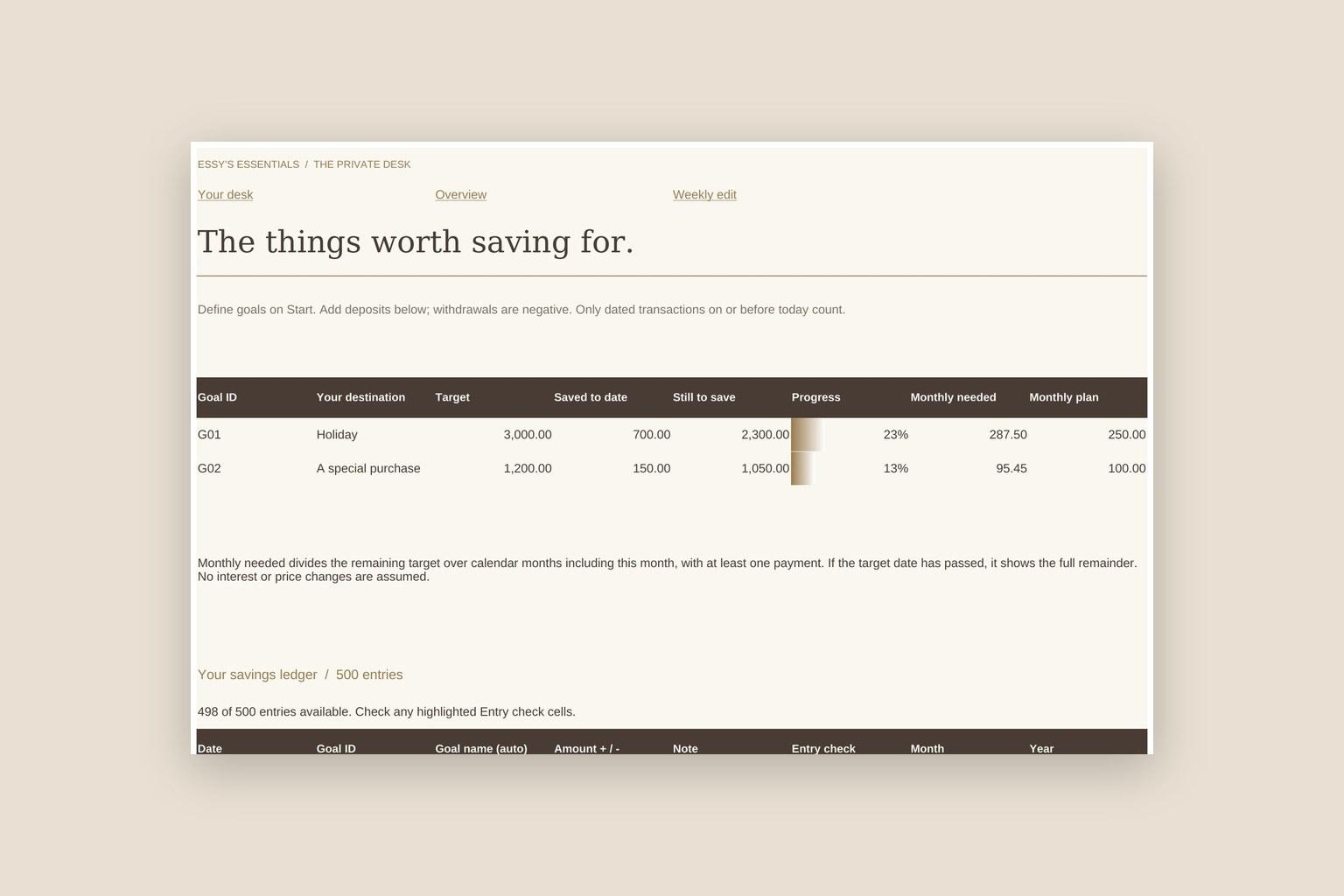
This is why I created The Private Desk: a considered place for career plans, savings goals and the life around them.
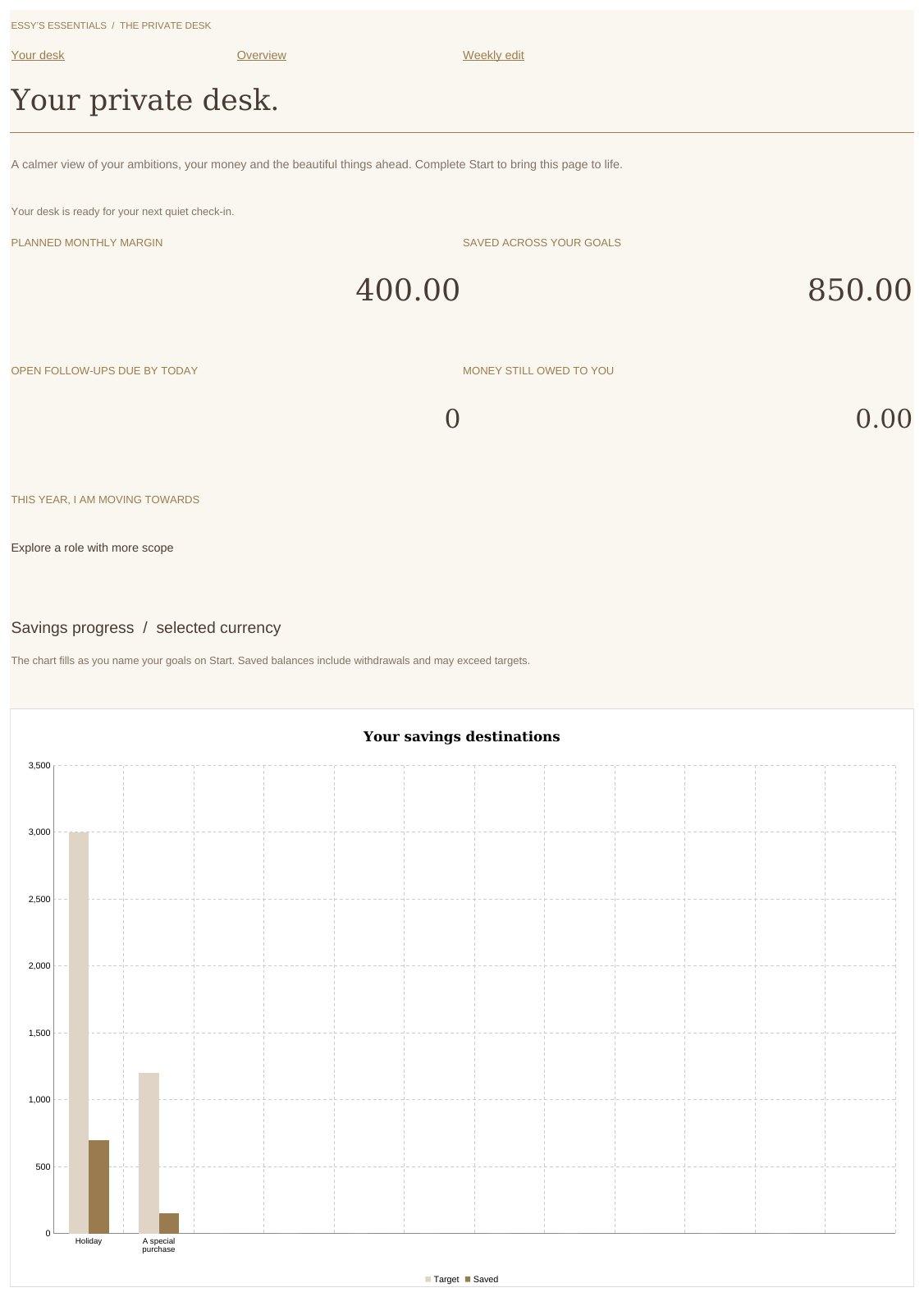
It brings those details into an Excel workbook, with a guided starting page, an overview, savings progress and space for weekly decisions. Warm ivory, taupe and brass details give the practical work of planning a setting I wanted to feel beautiful, too.
You can use the questions in this article in a notebook or the tools you already have. If you would like a ready-made structure with linked calculations and visual progress, The Private Desk is my own downloadable workbook, available for €49 as a one-time purchase.
Read Inside The Private Desk: From “One Day” to a Plan You Can See for a worked example and the software requirements before deciding whether it suits you.
Frequently Asked Questions
How do I plan career and personal goals together?
Look at the time and money each goal needs, then choose a manageable next step for each current priority. Review the plans together so that a demanding work period, a course or a trip does not get planned in isolation.
Do all my goals need a deadline?
No. Use a deadline when there is a genuine date to work towards, and a review date when you are still exploring. Both give the plan a place to return to.
Do I need a paid planner to do this?
No. A notebook, document or existing calendar can hold these decisions. A prepared workbook is an option if you would value the structure, calculations and overview already being arranged.
Before you close the page
What is one plan you keep leaving for a quieter month? What would move it forward, and where could that first step fit in the week ahead?
A Note on This Content
The content on Essy’s Essentials is intended for general inspiration, personal organisation and educational purposes. It does not constitute personal financial, investment, tax or legal advice. Always consider your own circumstances and seek qualified advice where appropriate. Any amounts shown are illustrative examples only, never a recommendation for what you personally should save or spend.

Written by Esther
Esther is a photographer and storyteller, and the founder of Essy's Essentials - a seasonal home for stories, rituals, recipes and everyday luxuries.
More about Esther →