Home & Living
A Winter Home That Smells Lovely, Not Like Christmas
Three scent directions for the weeks after the decorations come down, with room for the favourites you already own.

The decorations can go back in their boxes while winter carries on. Home fragrance is slightly less cooperative. You cannot pack away the cinnamon in the room simply because you have located the lid for the baubles.
I love cinnamon. I have no intention of filing for a separation on 2 January. But there is a point when the full festive combination — spice, sweetness, evergreen, something suggesting a bakery with a marketing budget — can feel a little dressed up for the life happening around it.
For the weeks after Christmas, choose the part of that atmosphere you still enjoy. Then give it a little more space.
Keep the warmth you actually like
Begin with the fragrance you already have, rather than the one labelled “January” that the internet may be preparing to sell you.
Smell each product on its own, according to its instructions. Ask what you like about it. Is it the dry woody impression? A soft sweetness? The sharper green part? Or is it mainly an association with the weeks when the tree was up?
A festive label does not automatically disqualify a fragrance from February. If you still enjoy it, use it. If the smell feels tied to Christmas for you, put it away only as the maker recommends, or finish it while you are still pleased to have it.
You are choosing the atmosphere of your home, which is a fairly personal jurisdiction.
Three directions for the rest of winter
These are descriptions to help you choose what to smell, rather than recipes or guarantees about a particular product. Different fragrances using the same note can feel very different.
You do not need one from each row. Choose the direction that interests you and begin there.
| If December felt like… | A direction to explore | What to notice when smelling it | |
|---|---|---|---|
| Sweet spice and baking | Softer woods with a little vanilla | Does the sweetness stay enjoyable, or take over? | |
| Pine, fir and festive greenery | Drier woods or a restrained green scent | Does it feel like a room you want to sit in? | |
| Rich, dense evening fragrance | A lighter woody or floral composition | Does it give you the change you want without feeling too sharp? |
1. Soft woods: warmth without the whole dessert
If you enjoyed the comforting side of your festive candle, a woody direction may keep some of that feeling.
Look for descriptions mentioning sandalwood, cedar or soft woods, then smell the actual product if you can. One can seem creamy, another dry, another much sweeter than you expected. The wording offers a starting point; your response decides the rest.
This is a useful direction when you want the evening room to feel warm, but have had enough of everything suggesting icing.
A little vanilla may still be lovely. There is no need to ban an ingredient you enjoy because somebody has changed the calendar.
2. Green and woody: a different view of winter
Perhaps the part you liked was the fresh, green impression around the tree.
Explore that feeling without expecting every product to reproduce a forest. Cedar, leafy notes or a less sweet evergreen composition can be starting points, depending on your taste.
Notice whether the scent feels pleasant after the first impression. Something striking in a shop can be quite a commitment beside the place where you spend an evening.
For this direction, the useful question is not how convincingly it announces winter. It is whether you would still want it in the room on a grey Tuesday.
3. A little floral complexity
Winter fragrance can also have flowers in it.
That need not mean turning the room into a spring display. A composition with a floral part and deeper woody or resinous notes can be another way to move away from an overtly festive mood.
Santa Maria Novella’s Terracotta Melograno is already part of my home-fragrance world. Its brand description includes citrus, flowers and deeper notes such as labdanum and patchouli. That combination is a useful reminder that a scent can have warmth and complexity without being built around a Christmas association.
There is more about the actual object in my Melograno article. This is one existing favourite to consider, rather than a reason to order an entire new fragrance wardrobe for the house.
Choose for the evening you have
A reading evening, supper with friends and a morning spent working at the kitchen table do not ask for exactly the same atmosphere.
For reading, choose something you are happy to sit beside for a while. For supper, let the food be part of the room; an unscented candle can provide the light. If the kitchen already smells of coffee and toast, you may have everything you wanted.
A living room after Christmas can be changed by the light, the seating and the activities you bring back to it. Fragrance is one choice among those things. The Winter Room After Christmas looks at the rest.
There is also the person sharing the sofa. Ask whether they enjoy the scent before deciding that it is now the identity of the entire downstairs.
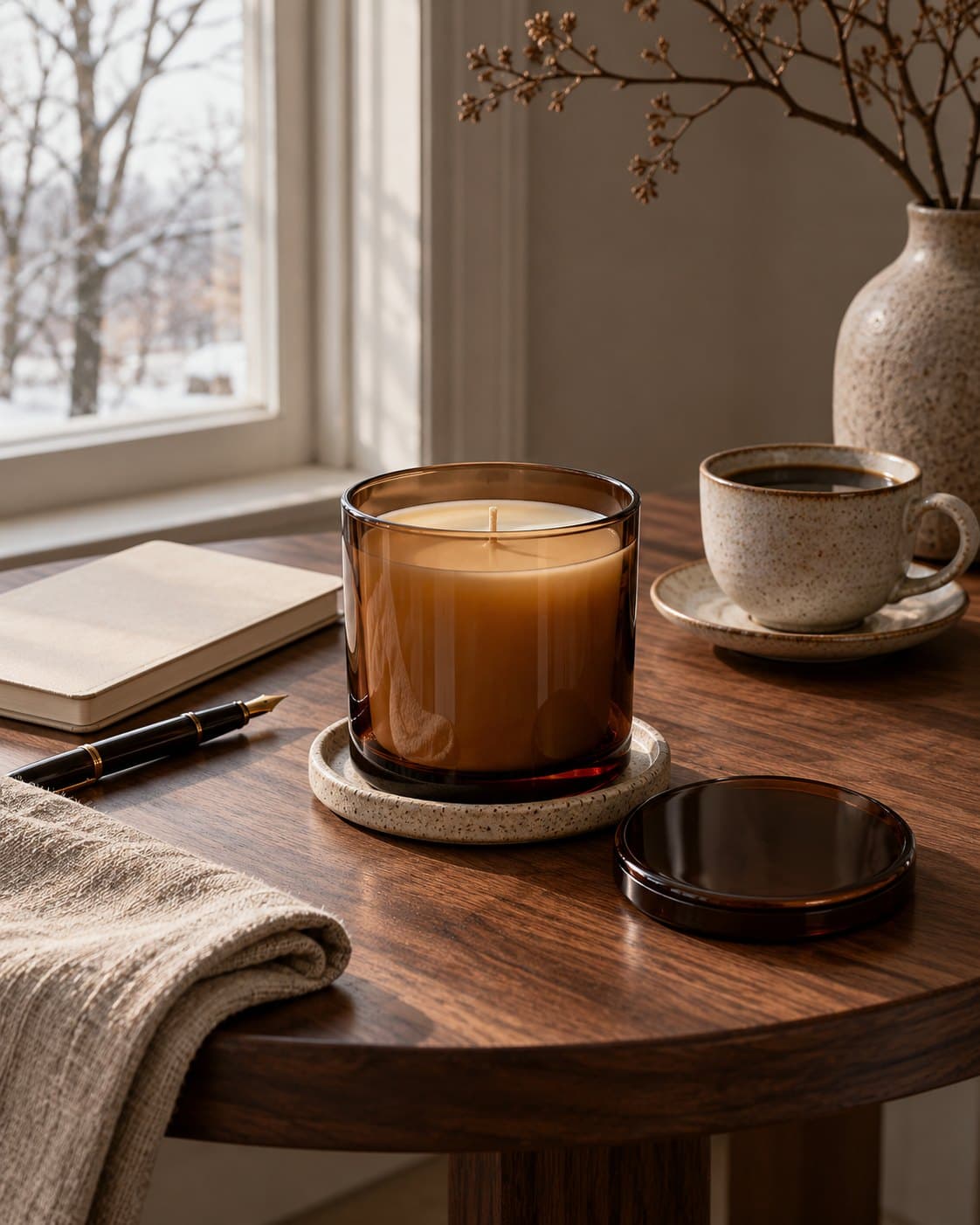
Try a small edit before buying
Put the products you are currently using into three groups: still enjoying, feels festive to me, and uncertain.
Keep the first group in use as appropriate. Follow the maker’s storage instructions for anything you put aside. For the uncertain group, return to one product at a time rather than adding another scent over it.
If something is still missing, name it before shopping. “A little less sweet” is a more useful brief than “make January nice”.
Choose a format that fits the way you want to use it. A candle gives you a chosen occasion; a passive fragrance source is a different commitment. Read the instructions and consider the people who use the room. Leave fragrance out if someone would be more comfortable without it.
For the broader approach, The Scent of Home is the place to begin.
What to do with the almost-finished Christmas candle
If you still like it, you can keep enjoying it within the maker’s instructions. If you no longer want to smell it, you do not have to finish it through sheer determination.
Do not combine leftover waxes, add oils or keep burning beyond the product’s stated stopping point. Follow its care and disposal instructions.
An unfinished purchase can tell you something useful about what to choose next time. Perhaps you like a very festive fragrance for a few evenings, rather than for three months. That is a reason to consider a smaller size when you next want one.
The candle has provided information. It does not also need to provide homework.
Let winter have the room
In Hollowpine, the cold season continues after the celebrations. There are ordinary evenings, things to cook and places to sit while it gets dark outside.
That is the part I want to carry home.
A fragrance you enjoy. A room you want to use. A little warmth that does not depend on the decorations staying up.
And, in my case, absolutely no promises about giving up cinnamon.
Continue reading
Questions about winter fragrance after Christmas
Can I keep using a Christmas fragrance in January?
Yes, if you still enjoy it and use it according to the product instructions. Its name or packaging does not determine when you are allowed to like the smell.
What should I try if I dislike sweet home fragrances?
Begin by smelling drier woody or green options, while remembering that a listed note does not tell you the full character or strength of a product. Try the actual scent where possible.
Do I need to change every room?
No. Choose the room where you want a change first. You may decide the rest of the house is already pleasant as it is.

Written by Esther
Esther is a photographer and storyteller, and the founder of Essy's Essentials - a seasonal home for stories, rituals, recipes and everyday luxuries.
More about Esther →