Beauty & Fragrance · Personal Discoveries
What Does Lactonic Perfume Smell Like? A Grown-Up Guide to Creamy, Milky Fragrance
What “lactonic” actually means, what creamy and milky perfume smells like, how it differs from gourmand, and why my favourite Valaya Exclusif is a lesson in not confusing a feeling with an official note.
Quick answer
A lactonic perfume has a soft, creamy or milky-smelling quality. Depending on the composition it may remind you of warm milk, coconut flesh, peach skin, almond-like softness or a smooth, almost buttery texture. It does not have to smell sugary, edible or like a glass of milk: in perfumery the word often describes the effect of a composition rather than a milk ingredient.
I have always been interested in fragrance, but exploring niche perfume made me much more curious about why I like certain scents. Some perfumes I can describe exactly. Others make me reach for words that are not especially technical: warm, soft, creamy, almost milky. For a while I wondered whether I was simply being unhelpfully vague.
Then I came across the word lactonic, and suddenly there was a new direction to explore. The funny part is that I am lactose-intolerant and apparently have a considerable weakness for things that smell milky. Fortunately, fragrance vocabulary and what suits me to eat are very different subjects.
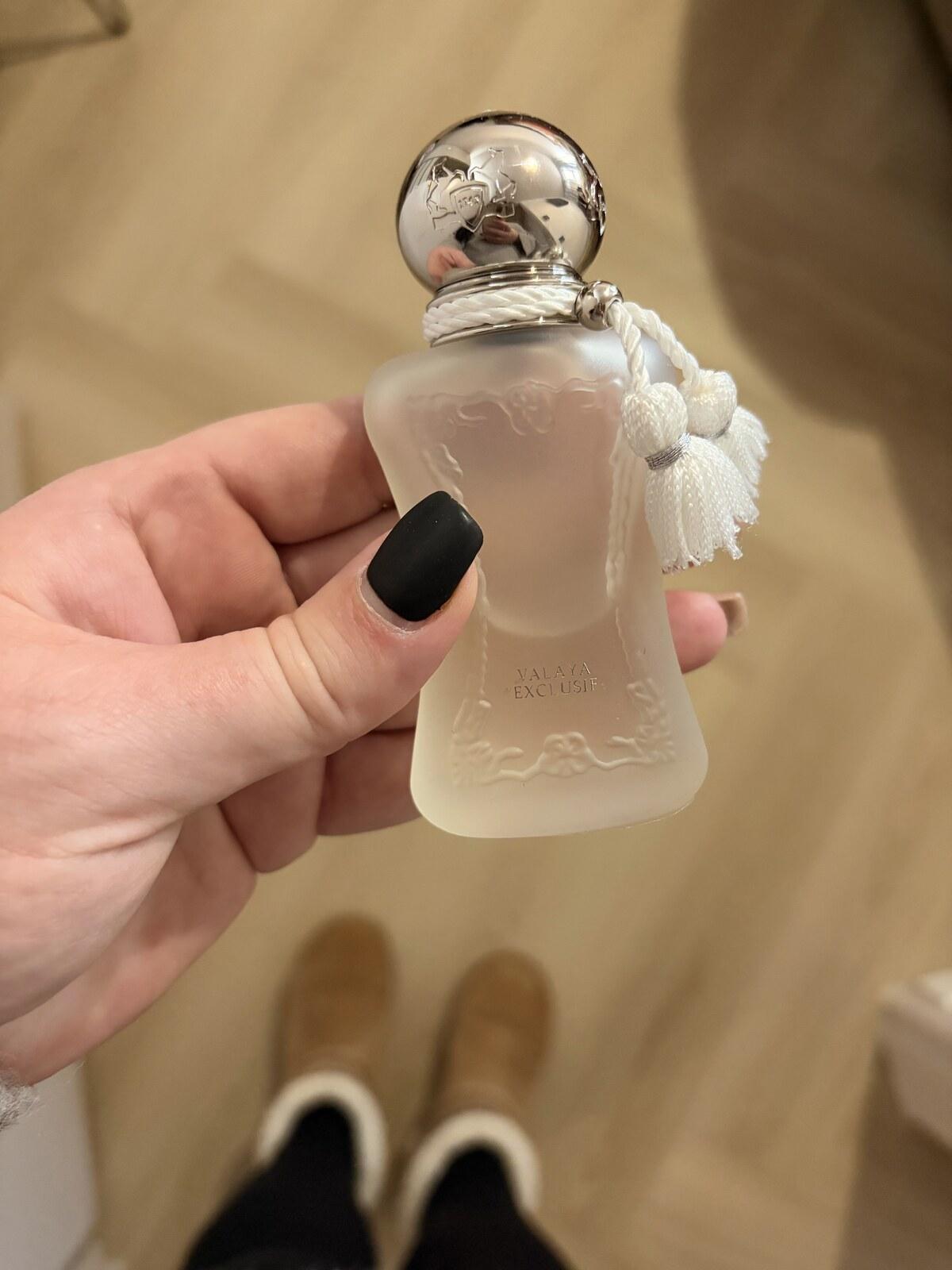
Parfums de Marly Valaya Exclusif is my current favourite, and I photographed my own bottle for the Currently section of this site. It is a useful starting point for the difference between a creamy impression and a fragrance a house actually describes as lactonic. First, the word itself.
What does “lactonic” mean in perfume?
In fragrance, lactonic usually describes an impression: creamy, rounded, velvety, milky, or sometimes softly fruity.
There is also a chemistry term behind the word. Lactones are a broad family of cyclic ester compounds, and some aroma materials in that family can contribute peach-like, coconut-like, creamy or buttery nuances. But lactones are not one ingredient, and not every lactone smells like milk.
That matters. Calling a perfume lactonic does not tell you its exact formula, and a perfume can seem creamy even when its list of notes never says “milk”. The Perfume Society has described how perfumers can build a milk-like impression from lactonic facets alongside other materials. I find that helpful: you are smelling an atmosphere, not necessarily a literal ingredient.
What does a lactonic perfume actually smell like?
Think of several different kinds of softness rather than one standard “milk perfume”.
- Warm and milky: the closest to the name, like gently warm or steamed milk, comforting and close to the skin, sometimes almost transparent rather than rich.
- Coconut-creamy: an effect resembling coconut flesh or coconut milk. It can feel sunny, but woods and musk can keep the same creaminess very restrained.
- Peach-skin softness: ripe peach or apricot, not juicy fruit so much as a soft, fuzzy, rounded feeling. It is why creamy fragrance can smell more fruity than milky.
- Buttery or custardy: a richer accord that suggests cream, butter or a pudding-like smoothness, where the effect begins to overlap with gourmand.
- Creamy woods and powdery musk: a scent can feel smooth and almost milky without a prominent milk note. Sandalwood, almond-like accords, iris, vanilla and some musks can reinforce a related perception of softness. That is not proof the perfume contains a lactonic accord, and I find it useful to keep the two ideas apart.
Lactonic vs gourmand vs powdery: what is the difference?
These words describe different aspects of a fragrance, and they overlap. A perfume can be both lactonic and gourmand, such as a milky vanilla with edible sweetness. It can be lactonic without being particularly sweet. And a creamy sandalwood may simply be woody and creamy, with no official lactonic classification.
I find this is where fragrance descriptions get most interesting. They are clues, not rigid boxes every beautiful scent has to fit into.
Lactonic, gourmand, powdery, musky and woody compared
| What it describes | It may remind you of | |
|---|---|---|
| Lactonic | A creamy, milky or softly rounded effect | Milk, coconut, creamy peach |
| Gourmand | A food- or dessert-like scent character | Vanilla cake, caramel, coffee, chocolate |
| Powdery | A soft, dry, cosmetic or silky impression | Face powder, iris, a makeup bag |
| Musky | A clean, warm, skin-like or sometimes sensual effect | Fresh fabric, warm skin, soft laundry |
| Woody | A wood-led structure or impression | Sandalwood, cedar, dry polished wood |
My current favourite: Valaya Exclusif by Parfums de Marly
Valaya Exclusif is a perfume I knew I loved very quickly. I first smelled it at de Bijenkorf, and less than a week later I had my own bottle. I love the soft, enveloping quality I experience when I wear it.
This is where I want to be precise, because the perfume deserves more than a technical label attached just because I like the sound of the word. Parfums de Marly officially describes Valaya Exclusif as floral, powdery and woody, not as a straightforward milk perfume. Its published fragrance pyramid is:
- Top: almond, bergamot and mandarin
- Heart: orange blossom and white flowers
- Base: white musks, Akigalawood, sandalwood and vanilla
To my nose, those notes work together into a smooth, soft, creamy impression. The almond, woods, vanilla and musk make it easy to see why I find it enveloping. That is my own wearing impression. It is not a statement that the brand lists milk as a note, and I have not analysed the formula.
It is a good example for someone who loves creamy perfume but does not want to smell like custard or a coconut dessert. And it gives me one piece of advice for buying fragrance: shop for the effect you love, not only the label someone puts on it.
Another personal reference: Matière Première Santal Austral
Santal Austral has also been a favourite, especially when I am drawn to warmer, creamy woods. It reminds me that sandalwood can be an important part of the texture I look for. The brand describes an Australian sandalwood focus with almond-milk and iris facets, so its published wording makes the creamy association more explicit than Valaya Exclusif’s note pyramid does.
Even so, I would avoid turning an impression into a universal claim. A sandalwood perfume can be dry, spicy, creamy, polished or earthy; it depends on the composition. Between them, these two perfumes show the direction that interests me: sometimes the creaminess is part of a stated accord, and sometimes it is how the whole perfume feels on my skin. I am not presenting either bottle as a laboratory example of a lactone-heavy formula.
Do lactonic perfumes always smell sweet?
No. Some milky fragrances are unmistakably sweet and dessert-like, but others are airy, woody, clean or almost powdery. A fresh opening can make a creamy heart feel brighter, sandalwood can give it a polished structure and musk can create a soft, skin-like finish. Vanilla warms it, but vanilla is not compulsory and does not always mean sugar.
If you dislike very sweet perfume, do not dismiss the whole family because a handful of popular milk fragrances sound like a dessert menu. Try a lighter, musky or woody interpretation and see how it feels after the first spray fades.
Do lactonic perfumes contain actual milk?
A milk accord or lactonic note describes a smell, not evidence that a perfume contains cow’s milk or another dairy ingredient. Perfumers commonly create these impressions with aroma materials.
Equally, a name alone cannot tell you a product’s ingredient sourcing or whether it suits a specific allergy, vegan preference or sensitivity. If that matters to you, check the official ingredients or ask the brand directly, remembering that labels do not always list every aromatic material individually.
My lactose intolerance is just a mildly ridiculous personal joke about loving the smell of milkiness. It says nothing about the composition of my perfume, and it is not health advice.
How to find a lactonic perfume you will actually want to wear
Start with the kind of creaminess you mean: warm milk, almond softness, coconut, ripe peach or creamy woods. A perfume can be called milky and still smell very different from the picture in your head.
Read the official notes, but do not stop there. Look for milk accords or explicitly lactonic language, then compare the wider structure, because a bright citrus opening, white flowers, powdery iris and a woody base can change the experience completely. Treat influencer descriptions and fragrance databases as opinions, not conclusive information about a formula.
Test on your own skin. Blotters are useful for screening, but I decide by how a perfume develops when I actually wear it, since something wonderful in the first ten minutes can be much less appealing later. Try a sample for a whole ordinary day before considering an expensive full-size bottle.
Write down your own words first. “Soft”, “warm”, “a little powdery”, “like expensive body cream” or “too sweet after an hour” can be far more useful than guessing individual molecules. I made a free Perfume Sample Tracker for exactly this: it is where I separate official notes from personal impressions and record the exact version I sampled.
Compare without buying more straight away. Try two samples side by side on separate days. You may find that what you call lactonic is really the sandalwood, almond, musk or powdery structure you enjoy most, which is a more useful discovery than a list telling you to buy five more bottles. The Perfume Fitting Room shows how I approach a sample set.
Can you layer a lactonic perfume?
You can experiment, but I would start gently. A clean musk may preserve a creamy perfume’s softness, a citrus fragrance can make it feel fresher, and a heavy vanilla or amber can make it far richer than intended. Test combinations on blotters first and avoid crowding two complicated perfumes together. For a fuller method, read The Art of Scent Stacking. Sometimes the best layering decision is to wear the perfume exactly as the perfumer intended.
Why I do not buy a perfume just because it is “lactonic”
The biggest lesson from finding language for my preferences is that a useful description is not a shopping instruction. I can love a creamy woody perfume and find a very sweet milk fragrance too much. I can enjoy almond and musk in one composition and dislike them in another. I can be completely smitten with a perfume the brand does not market as lactonic at all.
That is why I like sampling so much. It lets a fragrance be an experience rather than a category to collect. The perfume I reach for most does not have to prove a theory; I just have to want to wear it again.
The Essy’s verdict
I like the word lactonic because it gives me another way to talk about something I loved before I knew what to call it. I like it even more when I remember its limits. A perfume can feel creamy without smelling like milk, and it can be powdery, woody and beautifully soft without belonging to an official lactonic category. Two people can also experience the same perfume rather differently.
For me, Valaya Exclusif is the bottle I keep wanting to wear, for a personal reason: I love how it smells and feels on my skin. The official notes help me understand it, but they do not decide whether I love it.
If you are curious about lactonic fragrance, begin with a sample, a few honest words in a notebook and a little attention to how a perfume develops. You may find that what you were looking for was not milk at all. It was simply softness.
Pair It With
- My Perfume Sample Tracker: The Little Scents Worth Remembering
- The Perfume Fitting Room
- The Art of Scent Stacking
Frequently Asked Questions
What does lactonic mean in perfume?
It describes a creamy, milky or softly rounded scent quality. Certain lactone aroma materials can contribute this effect, but “lactonic” does not identify a single ingredient or guarantee that a perfume smells like literal milk.
What does a lactonic fragrance smell like?
It may resemble warm milk, coconut flesh, creamy peach, almond-like softness or a smooth, buttery texture. The surrounding floral, woody, musky and sweet notes shape the final result.
Is lactonic perfume the same as gourmand perfume?
No. Gourmand describes a food-like, often dessert-inspired scent, while lactonic refers to creamy or milky qualities. Some fragrances are both, but a lactonic perfume can also be fresh, woody or not especially sweet.
Are milky perfumes always sweet?
Not necessarily. Musk, citrus and woods can make a creamy perfume feel fresh or restrained, while vanilla and dessert-like accords can increase sweetness.
Does a lactonic perfume contain dairy?
Not necessarily. The term describes a smell rather than a declared dairy ingredient. Check a specific brand’s formulation or contact the manufacturer if ingredient sourcing or allergies matter.
Is Valaya Exclusif a lactonic perfume?
Parfums de Marly describes Valaya Exclusif as floral, powdery and woody. I personally experience a creamy softness when I wear it, but I would not claim the brand officially markets it as a milk or lactonic fragrance.
Is sandalwood a lactonic note?
Sandalwood is a woody note or material family, not a synonym for lactonic. Some sandalwood compositions have creamy qualities, but not every sandalwood scent has a pronounced milky accord.
What should I try if I like creamy perfume but dislike very sweet scents?
Look for perfumes described as creamy woody, musky, powdery or soft, and sample them on skin. Do not rely on one fragrance category; test how the composition develops before buying a full bottle.
Independence and method: written independently from my own fragrance experience. Official note pyramids are attributed to their brands, and phrases such as “creamy to my nose” are personal impressions, not ingredient or performance claims. No sponsorship or gifted product is involved, and there are no affiliate links on this page. The photograph is my own, as shown in Currently.
Fact-check sources
- Parfums de Marly — Valaya Exclusif: olfactive pyramid (checked 8 November 2026)
- The Perfume Society — The Milky Way
Read Also

Written by Esther
Esther is a photographer and storyteller, and the founder of Essy's Essentials - a seasonal home for stories, rituals, recipes and everyday luxuries.
More about Esther →