Beauty & Fragrance · Photography
How to Photograph Perfume Bottles at Home with Your Phone
Soft window light, reflection control, a readable label and a little patience. A simple at-home method for photographing perfume bottles with the phone you already own.
The short answer
Yes, a phone can produce beautiful perfume photographs. The biggest difference usually comes from controlling reflections, choosing soft light, keeping the bottle clean and composing the image with intention. You can try all of that at home before buying any specialist equipment.
Perfume is one of those things I enjoy both wearing and looking at. I love a beautiful bottle: the weight of the glass, an interesting cap, the way a frosted surface catches the light. But the photograph should still feel like a real object in a real life, not a catalogue image placed there by accident.
For Essy’s Essentials, I am interested in the small rituals around fragrance: choosing it, using it, remembering the one I fell for in a shop. A good photograph can tell a little of that story without a single line of text.
If you have tried photographing your favourite bottle and ended up with a black reflection across the glass, an enormous bright window in the cap or a strangely flat picture, you are not alone. Reflective objects have their own ideas about what they want to show the camera.
One note first: this is a method I would suggest, not a description of how any particular photograph on this site was taken. Here is the simple home setup I would try first.
What you need (and what you don’t)
Start with:
- Your phone’s camera.
- One perfume bottle, wiped clean with a suitable soft, dry cloth.
- A table or stable surface close to a window.
- A neutral background: card, paper, linen or a wall.
- A white piece of card or paper to bounce a little light back.
- A dark card, if you want a defined edge reflection in clear glass.
You do not need a professional flash, expensive lens, dedicated light tent or editing subscription to begin. Those can become useful for repeatable commercial work, but they aren’t the starting point for a beautiful personal photograph.
If you are photographing an especially valuable bottle, keep it on a stable, non-slip surface and away from the edge of a table. Don’t put an open bottle near fabric, electronics or hot lights; perfume may stain some materials and contains volatile ingredients.
Step 1: Find the right light before moving the bottle
My first suggestion is a window with soft, indirect daylight. Place the bottle on a table a short distance away from it and look at what happens to the glass.
Direct sunlight can create dramatic images, but it also creates sharp highlights, strong shadows and blown-out areas on reflective caps. If you are learning, an overcast day or indirect window light is much easier to control.
Move the bottle, not immediately the phone. Turn it a few degrees and watch how the highlight moves along the cap and the sides. A tiny change in angle often solves a reflection that looks impossible to fix later.
If the window creates a hard bright stripe, soften the light with a sheer curtain, without placing anything unsafe or obstructive near a heat source.
A mini experiment: photograph the same bottle facing the window, at 45 degrees to it and with the window off to the side. Compare the shapes of the highlights, not just how bright the image looks.
Step 2: Choose a background that supports the bottle
A transparent bottle can disappear against a busy background. A very pale frosted bottle can disappear against white. And a shiny silver cap can reflect every object in the room, whether you intended to include it or not.
I like beginning with materials we already live with: warm wood, a neutral piece of fabric, a page from a book or a quiet corner of a dressing table. You can still create a luxurious photograph without introducing a dozen props.
Think about three things:
- Contrast: can you clearly see the outline of the bottle?
- Texture: does the background add atmosphere without competing with the label?
- Colour: do the tones complement the packaging, or change its apparent colour?
For a minimal photograph, a bottle and one surface are enough. For a more editorial look, add one meaningful object, perhaps the coffee you actually drink while getting ready, or a small tray you use every day. Avoid inventing a lifestyle around a product just to make it look expensive.
Step 3: Control reflections in glass and metal
This is the part that makes perfume photography different from photographing a notebook or a croissant.
Glass is a mirror when the conditions are right. It may show the bright rectangle of the window, your hand, your phone or the furniture behind you. Metallic caps exaggerate the problem. Try these fixes in order:
- Shift the bottle or camera a few centimetres to change the reflection angle.
- Use a white card opposite the window to lift a dark side gently.
- Place a black card outside the frame to create a neat dark edge in transparent glass, if the bottle needs definition.
- Wear a plain, neutral top so a brightly coloured shirt doesn’t dominate a mirror-finish cap.
- Move distracting objects behind the camera rather than spending ages trying to remove them in editing.
Don’t expect to eliminate every reflection. A reflection can be beautiful, because it gives glass its shape. The goal is to keep the reflection intentional, not to erase every sign that the bottle is made of glass.
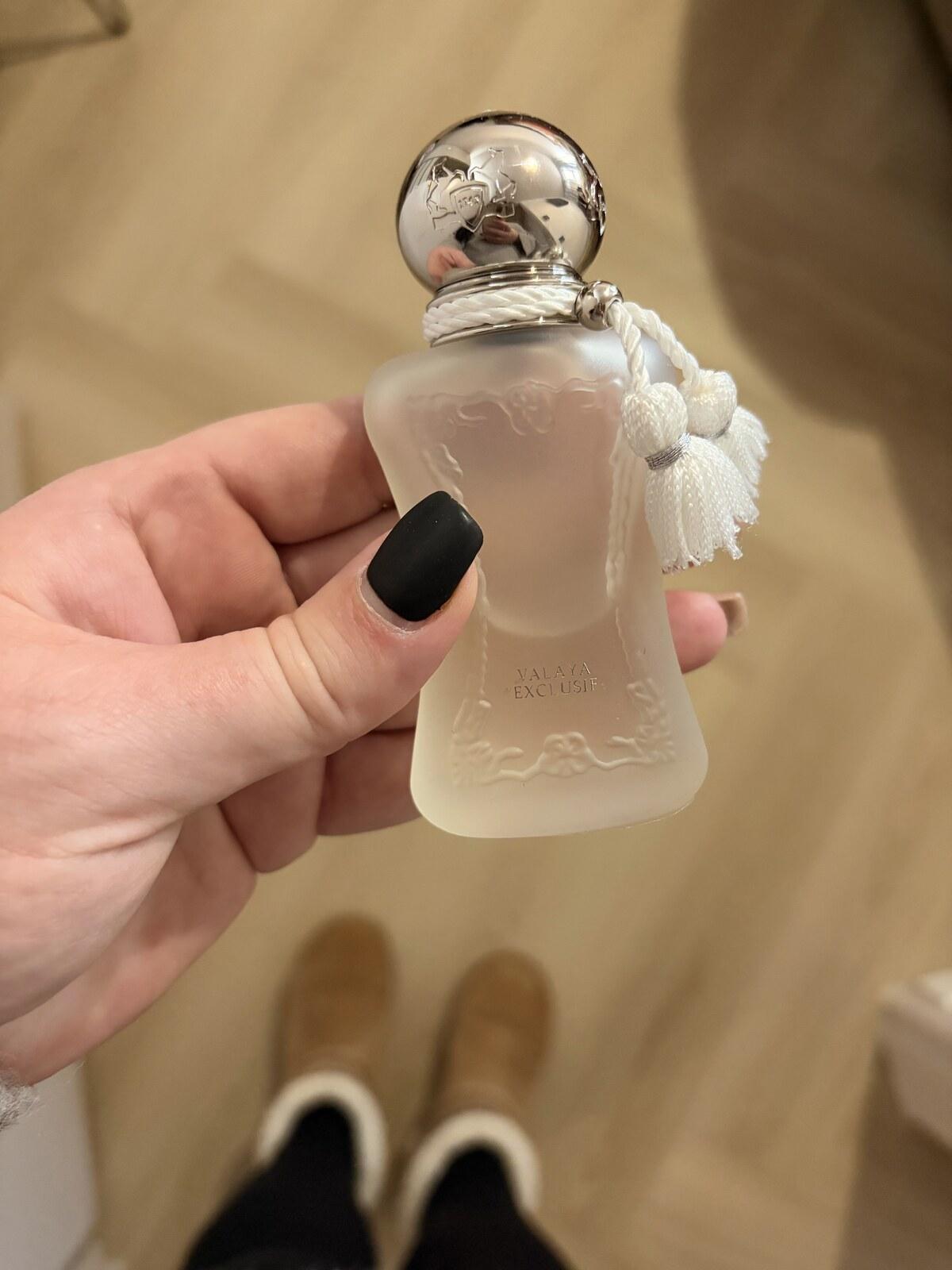
A note on reflective silver caps: one of my favourite bottles, Parfums de Marly Valaya Exclusif, has a pale, frosted body and a reflective metallic cap. It is a good example of why one lighting choice may not suit every part of a product. The soft glass wants gentle contrast; the cap wants enough structure to reflect without becoming a dazzling white patch.
The photograph at the top of this page shows the bottle held in a hand, with the focus on the packaging and a softly blurred background. The distinctive cap, tassels and lettering give the composition interest without additional styling. It is a real-life example, not a demonstration of the exact method above.
Step 4: Get the focus and exposure right on your phone
Smartphones tend to make sensible automatic decisions. With a perfume bottle, they can also focus on the wrong part of the image or brighten the background until a pale label disappears.
On an iPhone, Apple’s Camera app lets you tap the subject to place focus, adjust exposure and, on supported configurations, hold to activate AE/AF Lock. The exact controls depend on the phone and software version. Start by focusing on the front label or a crisp edge of the bottle, then lower exposure slightly if the highlights are too bright.
If your phone has a macro mode, don’t assume it is automatically the best choice. Getting extremely close can distort the bottle’s proportions or switch camera lenses. Step back and frame carefully first, and use a stable surface or support your elbows to reduce camera movement.
Try this three-shot test:
- Frame A: bottle centred with generous space around it, useful for a website hero or square crop.
- Frame B: a closer, portrait composition focusing on the cap and label, useful for Pinterest.
- Frame C: a detail of the glass or tassel, useful as a supporting editorial image.
Check each photograph at full size before rearranging everything. A phone-screen thumbnail can hide soft focus on the name of the fragrance.
Step 5: Use composition to tell the right story
One photograph can answer a practical question: what does this bottle look like? Another can say something about the life it belongs to.
For an explanatory review, the reader should be able to identify the product clearly. Use a relatively straight angle, a readable label and honest colour. For a personal essay or social post, the photo can be more atmospheric: the bottle in a hand, a soft background, a little movement or a quiet corner of the house.
I would shoot a small set rather than trying to make one image serve every purpose.
The important word is believable. You don’t need an elaborate “luxury dressing table” if that isn’t where you actually use your perfume.
A Small Set of Photographs
| Purpose | Composition | |
|---|---|---|
| Product portrait | Review or reference | Entire bottle, legible label, simple background |
| Editorial moment | Blog story | Bottle in a believable ritual, considered negative space |
| Detail shot | Texture and storytelling | Cap, frosted glass, tassel, label or shadow |
| Vertical variation | Portrait crop with room for a headline, never covering the product name |
Step 6: Edit lightly without changing the product
Editing should improve the photograph, not misrepresent the bottle.
I would start with straightening, crop, white balance, exposure and small adjustments to highlights and shadows. If the bottle is white or pale pink, pay particular attention to whether a warm filter has turned it yellow or peach.
Be cautious about using generative removal tools to reshape the label, erase the brand name, invent a reflection or alter the cap. Those changes may make a prettier image but a less honest product photograph.
For a consumer-facing article, aim for a faithful view of the real product. For an editorial creative concept, more stylisation may be appropriate, provided it is clearly presented as that and not as a documentary product shot.
Keep a high-resolution original, then export web versions. This is especially useful if you later want to crop the same image for a blog, an Instagram post and a Pinterest pin.
Step 7: Take a second photograph with a different purpose
After taking the safe photograph, ask one more question: what is distinctive about this bottle?
For Valaya Exclusif, I notice the frosted finish, metallic cap and soft tassels. For a different perfume, perhaps it is the amber glass, a sculptural label or the way sunlight passes through the liquid.
Let the design guide your composition instead of applying the same setup to every bottle.
Common perfume photography problems, and quick fixes
Most problems come down to light, angle or background.
- The label is blurry: tap the label to focus, give the camera more light, move back a little and check the photograph at full size. Avoid digital zoom if it degrades the detail.
- The cap is a bright white blob: reposition the bottle or phone so it reflects a softer, more even area. A white card can make a controlled reflection; a dark card can restore shape.
- The glass looks flat: move the light to the side, add a gentle edge highlight or put a darker surface behind clear glass. Texture and controlled reflections add depth.
- The bottle looks yellow: check your white balance and the surrounding light. Mixing warm room lamps with cool daylight can change the product’s apparent colour. For a true-to-life review, use consistent lighting.
- I can see my phone in the bottle: change the camera angle, step back and crop, or use a reflector to change what the shiny surface sees. If a tiny reflection remains, it may be more honest to keep it than to reconstruct the surface with generative editing.
- My photograph looks cluttered: remove props one by one until the bottle is clearly the subject. Fragrance bottles are already designed objects; they rarely need much competition.
Frequently Asked Questions
How do you take aesthetic perfume photos at home?
Choose soft light, a simple background and a stable surface. Clean the bottle, control the reflections and focus on the label or a crisp edge. Take several compositions rather than relying on one image.
Can I photograph perfume with an iPhone?
Yes. You can use an iPhone’s standard camera controls to focus and adjust exposure. The most important improvements are usually lighting, background and reflection control, not specialist gear.
What is the best lighting for perfume photography?
Soft, directional light is often an easy starting point for beginners. Window light is convenient, while reflectors or cards can help control contrast. The best setup depends on whether the bottle is clear, dark, frosted or metallic.
How do you avoid reflections on a perfume bottle?
Move the camera, bottle and nearby reflective surfaces until unwanted objects disappear from the glass. White and black cards can shape the reflections rather than removing them entirely.
Do I need a lightbox for perfume photography?
No. A lightbox can be useful for consistent product images, but a window and a few pieces of card are enough for many attractive at-home photographs.
How do you make a perfume bottle look expensive in photos?
Prioritise clean styling, believable colour, intentional highlights and good composition over numerous luxury props. A clear, elegant photograph of the real product is often more convincing.
Should I use portrait mode for perfume photography?
You can experiment with it, but check the edges carefully. Artificial background blur may produce strange outlines around transparent glass, tassels or narrow bottle details. Standard Photo mode may look more natural.
Can I edit out dust, scratches or reflections?
Minor dust removal may be reasonable, but product images should not conceal material damage or change the product’s features. Be transparent about heavily edited creative imagery.
I think the loveliest perfume photographs feel personal before they feel polished. The bottle has been chosen for a reason. It has a weight, a place in the room, maybe even a memory attached to it. You don’t need to build a studio to photograph that: you need light that makes the object visible, a background that doesn’t fight it and enough patience to let a beautiful detail become the centre of the image.
If you keep a record of the fragrances you try, My Perfume Sample Tracker is a good companion. For fragrance, skincare and coffee in a styled morning, see our independent editorial concepts Slow Mornings, Soft Seasons and The First Whisper of Autumn.
Photographed objects are from my personal collection where explicitly described. No brand commissioned this article, and product names belong to their respective owners.
Technical reference
- Apple Support — Use iPhone camera tools to set up your shot
Read Also

Written by Esther
Esther is a photographer and storyteller, and the founder of Essy's Essentials - a seasonal home for stories, rituals, recipes and everyday luxuries.
More about Esther →