A story from Cortelume
The Closed Shutter
One green shutter stays closed while the rest of the village opens - until the last Sunday of the season.
Set at Casa Alta
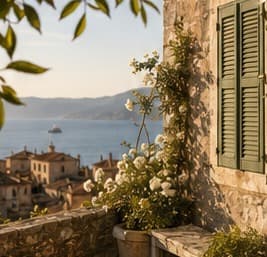
“We simply understood that leaving was not the only possible beginning.”
On the last Sunday of August, Cortelume opened all its windows.
It was not an official tradition. There was no notice pinned beside the fountain in Piazza del Lume, no announcement delivered with the morning bread, and no little painted sign propped among the flowers outside Fiora & Fig.
It was simply something the village did.
The shutters of Casa Livia were folded back before the sun reached Via Pietra. Pale curtains breathed in and out of the open windows, carrying the scent of coffee and warm linen into the street.
At Forno Nica, the narrow window above the ovens was pushed open with the handle of a wooden spoon, releasing a cloud of heat that smelled of flour, rosemary and lemon peel.
The door of Bottega Basso remained open even during the hottest hour, shaded by the great stone staircase above it. At Atelier Sera, both blue-grey doors were fastened against the wall so that the afternoon light could travel all the way across the worktables and touch the jars of brushes at the back of the room.
Even the smallest attic windows were opened.
Cortelume let the summer pass through it.
All except one.
High above the village, on the upper floor of Casa Alta, a single green shutter remained closed.
Mara had noticed it on her first morning in Cortelume.
She had noticed it again every day since.
The shutter was on the western side of the house, facing the sea. Its paint was faded to the soft green of olive leaves turned silver in the sun. Every other shutter on Casa Alta stood open from morning until evening, but that one remained fastened across the window.
Sometimes, while walking down Via Pietra, Mara thought she saw the edge of a curtain moving behind it.
Once, during a night of warm wind, she had heard something strike the wood from inside.
Not loudly. Just a small, irregular tapping.
When she asked Livia about it, Livia had been slicing peaches at the long kitchen table beneath the open windows.
"Old houses make sounds," she had said.
"That was not the house."
"No," Livia had agreed, placing the peach slices in a shallow ceramic bowl. "Probably not."
Then she had carried the bowl outside and begun discussing whether the figs at Fiora & Fig would ripen early that year.
That had been six weeks ago.
Now Mara stood beside the bed in her room at Casa Livia and folded her last linen dress into an open suitcase.
The room looked strangely untouched by her leaving. The curtains still lifted in the morning air. The little blue glass beside the bed caught a square of sunlight. On the chair lay the straw hat she had bought during her second week, when the heat had grown too strong to walk between the piazza and the harbour bareheaded.
Only the suitcase suggested an ending.
At the bottom of it lay the small things she had collected without meaning to: a paper bag from Forno Nica, folded neatly along its creases; a pale shell from Il Porto Piccolo; a postcard showing Piazza del Lume before the fountain had been restored; two pressed bougainvillea petals; a bottle of lemon oil from Bottega Basso; and a paper napkin on which Sera had drawn the curve of the harbour while explaining where the light went after sunset.
Mara placed the dress on top and closed the suitcase halfway.
She was leaving the following morning on the first boat.
The decision had been made long before she came to Cortelume. There was an apartment waiting in the city, a desk covered with unopened letters and a calendar already full of obligations that had seemed perfectly reasonable when she wrote them down.
She had always known the summer would end.
Still, all morning she found reasons not to fasten the suitcase.
Downstairs, Livia was arranging apricots in a wide bowl.
"You are going to the piazza?" she asked without looking up.
"I thought I might take one last walk."
"Then it is fortunate Cortelume has not moved overnight."
"I want to remember it properly."
Livia smiled.
"That is never how remembering works."
She chose an apricot, rubbed it gently against the edge of her apron and handed it to Mara.
"Go before the heat finds you."
Mara stepped into the street.
The stones were still cool in the narrow strip of shade beside Casa Livia. Above her, every window stood open.
She looked toward Casa Alta.
The closed shutter was visible between the roofs.
On the last Sunday of August, when all of Cortelume had opened itself to the summer air, it appeared more deliberate than ever.
Not forgotten.
Not stuck.
Closed.
Piazza del Lume was quieter than usual.
The market crates had been stacked beside the fountain, and only a few lemons remained beneath a folded cloth. Two elderly men sat outside the café, their chairs angled toward one another, although neither seemed to be speaking.
At the fountain, Nica was filling a copper jug.
She wore her bakery apron over a pale dress, its front dusted with flour despite the early hour. A twist of hair had escaped at the nape of her neck.
"You are not usually allowed this far from the ovens before ten," Mara said.
"Today the bread has agreed to behave without me."
Nica lifted the jug from the water.
"Livia says you leave tomorrow."
"She told you?"
"Cortelume told me. Livia merely confirmed it."
Mara sat on the low edge of the fountain.
From there, Casa Alta was visible above the eastern roofs.
Nica followed her gaze.
"The shutter," she said.
"So everyone knows I have been asking about it."
"Everyone knows everything here. We simply choose different speeds at which to admit it."
"What is behind it?"
"A room."
"I had gathered that much."
Nica set down the jug.
"When I was a girl, I believed there was a piano inside. My brother said it was a room filled with stolen church candles. Basso insisted a woman lived there who had not aged for a hundred years."
"And what was actually there?"
Nica smiled.
"That depends on which summer you are asking about."
She reached into the pocket of her apron and gave Mara a small round loaf wrapped in paper.
"For the boat tomorrow."
"I can buy one."
"You cannot buy this one."
"What is different about it?"
"I made it for someone who is leaving."
Nica lifted the jug again.
"Those require more salt."
Before Mara could ask what she meant, Nica was already crossing the square toward the bakery.
Mara placed the bread in her bag.
At the entrance to Via Pietra, a linen sheet had been hung between two buildings. It moved slowly above the street, filling with air and collapsing again like a sail that had forgotten the sea.
Mara walked beneath it.
The village smelled of soap, basil and sun-warmed stone.
At Bottega Basso, crates of tomatoes and courgettes stood in the shadow beneath the staircase. Bottles of oil caught fragments of light on the highest shelf. A basket of onions hung beside the open door.
Signora Basso sat on a low wooden stool, sorting green beans into two bowls.
"You are walking slowly," she observed.
"I have nowhere I need to be."
"That is why people walk slowly."
Mara picked up one of the green beans that had fallen to the ground and placed it in the bowl.
"May I ask you something?"
"You may. Whether I answer is a separate matter."
"The closed shutter at Casa Alta."
Signora Basso continued sorting.
"What about it?"
"Nica said that what was behind it depends on which summer I am asking about."
"Nica says poetic things when she has been awake since four."
"She also said you believed a woman lived there who never aged."
"That was before I understood that not ageing would be exhausting."
Mara waited.
Signora Basso sighed and set the beans aside.
"The shutter was open once," she said.
"When?"
"The summer nobody left."
Mara leaned against the wall beneath the staircase.
"What does that mean?"
"It means exactly what it says."
"Nobody left the village?"
"Not one person."
"For the entire summer?"
"For longer than they intended."
"Why?"
Signora Basso picked up the bowl of beans.
"Ask the street."
"The street?"
"Via Pietra remembers more footsteps than I do."
She disappeared into the shop.
A moment later she returned and placed a small bottle in Mara's hand. It was filled with golden oil and sealed with a plain cork.
"For Livia," she said.
"What is it?"
"She will know."
Mara looked at the bottle.
"Is this part of the story?"
"Everything becomes part of a story once you carry it long enough."
Signora Basso went back inside before Mara could return the bottle.
The sun had reached the upper windows of Via Pietra. Laundry moved above the street. Somewhere behind a wall, a radio played a song that Mara had heard many times that summer without ever learning its name.
She continued toward The Lemon Gardens.
The path rose beyond the last houses and divided between low stone walls. Lemon trees leaned over the terraces, their branches heavy with fruit. The air beneath them was cooler and sharper, green with crushed leaves and citrus peel.
A wicker basket stood on the wall beside the path.
Inside it lay eleven lemons.
Mara counted them twice.
At the far end of the terrace, a man was repairing a section of wall that had loosened during the spring rains. He straightened when he saw her.
"You should not leave a basket of lemons unattended," Mara said.
"They have made no attempt to escape."
"There are eleven."
"There were twelve."
"What happened to the last one?"
He nodded toward her bag.
Mara looked inside.
Beside the loaf from Nica and the bottle from Basso lay a lemon.
She was certain it had not been there before.
"When did you put that in?"
"I did not."
"Then who did?"
The man returned to the wall.
"The gardens have their methods."
Cortelume, Mara thought, had spent the entire summer pretending not to be mysterious and was becoming increasingly bad at it.
She took the lemon from her bag. One small leaf remained attached to the stem.
"Did everyone truly stay?" she asked.
The man pressed a stone into place.
"Not at first."
"Basso said nobody left."
"She is correct."
"But you just said—"
"People can begin leaving long before they go anywhere."
He brushed the dust from his hands.
"That summer, half the village had already left in their minds."
"Where were they going?"
"Everywhere. Cities. Other ports. Houses belonging to cousins they barely knew. Places where work was said to be easier and winters less quiet."
"And then?"
"And then the road broke."
Mara looked toward the village below.
"The road?"
"And the harbour wall. And three roofs. Part of this terrace. The steps to the port. The old fountain."
"All at once?"
"It was a very determined storm."
"But storms do not last an entire summer."
"No," he said. "They merely reveal what was already falling apart."
He placed another stone in the wall.
"Go to Casa Livia before noon. The windows will tell you the next part."
Mara had stopped asking how windows were expected to speak.
She returned through Via Pietra carrying the lemon in one hand.
By the time she reached Casa Livia, the open windows had filled the front room with moving squares of light. The curtains lifted from the sills, and the house smelled of apricots warming in the kitchen.
Livia was not there.
On the table stood a shallow bowl containing twelve peaches.
Beside it lay a folded note.
Take one upstairs.
Mara chose the ripest peach and climbed to the upper floor.
She had passed the narrow staircase many times but had never gone beyond her own room. At the end of the corridor, another flight of steps led to a small landing beneath the roof.
There she found an open window.
Its shutters had been folded back against the wall. Through it, she could see the whole village: the roofs, the piazza, the lemon terraces, the line of Via Pietra descending toward the harbour and, highest of all, Casa Alta.
The closed shutter faced her directly.
On the sill stood a little ceramic plate.
Mara placed the peach upon it.
Only then did she notice the writing scratched faintly into the wood beneath the window.
WE THOUGHT LEAVING WAS THE ONLY WAY TO BEGIN.
She ran her fingers across the words.
Behind her, the stairs creaked.
Livia appeared carrying two glasses of water.
"You found it," she said.
"Who wrote this?"
"Someone who was twenty-two and very certain about everything."
"You?"
Livia handed her a glass.
"I was twenty-three."
"What happened during that summer?"
Livia stood beside the open window.
"Not yet."
"Why does everyone keep saying that?"
"Because you are trying to hear the end before you have walked through the middle."
"I leave tomorrow."
"That is precisely why you must not hurry."
Livia nodded toward the harbour.
"Go to Fiora & Fig. Then follow the steps down."
"And after that?"
"The village will find you."
Fiora & Fig appeared almost hidden behind its own abundance.
Buckets of late-summer flowers stood outside the open door: white cosmos, pale pink dahlias, lavender and tall branches of green seed pods. Crates of figs lined the wall beneath the window.
Inside, someone was tying stems with narrow cotton ribbon.
Mara had barely crossed the threshold when a paper parcel was placed in her hands.
"What is this?"
"Open it later."
"Is everyone in Cortelume involved in this?"
"In what?"
"This trail of bread and bottles and cryptic instructions."
"You make us sound very organised."
Mara looked around the shop.
A small round table stood beside the door. On it lay a single fig, cut open to show its deep red centre.
"Was Fiora & Fig here during the summer nobody left?"
"Not yet."
"What was here?"
"An empty room."
"And after the storm?"
"A less empty room."
"That is not an answer."
"It is the beginning of one."
The florist tucked a loose stem into the bucket beside her.
"The storm tore flowers from every garden in Cortelume. It covered the streets with branches, leaves, fruit and broken pots. For three days, people brought everything that could be saved into this room."
"Why here?"
"It had the only roof on this side of Via Pietra that did not leak."
"What did they do with it all?"
"At first, they tried to separate what belonged to whom. Then they stopped."
"Why?"
"Because after a storm, ownership becomes a very small concern."
She touched the parcel in Mara's hands.
"Go before the afternoon heat. Sera is waiting."
Mara followed Via Pietra until the street narrowed into La Scala Bassa.
The lower steps descended steeply between old walls. Plants spilled from terracotta pots along the edges, and the harbour flashed bright blue at the bottom.
Halfway down, she stopped.
One of the stones beneath the handrail was a different colour from the others. Smoother. Newer, although it had already been worn by many feet.
A date had been carved into it.
Thirty-one years earlier.
Below the date were twelve small lines.
Not names. Simply marks, side by side.
Mara counted them.
Twelve.
At the bottom of the staircase, Il Porto Piccolo opened before her.
Small boats moved against their ropes. Nets lay folded beside wooden crates. The sea was calm enough to reflect the harbour buildings in long trembling bands of cream, pink and green.
Atelier Sera stood at the far end of the quay, its doors open to the water.
Sera was outside, washing blue pigment from a glass jar.
"I wondered how long it would take you to reach the carved stone," she said.
"You knew I would see it?"
"People who stare at closed shutters usually notice unusual stones."
Mara placed the bottle from Basso on the worktable.
"She said Livia would know what it was."
Sera held the bottle up to the light.
"Oil from the first olive harvest after the storm."
"That was thirty-one years ago."
"The oil is newer. The bottle is not."
She turned it in her hands. A fine white line ran through the glass where it had once cracked and been repaired.
"It belonged to Casa Alta."
"Why does everyone keep objects from that summer?"
"Because people are unreliable witnesses. Objects are quieter."
Mara looked around the atelier.
Sketches were pinned to the walls. Some showed the harbour, others the curve of the terraces or the windows of Casa Livia. On the largest worktable lay a map of Cortelume.
Twelve places had been marked in faded ink.
Piazza del Lume. Casa Alta. The Lemon Gardens. Casa Livia. Forno Nica. Bottega Basso. Via Pietra. Fiora & Fig. Atelier Sera. La Scala Bassa. Il Porto Piccolo. Terrazza del Porto.
The same twelve places now shown on every visitor's map of the village.
"Did you draw this?" Mara asked.
"My mother did."
"During the storm?"
"After."
"Why?"
"So they could see what they had saved."
Sera placed the repaired bottle beside the map.
"The storm came on the night before the first departures."
"How many people were planning to leave?"
"Twelve."
"The same twelve as the marks on the step?"
Sera nodded.
"They were not all young. They were not all unhappy. Some were leaving for work, some for marriage, some because their children had gone ahead of them. One had been offered a room above a restaurant in the city. One had a place on a fishing boat farther north. One had written to a cousin and received a train ticket in return."
"And Livia?"
"She had been accepted into a school that taught hotel management."
Mara thought of Casa Livia: the open windows, the bowls of fruit, the rooms made ready before anyone arrived.
"She would have been good at it."
"She was good at it. She simply built her own hotel without calling it one."
"And Nica?"
"Her family had decided to close the old oven. She was going to work in a bakery in another town."
"Basso?"
"Her father wanted to sell the shop space beneath the stairs."
"And your mother?"
Sera looked toward the water.
"She had packed her brushes."
The atelier was quiet except for the small movement of the boats against the quay.
"Where did they keep their luggage?" Mara asked.
Sera turned toward her.
"You already know."
"Casa Alta."
"It was empty then. The owner had gone to stay with her sister inland. The twelve travellers placed their suitcases in the western room because it was close to the road down to the harbour."
"The room behind the closed shutter."
"Yes."
"What happened when the storm came?"
"The wind reached Cortelume after midnight. By one, the boats were striking the harbour wall. By two, the fountain had overflowed into the piazza. At three, part of the road above the lemon gardens collapsed. Before dawn, nobody could enter the village and nobody could leave."
"And the suitcases?"
"Safe and dry in Casa Alta."
"So they were trapped."
"For nine days."
"But that still does not explain why none of them left after the road reopened."
Sera smiled slightly.
"That is Livia's part of the story."
She took a small square of thick paper from the worktable. On it she had painted the closed green shutter of Casa Alta.
"For your suitcase," she said.
Mara accepted the painting.
"How did you know I was packing?"
"Your room faces the harbour. You fold dresses very carefully."
Mara looked back toward Casa Livia, high above the water.
Cortelume, she decided, needed curtains that were significantly less transparent.
Before she left, Sera gave her one final instruction.
"Go to Terrazza del Porto at sunset."
"Will everyone be there?"
"No."
"Livia?"
"Yes."
"And the full story?"
"If she believes you are ready to hear it."
"How will she decide?"
"She already has."
The day passed slowly after that.
Mara sat at the edge of Il Porto Piccolo and watched the boats turn with the tide.
She ate the fig from Fiora & Fig. She walked once more along the quay and stood before Atelier Sera, memorising the warm darkness inside. She climbed La Scala Bassa, placing her foot carefully beside the stone with the twelve carved marks.
At Forno Nica, the afternoon bread had been placed on the shelves.
At Bottega Basso, the empty vegetable crates were being carried inside.
At Casa Livia, the peach was gone from the upstairs windowsill.
Mara returned to her room.
The suitcase waited on the bed.
She opened the paper parcel from Fiora & Fig.
Inside lay twelve pressed flowers tied together with cotton thread.
One for each place on the old map.
Mara placed them between the pages of her notebook.
Then she fastened the suitcase.
At sunset, she followed the harbour road to Terrazza del Porto.
The terrace overlooked the water from beneath a vine-covered pergola. A long table had been set with a cream linen cloth, simple glasses and small plates. Bowls of olives, figs, tomatoes and apricots stood between loaves of bread.
There were twelve chairs.
Only Livia was waiting.
She stood beside the balustrade in a pale dress, watching the light move across the harbour.
"You set twelve places," Mara said.
"I always do on this Sunday."
"Does anyone else come?"
"Sometimes."
"And tonight?"
"Tonight they are giving us privacy while pretending not to watch from their windows."
Mara glanced toward the village.
Several curtains moved at once.
Livia poured water into two glasses.
For a while, neither spoke.
The harbour turned gold, then copper. The first lamps appeared behind the windows along the quay.
Finally, Livia said, "The storm kept us in Cortelume for nine days."
"You were one of the twelve."
"Yes."
"And after nine days?"
"The road was cleared. The harbour wall was repaired enough for one boat to leave. We were told it would depart the following morning."
"But nobody boarded it."
"Not one of us."
"Why?"
Livia looked toward Piazza del Lume, where the upper floors had begun to glow in the last of the sun.
"Because during those nine days, we had accidentally built the lives we had been planning to search for elsewhere."
She rested her hands on the stone balustrade.
"The first morning after the storm, Nica found that the old oven was still standing. There was no electricity in half the village, but the oven burned wood. She baked every sack of flour she could find. People came to Forno Nica because it was warm and because bread gave them something to do with their hands."
"Basso opened the shop beneath the stairs and stopped keeping account of who took what. Oil, candles, tomatoes, rope, soap. She wrote everything in a little book at first. By the second day, the rain had soaked the pages and she gave up."
Livia smiled at the memory.
"My mother opened Casa Livia to the families whose roofs had broken. Every bed was filled. People slept in the hallway and on the kitchen floor. For the first time, I understood that preparing a room for someone could be more than work. It could be a way of saying: you are safe here."
"The lemon terraces had collapsed in three places. Everyone who could lift a stone went to rebuild them. The wall you saw today was laid by people who had believed they were finished with Cortelume."
"The flowers and fruit rescued from the streets were carried into the empty room that became Fiora & Fig. Sera's mother spread paper across the floor and drew a map of every damaged place, so no house and no family would be forgotten."
"At La Scala Bassa, twelve of us repaired the broken steps. Each of us carved one line into the final stone."
"The harbour was the worst. Boats had broken loose. Nets were lost. Part of the quay had fallen into the water. We worked until our hands blistered. At night we ate here, on this terrace, under a sheet tied between two poles because the pergola had blown away."
Mara looked at the twelve empty chairs.
"This is where you decided to stay?"
"No."
Livia's voice softened.
"We decided one by one, and most of us were too frightened to say it."
The evening air moved through the vines overhead.
"On the ninth night, we knew the boat would leave at sunrise. We ate together here, just as we had every night after the storm. Nobody mentioned the suitcases waiting in Casa Alta."
"Nica said she would need to light the oven early, but that she would still make the boat. Basso said she had promised to finish repairing the shop door, but could do it before dawn. Sera's mother said the map needed one final line."
"And you?"
"I said there were sheets drying at Casa Livia and I could not possibly pack them wet."
Livia laughed quietly.
"We were inventing reasons to delay by hours because none of us was brave enough to reconsider the rest of our lives."
"What changed?"
"The shutter."
Mara looked up toward Casa Alta.
"The storm had torn it from one hinge. All week it had struck the wall whenever the wind rose. On the ninth night, we could hear it from this terrace. Bang. Pause. Bang. Pause. Again and again."
"Finally, Nica stood up and said she could not listen to it any longer."
"We climbed to Casa Alta carrying a lantern and a hammer. The house was dark. The suitcases were still arranged in the western room exactly as we had left them."
"Twelve packed lives."
Livia's gaze remained fixed on the house.
"Nica repaired the hinge. Then she pushed the shutter open."
"The moonlight came through the window and fell across the suitcases. There they were—our good shoes, our letters, our train tickets, dresses wrapped in tissue paper, photographs of the people we thought we needed to become."
"No one moved."
"Then Basso sat on the floor and opened her suitcase."
"What did she take out?"
"Everything."
"One by one, we did the same."
"Nica unpacked her bakery clothes. Sera's mother removed her brushes. I unfolded the dress I had planned to wear on my first day at the hotel school."
"We did not make speeches. We did not swear that Cortelume was perfect. It was not. The road was still broken, the harbour wall was held together with temporary boards and three houses had no roofs."
"We simply understood that leaving was not the only possible beginning."
"So you all stayed."
"We chose again."
Livia turned to Mara.
"That is the important part. The storm prevented us from leaving for nine days. It did not make us stay for thirty-one years."
"What did you do with the suitcases?"
"We left them in the room."
"Empty?"
"Not entirely."
Livia took the repaired oil bottle from her bag and placed it on the table.
"Each year, on the last Sunday of August, we place something inside them. A small proof of the life that grew after we unpacked."
"The first loaf from the new oven. A drawing of the restored harbour. A lemon from the rebuilt terrace. The key to the first guest room at Casa Livia. A receipt from Bottega Basso. A pressed flower from the day Fiora & Fig opened."
"Why keep the shutter closed?"
"The luggage tags are made of paper. Sunlight would fade the names."
Mara had expected a darker answer.
A secret room. A vanished woman. A promise broken and hidden.
Instead, behind the shutter were twelve old suitcases filled with ordinary evidence that people had changed their minds.
Somehow, that felt more mysterious.
"Why has nobody told me before?"
"Because visitors like legends better than choices."
Livia poured more water into their glasses.
"A storm is romantic from a distance. Staying to rebuild a wall is not. Opening a bakery before sunrise every day is not. Making beds for strangers is not. Repairing the same harbour steps again and again is not."
"But that is what made Cortelume."
"Yes."
The last sunlight left the terrace.
Below them, the lamps of Il Porto Piccolo trembled on the water.
Mara looked at the empty chairs.
"I thought the story was going to tell me I should stay."
Livia smiled.
"Why would it?"
"Because nobody left."
"That summer."
"And tomorrow?"
"Tomorrow you have a boat."
Mara looked down at her hands.
"What if leaving is a mistake?"
"It might be."
"That is not very comforting."
"Comfort and truth are not always the same thing."
Livia reached across the table and touched Mara's wrist.
"The lesson was never that leaving is wrong. Some people must leave in order to find the place where they can become themselves. Some return. Some do not. Some carry more than one home for the rest of their lives."
"Then what does the summer nobody left mean?"
"It means that none of us left simply because we had forgotten what we loved."
Livia stood.
"Come. There is one thing left to do."
They climbed from the harbour through La Scala Bassa.
The village had grown quiet. At Atelier Sera, warm light still shone through the open doors. Via Pietra was empty except for a bicycle leaning beneath a lamp.
At Fiora & Fig, one bucket of flowers remained outside.
At Bottega Basso, the door stood open by the width of a hand.
Forno Nica was dark, but the scent of tomorrow's bread had already begun to gather behind its walls.
In Piazza del Lume, water moved softly in the fountain.
They continued uphill.
Past Casa Livia.
Past the last garden wall.
Up the broad stone steps to Casa Alta.
Livia unlocked the door.
Inside, the house smelled of wood, dust and dried lavender. Moonlight entered through the open shutters on the eastern side, laying pale shapes across the floor.
They climbed to the upper level.
At the end of the corridor stood a green door.
Livia opened it.
The western room was smaller than Mara had imagined.
Twelve suitcases rested on wooden shelves along the walls. Some were made of dark leather, others of canvas or woven fibre. Their straps were cracked with age. Each carried a paper luggage tag tied to the handle.
The closed shutter filled the wall opposite the door.
Livia lit a small lamp.
Mara moved slowly between the cases.
One contained a wooden bread paddle in miniature, a flour-stained recipe card and a tiny paper bag from Forno Nica.
Another held bottles, account books and the old brass key from Bottega Basso.
There were pressed lemon leaves, faded maps, photographs of the harbour, pieces of blue-green glass, hotel postcards never sent, flower ribbons, paintbrushes worn almost smooth, a length of boat rope and a linen napkin embroidered with the outline of Piazza del Lume.
Ordinary objects.
A village, gathered in twelve suitcases.
Livia opened the final case.
It was hers.
Inside lay a folded dress, pale blue and carefully preserved. Beside it rested a guest-room key, several handwritten notes, a dried apricot stone and a photograph of Casa Livia with every window open.
"You kept the dress," Mara said.
"I wore it the first evening I served dinner to paying guests."
"So you did use it for a first day."
"Just not the one I had planned."
Livia lifted the dress and removed a small envelope from beneath it.
The paper was blank.
"This is for you."
"What am I meant to put in it?"
"Something from the summer."
"To leave here?"
"No. To take with you."
Mara held the envelope.
"I do not understand."
"We keep objects to remember why we stayed. You need something that reminds you why you are going."
Mara looked around the room.
The bread in her bag. The lemon. Sera's painting. The flowers from Fiora & Fig. The repaired bottle. Six weeks of mornings, meals, stories and warm evenings that could not be folded neatly into luggage.
"What if I do not know yet?"
"Then leave the envelope empty until you do."
Livia closed the suitcase.
Together, they approached the window.
"May I open it?" Mara asked.
"The shutter?"
"Yes."
Livia considered this.
"It has not been opened for a visitor before."
"I am leaving in the morning. Perhaps I am no longer a visitor."
"No," Livia said. "Perhaps you are not."
They lifted the latch.
The old wood resisted at first.
Then the shutter opened outward.
Night air entered the room.
From Casa Alta, all of Cortelume lay below them.
Piazza del Lume shone beneath the lamps. Via Pietra curved between the roofs. The Lemon Gardens were dark except for a pale glimmer on the stone walls. Casa Livia stood with its upper windows still open. Farther down, the harbour held the lights of Atelier Sera, La Scala Bassa and Il Porto Piccolo.
On Terrazza del Porto, the table remained set for twelve.
One by one, windows opened across the village.
A figure appeared outside Forno Nica.
Another beside the door of Bottega Basso.
Someone stepped onto the quay below Atelier Sera.
Small lights moved through Cortelume, answering the open shutter.
"No one was merely watching from their windows," Mara said.
"Of course not," Livia replied. "They were waiting."
"For what?"
"For you to open it."
Mara stood at the window until the night had settled completely over the village.
The next morning, Cortelume woke before dawn.
Mara carried her suitcase down the stairs of Casa Livia.
On the kitchen table waited a paper parcel from Nica, a small jar from Bottega Basso and a bunch of flowers tied with cotton thread.
Livia stood beside the open door.
"You have everything?" she asked.
"Probably not."
"Good. People who leave with everything have no reason to return."
They walked together through Via Pietra.
At Piazza del Lume, the fountain was still silver in the early light. The café chairs had not yet been set outside. The village belonged to footsteps, birds and the first warm scent escaping from Forno Nica.
At La Scala Bassa, Mara paused beside the stone with the twelve carved lines.
There was space beneath them.
Not for a thirteenth line.
For something else.
She rested her hand briefly on the stone, then continued down.
The first boat waited at Il Porto Piccolo.
Sera stood outside her atelier. Nica leaned against a crate near the quay. Signora Basso had brought a basket she claimed she had merely happened to be carrying in the same direction.
Others waited farther back.
Nobody made a speech.
Cortelume did not turn departures into performances.
Mara placed her suitcase aboard.
Before following it, she looked up at Casa Alta.
The western shutter stood open.
Sunlight had begun to enter the room of the twelve suitcases.
Only for a moment.
Then, slowly, Livia reached from the window and drew it closed.
Not to hide what was behind it.
To keep it safe until it was needed again.
Mara boarded the boat.
As the harbour grew smaller, the village gathered into its familiar shapes: warm roofs, green shutters, pale stone, lemon terraces and the bright thread of Via Pietra winding up from the sea.
She took the empty envelope from her bag.
For a while, she held it against her knee.
Then she opened her notebook and began to write.
Not a list of everything she would miss.
Not a promise that she would return unchanged.
Not a plan for recreating Cortelume somewhere else.
She wrote only one sentence.
I am leaving because I have remembered what I want to return to.
She folded the paper, placed it in the envelope and tucked it beneath Sera's painting of the closed shutter.
The boat turned beyond the harbour wall.
Cortelume disappeared slowly, then all at once.
But the summer did not.
Some summers ask you to stay.
Others teach you how to leave without abandoning what they gave you.

Written by Esther
Esther is a photographer and storyteller, and the founder of Essy's Essentials - a seasonal home for stories, rituals, recipes and everyday luxuries.
More about Esther →