A story from Hollowpine
The Cake That Wouldn't Wait
Emil brings a hazelnut and coffee cake to Marta's carefully planned dinner. In Hollowpine, dessert has ideas of its own.
Set at Pension Linden
Emil had not agreed to bring a cake.
He had agreed to bring something small, which allowed a certain amount of interpretation. The cake fitted on one plate. He considered this a reasonable measure of smallness and did not intend to discuss it before anyone had tasted it.
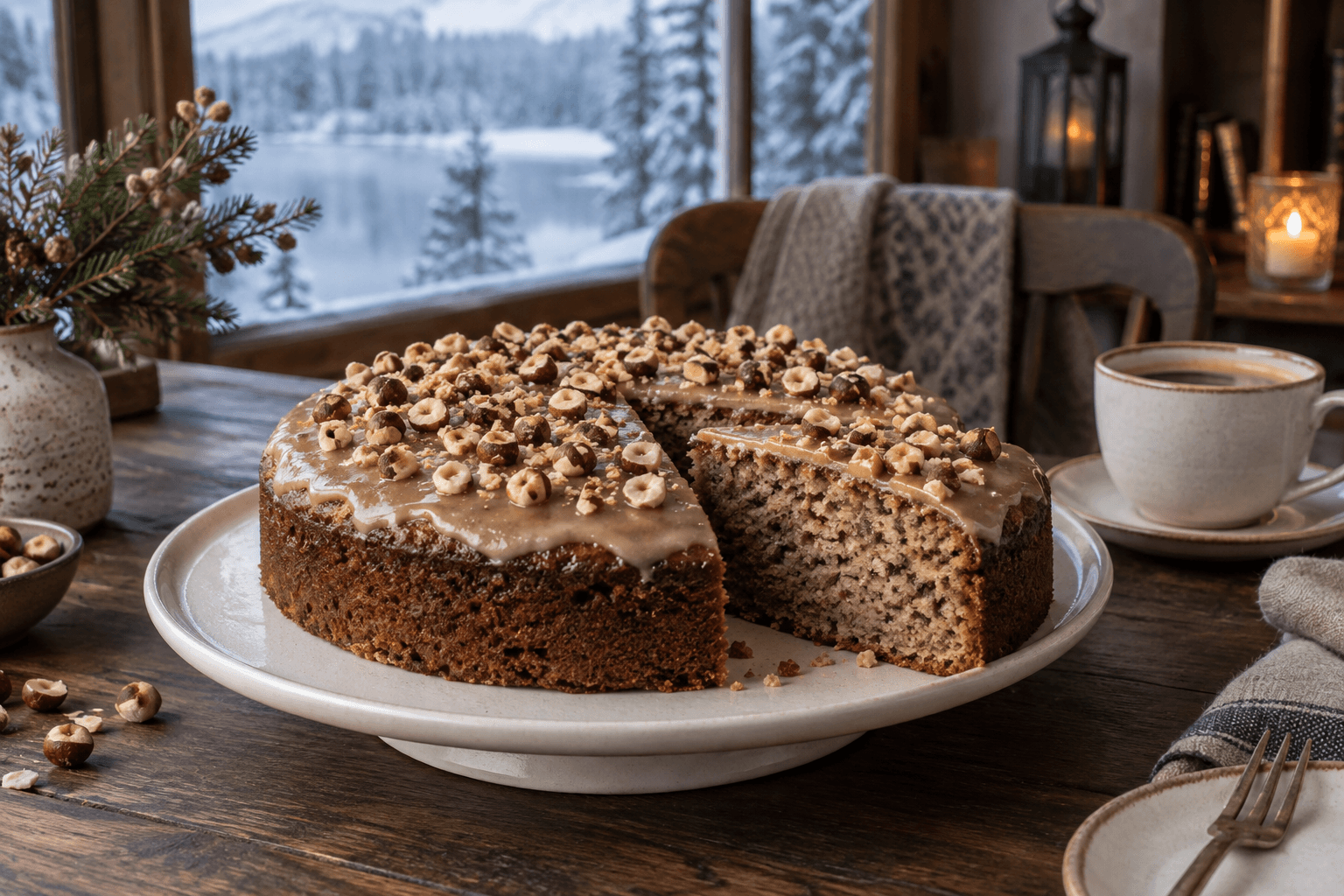
It was a hazelnut and coffee cake, with a thin glaze that had finally stopped threatening to run over the edge. He had made it that morning between the bread and a batch of rolls, setting aside a handful of the better-looking hazelnuts for the top. By four, the bakery was clean and the cake sat in its box on the counter.
He lifted the lid once more.
“You'll do,” he said.
There was nobody else in the shop to hear this, which was fortunate. He had views about people who talked to their baking.
Outside, the snow had been pushed into low walls along the pavement. The middle of the street was wet and dark. Emil carried the box with both hands, keeping it level while negotiating the uneven ridge at the corner of Café Vesper.
Through the window he saw Ruth beside the newspaper rack. She lifted a finger in greeting, then pointed at the box.
He nodded.
She held up five fingers, followed by a questioning expression.
“More than enough,” he mouthed.
Ruth looked pleased. She put her coat on.
At Pension Linden, Marta opened the door before he reached the bell.
“Good,” she said. “You're early.”
Emil was encouraged. Then she saw the box.
“What have you brought?”
“Something small.”
“Is there another box?”
“No.”
“Then we're using the word differently.”
She took it through to the kitchen, where a pot was on the stove and there was bread warming. Emil could tell from the arrangement of bowls and spoons that Marta had made a plan. He respected a plan. He merely thought it should be capable of accommodating cake.
“We'll have it after,” she said.
“With coffee.”
“Yes. After.”
He lifted the lid. “It was made this morning.”
“How sensible.”
“I thought we could begin with a little piece.”
Marta turned to him, holding the ladle. “Before dinner?”
It sounded rather more unreasonable when she said it.
Emil looked at the cake. He had imagined them seeing it when they arrived: the toasted nuts, the pale glaze, the neat shape of something he had made especially. He had imagined pouring the coffee, cutting a first slice, hearing that small silence when people tasted something good.
He had not imagined it sitting in its box until eight o'clock while he pretended not to wonder whether anyone wanted it.
“It's better today,” he said.
“It will still be today after the soup.”
The bell rang. Marta put down the ladle.
“Please leave it there a moment.”
He left it there. Then he looked for a plate.
The old oval serving dish was in the sideboard where it had always been. One handle had been repaired so neatly that only a fine line remained. Emil recognised it immediately. Marta had an excellent memory for damaged crockery and an unreliable memory for how it had become damaged.
He put the cake on it.
Lena came into the kitchen carrying the branches from last week. She had noticed one hanging loose and was trying to persuade it back into the jug.
“Oh,” she said, seeing the cake.
Emil felt better.
“Coffee and hazelnut.”
“It looks wonderful.”
Marta appeared behind her. “It does. Later.”
Ruth was already taking off her gloves in the doorway.
“I was promised more than enough,” she said.
“Nobody promised anything,” Emil replied.
“You used your eyebrows.”
Felix arrived in time to find four people looking at a cake with the seriousness normally reserved for a parcel delivered to the wrong address.
“Am I late?”
“No,” Marta said.
“The cake is early,” Lena explained.
There was a short silence. Then Ruth said, “Could we each have a very small piece?”
Marta looked towards the stove. The soup was ready. Nothing was going to collapse if it waited. She appeared to find this less comforting than Emil would have hoped.
“There won't be room for dinner.”
“Marta,” Ruth said, “I have been making room for dinner for sixty-nine years.”
It was Lena who laughed first. Marta followed, reluctantly, and put the kettle on.
Emil carried the cake into the winter garden. He placed it in the middle of the table and stood back while everyone sat down. There was the attention he had wanted. It made him feel pleased and, unexpectedly, a little foolish.
The pieces were small. Marta made certain of that by taking the knife herself.
They ate cake with coffee while the windows turned dark. The glaze clung faintly to a fork. Hazelnut crumbs escaped onto the tablecloth. Felix asked Emil whether he had used ground nuts in the batter, and Emil answered at greater length than was strictly necessary.
Ruth turned the serving dish to look at the repaired handle.
“Is this the one from the bicycle?”
“From the gate,” Marta said.
“There was a bicycle involved,” Emil admitted.
“You put it in the basket.”
“Wrapped.”
“In a napkin.”
“A thick napkin.”
Lena put down her fork. “What happened?”
Emil explained that he had borrowed the dish for an order several winters earlier. He had returned it carefully in the basket of his bicycle, walked the bicycle through Marta's narrow side gate and misjudged the handlebar by a small amount.
“You said the table moved,” Marta told him.
“The table also moves.”
“It wasn't even outside.”
Felix began to laugh. Ruth joined him. Emil accepted that his original account had not survived scrutiny and helped himself to the last crumb on his plate.
The soup followed. Everyone ate it. There was bread, conversation and a second pot of coffee later, though nobody wanted more cake until Ruth asked for another sliver and started a general reconsideration.
When Emil went through to fetch the empty box, he found Marta wiping the counter.
“I could have asked,” he said.
She looked up. “About the gate?”
“About bringing this.”
Marta folded the cloth over the tap. “I did say something small.”
“I thought it would be nice.”
“It was nice. I just didn't know we were having your evening as well as mine.”
He considered that. Behind them, Lena was telling Felix something about a book with a broken clasp. Their voices were easy together now.
“What would you like next time?” Emil asked.
Marta looked genuinely surprised.
“Bread,” she said. “The ordinary loaf. We all like that.”
“Just bread?”
“Just bread.”
He nodded. He could do just bread. It would require restraint, but he had managed more difficult things.
At the door, she handed him a packet containing the remaining cake.
“For tomorrow.”
“I thought you might keep it.”
“I have. That's your share.”
He tucked it carefully beneath his arm. Across the hall, Otto was examining an abandoned scarf with quiet professional interest.
“And Emil?”
He turned.
“Leave the dish.”

Written by Esther
Esther is a photographer and storyteller, and the founder of Essy's Essentials - a seasonal home for stories, rituals, recipes and everyday luxuries.
More about Esther →