A story from Hollowpine
Six Places for Saturday
The first Saturday brings warm food and good company to Pension Linden. Marta discovers how much of the evening happens without her.
Set at Pension Linden
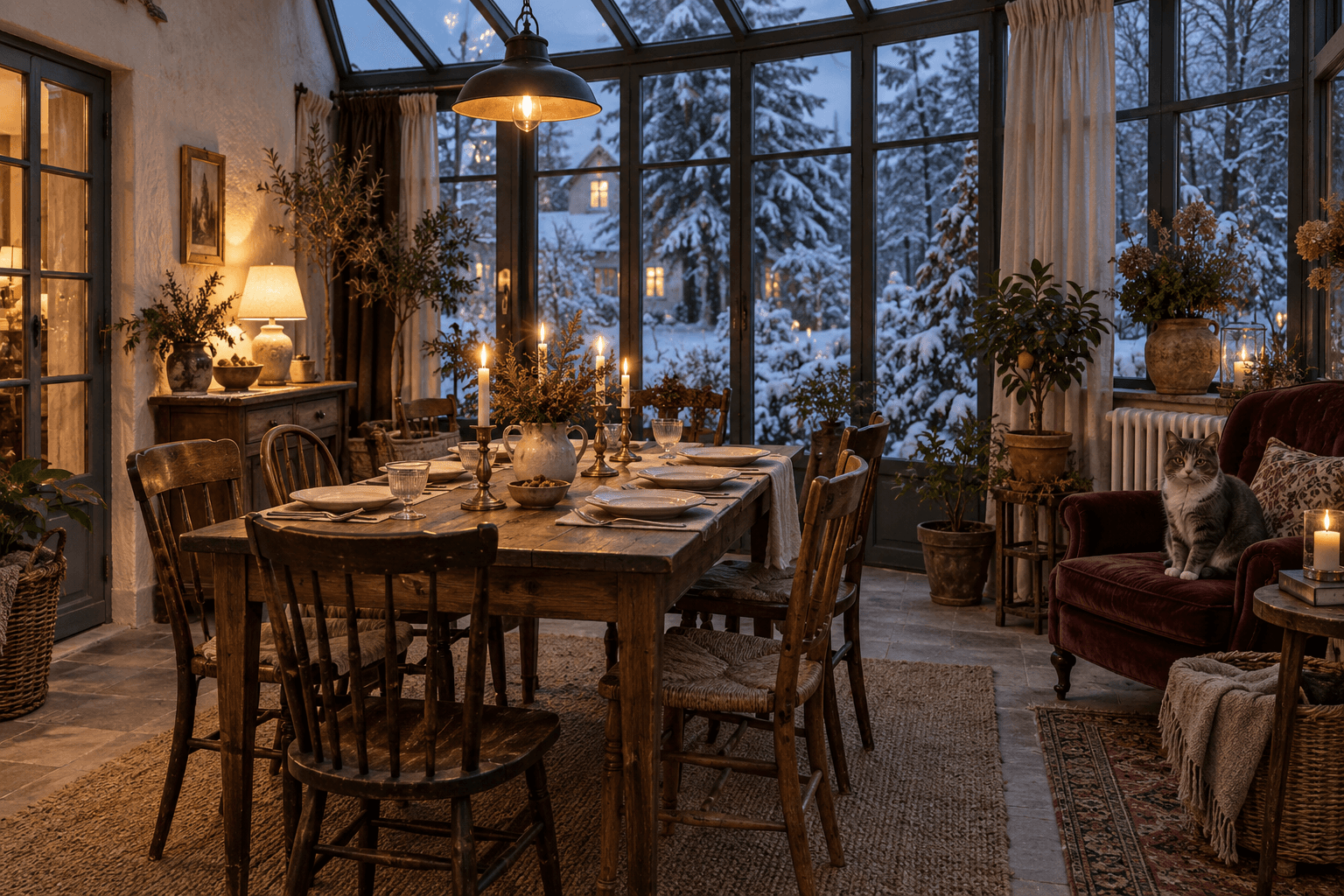
By four o'clock, Marta had changed the napkins twice.
The first ones were too large. The second ones were perfectly suitable, which had somehow made her wonder whether the first ones had been better. She stood beside the table holding both sets until Otto came in, looked at her and left again.
“You're right,” she said after him.
She put the smaller napkins down.
The mushroom goulash was ready. It stood on the back of the stove in a heavy pot, darker and better for the afternoon it had spent there. The polenta would need her attention later, but the onions were chopped, the bowls were warm and the kitchen was unusually clear.
There was nothing to do for twenty minutes. Marta found this difficult.
She checked the winter garden's radiator, moved the bread plate and went upstairs.
In her room, she exchanged her working cardigan for a dark blouse and fastened the small earrings she had left in a saucer that morning. The bottle of Givenchy L'Interdit Elixir stood beside the mirror. She put on a little, then looked at herself properly for the first time that day.
She had been dressed for everybody's dinner since breakfast. This was better.
Downstairs, the front bell rang.
Emil was carrying a loaf wrapped in a clean cloth.
“You said no starter.”
“I said come and eat.”
“This isn't a starter. It's bread.”
Marta took it. There were distinctions it was too early in the evening to dispute.
Lena arrived next, her cheeks bright from the walk. She held a small bunch of winter branches tied with string and immediately apologised for the fact that they weren't flowers.
“They're lovely,” Marta said.
“I wasn't sure what to bring.”
“Yourself was the arrangement.”
“I know. I brought that as well.”
Ruth came in behind her carrying nothing except her handbag. She took off her gloves one finger at a time and admired the lamp in the hall.
“It's always been there,” Marta said.
“Then I've been admiring it privately.”
Felix arrived last, although not late, with a dusting of snow on his shoulders. He had paused to help someone wheel a shopping trolley over a ridge of old snow, and the explanation took him longer than the task apparently had.
Soon there were coats in the hall, five glasses on the sideboard and voices in a room that had spent most of the winter listening to the radiator.
Marta had set six places out of habit. She removed the unused bowl and moved the spare chair back a little. Lena's branches went at that end of the table in a narrow jug.
“Where would you like me?” Ruth asked.
“Anywhere.”
Ruth chose a chair.
“Except that one,” Marta said. “It catches the door.”
Ruth stood up again. “Almost anywhere.”
The first few minutes went exactly as Marta had imagined. People looked around, said the room was lovely and settled into the soft awkwardness of a first evening. Emil asked Felix about a piano he had been working on. Lena tucked one foot under her chair. Outside, snow drifted through the lamplight in occasional, unhurried flakes.
Marta went to finish the polenta.
From the stove she could hear pieces of conversation, though never quite the pieces she needed. Someone said a name, then Ruth made a remark that brought a burst of laughter. Marta stirred more quickly.
When she returned with the bowls, they had moved on.
“What was funny?” she asked.
“The mayor's accordion,” said Felix.
“It wasn't the accordion,” Ruth said. “It was the determination.”
They laughed again, kindly, trying to bring her in, but explaining it made the story lose its shape. Marta smiled and went back for the pot.
She served everyone, fetched the bread knife and noticed that Lena's water glass was nearly empty. By the time she had filled it, Emil was looking towards the kitchen.
“Shall I get yours?”
“In a moment.”
“Is it different?”
“What?”
“Your dinner. Is it something complicated?”
“It's the same dinner.”
“Then it should be fairly easy to find.”
Ruth moved the jug towards the middle of the table.
“Sit down, Marta. We can reach things.”
Marta sat. Her place was nearest the kitchen door. She had chosen it because it was convenient, and now she wondered whether convenience had been the problem.
The mushrooms were tender, the sauce caught in the folds of the polenta, and the bread was still good enough to make Emil unnecessarily pleased with himself. For several minutes she ate and listened.
Lena was describing a book someone had brought in to be rebound. Between its pages were fourteen pressed flowers, a shopping receipt and a photograph of a dog. The owner had supplied detailed instructions for the flowers and nothing at all about the dog.
“You have to assume the dog stays,” Felix said.
“I did.”
“What about the receipt?”
“It was for a washing machine.”
Ruth nodded. “A significant purchase.”
Marta laughed with the others. This time she had been there for all of it.
Then she noticed that the pot was running low.
She was on her feet before she had finished swallowing. There was more in the kitchen; somebody might want another helping. Emil stood too, picked up the pot and began spooning the remainder into a smaller dish.
“No, leave it in that,” Marta said.
“This one fits on the table.”
“But then the sauce—”
He paused with the spoon in his hand.
They regarded each other across the kitchen counter. Behind them, Ruth was asking Felix a question about his work.
“Do you want help?” Emil asked.
“Yes.”
“Some of it appears to involve letting me move food.”
She almost laughed. Almost.
“All right. Use that one.”
They returned together. The smaller dish fitted perfectly between the water jug and the bread.
Later, Otto appeared in the doorway, took in the increased number of people and decided his upstairs basket had advantages after all. Felix left at the same time as Ruth so they could walk down the hill together. Lena stayed just long enough to carry two glasses through, and Emil remembered his empty bread cloth only after he had put on his coat.
When the door closed, Marta stood still in the hall.
It had been a good evening. She knew it had. She had laughed, and the food had gone, and Ruth had said, “Next Saturday, then,” without making it sound like an obligation.
In the winter garden, she gathered the napkins. Four were rumpled beside the plates. Hers was still folded on the chair, exactly as she had placed it at four o'clock.
Marta picked it up and shook it open.
She left the glasses for a moment, moved her chair farther from the kitchen door and sat down to finish the last of her wine.

Written by Esther
Esther is a photographer and storyteller, and the founder of Essy's Essentials - a seasonal home for stories, rituals, recipes and everyday luxuries.
More about Esther →