The Whole-Home Organisation Reset
A room-by-room review for improving household systems without attempting to reorganise everything at once.
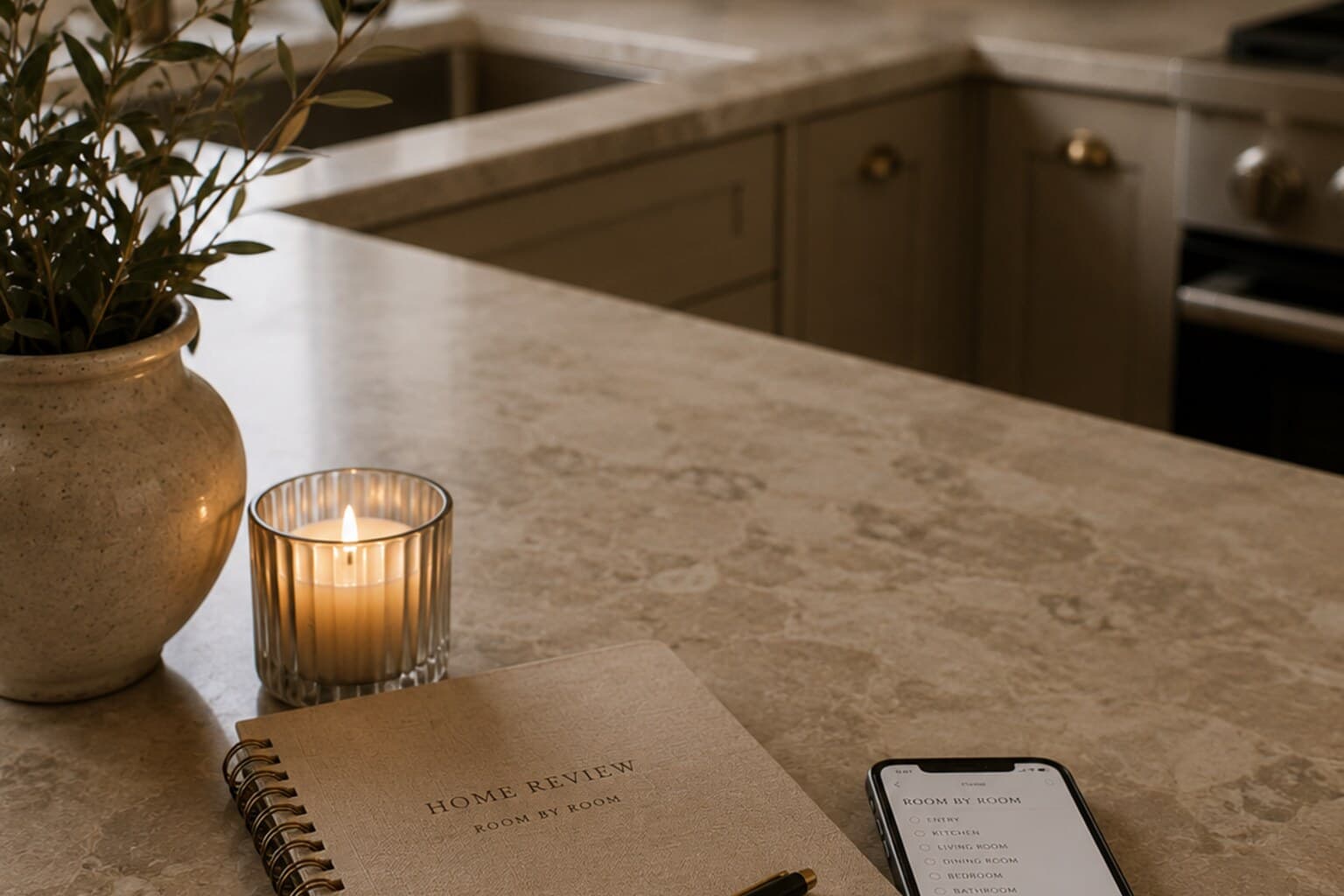
At a Glance
- Set the scope
- Rate each area
- Review the entrance
- Review the kitchen
- Review the living area
- Review bedrooms
- Review bathrooms
- Review work and administration areas
- Review utility and hidden storage
- Identify migrating objects
- Create the project list
A whole-home reset does not mean emptying every cupboard. It means reviewing how the home functions as one connected system.
Where does clutter begin? Which items repeatedly lose their place? Which cupboards are full while everyday objects remain on surfaces? Which rooms contain categories that belong elsewhere?
The Whole-Home Organisation Reset identifies these patterns. It creates a plan for smaller, focused improvements.
What You’ll Need
- A notebook
- Phone camera
- A small basket
Set the Scope
Walk through the home with a notebook, phone camera and a small basket. Do not begin reorganising during the first review - record what is not working.
Look for blocked surfaces, overfilled storage, items with no home, daily objects stored too far away, duplicate supplies, unused furniture, categories spread across several rooms, and rooms serving too many functions.
Rate Each Area
Use three levels: working well (no immediate change needed), needs a small adjustment (one clear issue can be solved quickly), and needs a separate project (the area requires time, decisions or new storage).
This prevents every observation from becoming urgent.
Review the Entrance
Can people arrive without placing items in other rooms? Do keys, coats, shoes and bags have clear places? Is there room for guests? Does outgoing post or returns have a location? Is the main route clear?
Choose one adjustment.
Review the Kitchen
Are daily tools easy to reach? Are worktops used for storage? Are food categories visible? Are duplicates open at the same time? Can dishes be put away easily? Are serving pieces stored near where they are used?
Choose one drawer, shelf or category for the next edit.
Review the Living Area
Where do daily items gather? Are chargers, remotes and blankets contained? Does every piece of furniture still serve the room? Are open shelves overcrowded? Is paperwork entering the room? Can the room be reset in five minutes?
Choose one friction point to solve.
Review Bedrooms
Can clothing return to the wardrobe easily? Are bedside surfaces practical? Does under-bed storage contain known items? Are laundry baskets placed where clothing is removed? Is seasonal clothing using prime space?
Choose one wardrobe or bedside improvement.
Review Bathrooms
Are daily products accessible? Are backups separated from current products? Are expired or unused items present? Is cleaning equipment easy to reach? Do towels have enough storage? Are surfaces difficult to clean because they are crowded?
Choose one category to simplify.
Review Work and Administration Areas
Does paper have one entry point? Are current documents separate from archives? Are supplies near the work area? Can the desk be cleared at the end of the day? Is technology stored safely? Are cables identifiable?
Choose one system to improve.
Review Utility and Hidden Storage
Are cleaning supplies safe and visible? Can household tools be found? Are seasonal items labelled? Are heavy items stored appropriately? Do backups exceed realistic needs? Is anything damaged by moisture, heat or poor access?
Choose one area requiring maintenance or reduction.
Identify Migrating Objects
Migrating objects repeatedly appear in the wrong room - post on the dining table, shoes in the living room, laundry on a chair, chargers across several surfaces, tools in kitchen drawers, travel items in bedrooms.
For each one, ask: does it need a better home? Is its current home too difficult to use? Does the household need more than one location? Is the item no longer needed? Solve the pattern rather than moving the object repeatedly.
Create the Project List
Limit the organisation plan to three quick adjustments, three medium projects and one larger project.
Quick adjustments: add a tray, move a basket, relabel one shelf, remove one broken item. Medium projects: edit one wardrobe section, organise the cleaning cupboard, create an entrance system. Larger projects: replace unsuitable storage furniture, reconfigure a utility room, create built-in storage.
Complete quick adjustments first - they may reduce the need for larger interventions.
The Checklist
- Working systems to keep
- Daily friction points
- Objects without homes
- Overfilled categories
- Storage used inefficiently
- Repairs required
- Three quick adjustments
- Three medium projects
- One larger project
- Next review date
Pair It With
A well-organised home is not created through one dramatic weekend.
It develops through a sequence of practical corrections. One drawer that opens properly. One entrance that receives the day. One cupboard that stores what is genuinely used.
One system at a time, the home becomes easier to live in.
Enjoyed this?
The Seasonal Letter brings more stories, recipes and rituals like this one - a few times a season, never more.

Written by Esther
Esther is a photographer and storyteller, and the founder of Essy's Essentials - a seasonal home for stories, rituals, recipes and everyday luxuries.
More about Esther →