The Slow Hobby Hour
A quiet hour built around one slow, hands-on hobby - journaling, mending, watercolour or anything else that asks for your hands instead of a screen.
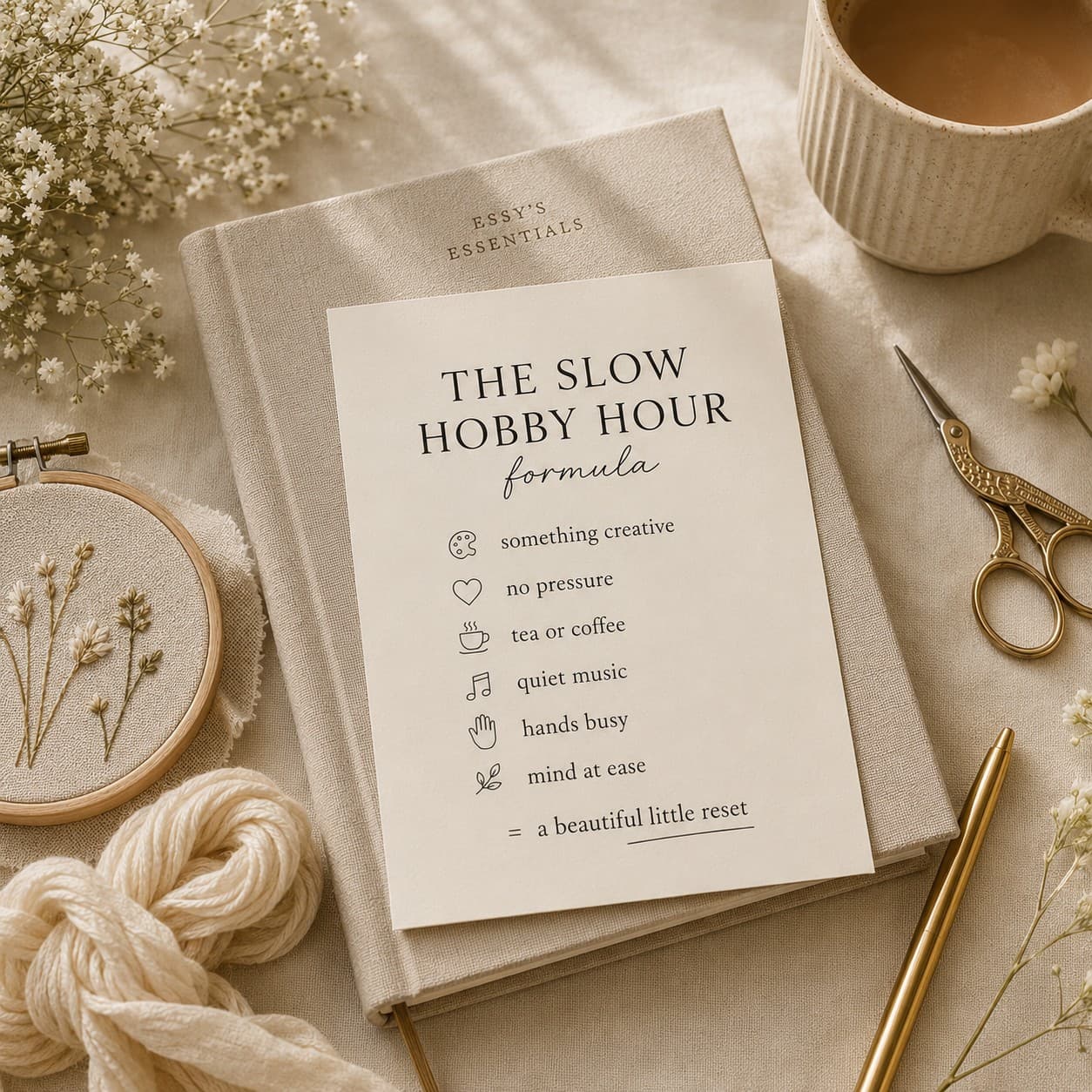
“A cosy hobby doesn't need to become a skill. It only needs to ask for your hands instead of your phone for a little while.”
At a Glance
- Choose one hobby, not several
- Set a fixed, short amount of time
- Remove the phone from the room
- Choose materials in advance
- Let the result be unimportant
- Add one sensory detail
- Return to it on a rhythm, not a rule
Self-care used to default almost automatically to skincare and a bath. Lately, a quieter alternative has taken hold: a slow, hands-on hobby - journaling, mending, watercolour, slow reading, letter-writing - picked up for no reason other than that it asks for attention instead of a screen.
The point is not to become skilled at the hobby, or to produce anything worth keeping. It is simply to hold one hour's attention somewhere other than a phone.
Choose One Hobby, Not Several
Pick a single hobby for this hour - journaling, mending, watercolour, cross-stitch, slow reading, letter-writing - rather than researching the "right" one.
Which hobby it is matters far less than actually sitting down and doing it.
Set a Fixed, Short Amount of Time
Twenty to forty minutes is usually enough. A clear time limit removes the pressure to "finish" something, and keeps the hour from quietly turning into another task.
Stop when the time is up, whatever state the page, stitch or paragraph is in.
Remove the Phone From the Room
Leave it in another room rather than simply turning it face down nearby.
Being screen-free is the entire point of the hour, not an incidental detail.
Choose Materials in Advance
Keep a small, ready kit - a notebook and pen, a paint set, mending supplies, stationery - so the hour doesn't begin with ten minutes of searching for materials.
A hobby that's ready to pick up gets picked up far more often than one that requires setup first.
Let the Result Be Unimportant
This is not a productivity practice or a new skill to master. A messy page, an uneven stitch or an unfinished letter is not a failure.
Judging the result quietly turns the hour back into work - which is exactly what it is meant to be an escape from.
Add One Sensory Detail
Tea, a specific playlist, a candle - one small, consistent detail is enough to mark the hour as different from an ordinary evening.
Repeating the same detail each time also helps the hour start to feel automatic rather than like a decision to make from scratch.
Return to It on a Rhythm, Not a Rule
Once or twice a week, tied to a particular evening, tends to hold up better than an ambitious daily promise that quietly gets skipped.
A loose, repeatable rhythm survives a busy week. A strict daily rule usually doesn't.
The Checklist
- One hobby chosen for this session
- A fixed time set in advance
- Phone left in another room
- Materials ready before starting
- No expectation of a finished or good result
- One sensory detail added
- A loose weekly rhythm, not a daily rule
Make It Seasonal
Summer
- Watercolour outdoors in the last of the evening light.
- A travel journal kept through the season, one line a day.
Autumn
- Mending and visible darning as the evenings draw in.
- Letter-writing, paired with a warm drink.
Winter
- A longer-format project suited to darker evenings - a bigger cross-stitch, a full season's journal.
- Slow reading by lamplight rather than a screen.
Spring
- Pressing flowers into a journal.
- Sketching whatever is newly in bloom nearby.
Make It Your Own
- Keep a single "hobby shelf" so materials never need finding.
- Pair it with a specific drink or playlist so the hour signals its own start.
- Let it double as a small archive - a season of journal pages, a growing pile of mended clothes, a shelf of finished watercolours.
- Share the rhythm with one other person, without turning it into a class or a commitment.
Pair It With
A slow hobby doesn't have to produce anything worth keeping.
It only has to hold one hour's attention somewhere other than a screen - which, on its own, is often enough.
Enjoyed this?
The Seasonal Letter brings more stories, recipes and rituals like this one - a few times a season, never more.

Written by Esther
Esther is a photographer and storyteller, and the founder of Essy's Essentials - a seasonal home for stories, rituals, recipes and everyday luxuries.
More about Esther →