The Calm Baking Cupboard
A considered collection of baking ingredients and tools for making simple cakes, cookies and breads without overcrowding the kitchen.
At a Glance
- Begin with the recipes
- The everyday foundation
- Store in practical quantities
- Label decanted ingredients clearly
- Create a use-first section
- Check freshness
- Limit specialist decorations
- Review baking tools
- Store tins vertically where possible
A baking cupboard can become one of the most difficult kitchen areas to manage - half-used bags, several types of sugar, decorations purchased for one occasion, old raising agents, duplicate tins, ingredients stored without labels.
The Calm Baking Cupboard is built around a small number of recipes and ingredients that work across several kinds of baking. Its purpose is not to provide every possible option. It is to make familiar recipes easy to begin.
Begin with the Recipes
List the bakes prepared most often - loaf cake, cookies, fruit crumble, focaccia, muffins, brownies, scones. Identify the ingredients repeated across them.
These ingredients form the foundation.
The Everyday Foundation
A simple baking cupboard may contain dry ingredients (plain flour, self-raising flour where regularly used, oats, sugar, brown sugar, cocoa, baking powder, bicarbonate of soda, salt, yeast), flavour ingredients (vanilla, cinnamon, cardamom, nutmeg, almond extract where used, citrus zest from fresh fruit), and texture and additions (chocolate, nuts, seeds, dried fruit, coconut, breadcrumbs).
Keep only additions that regularly appear in recipes.
Store in Practical Quantities
Large packages may appear economical but are not useful when ingredients lose freshness before use. Choose quantities based on how often baking happens, available storage, shelf life, household size, and humidity and temperature.
Review specialist ingredients before replacing them.
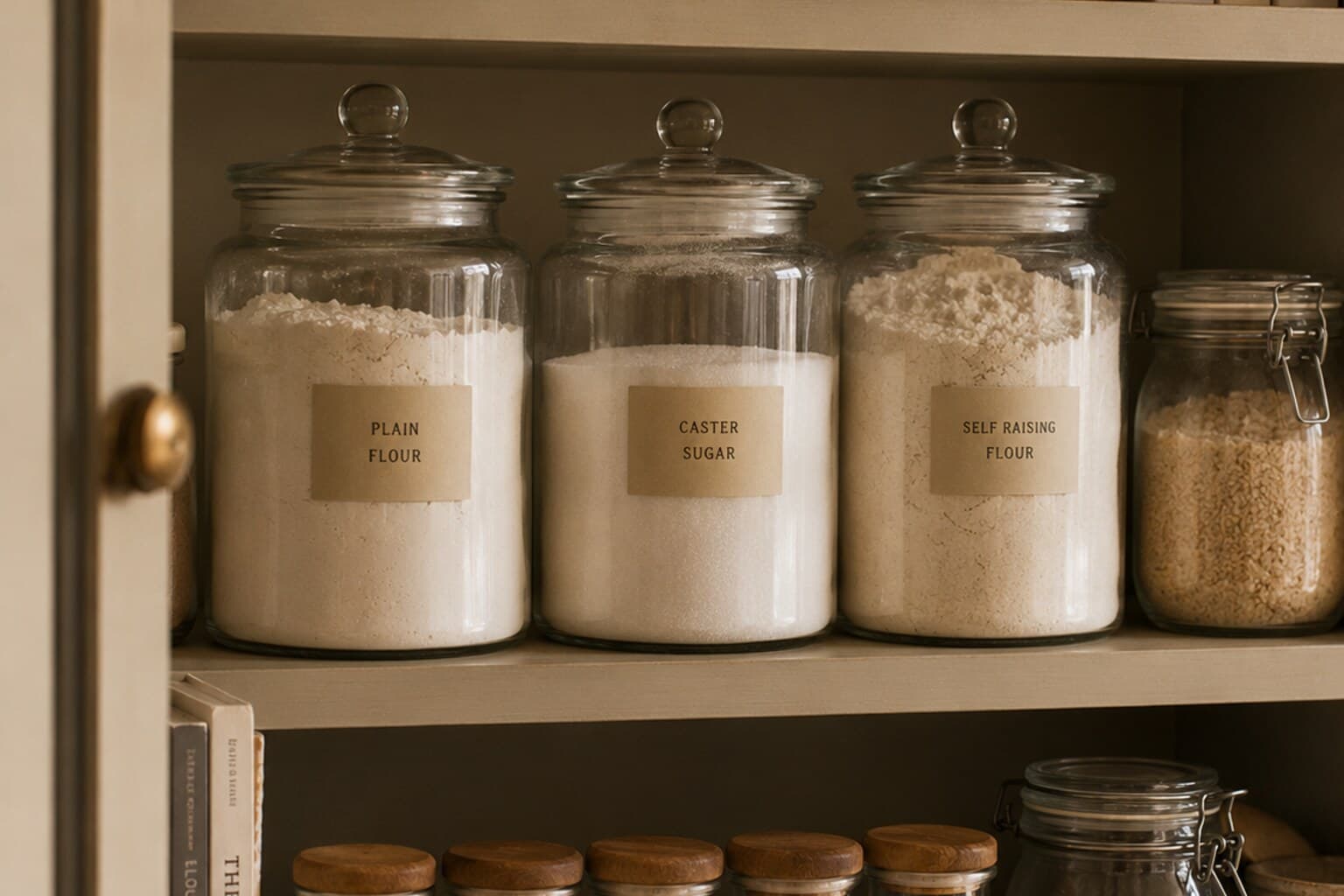
Label Decanted Ingredients Clearly
When ingredients are transferred into containers, include ingredient name, allergen information, best-before date, type or strength where relevant, and cooking instructions if needed.
Flour, sugars and raising agents can look similar. Clear labels prevent mistakes.
Create a Use-First Section
Place open or nearly empty ingredients together - half a bag of flour, opened nuts, chocolate pieces, dried fruit, part-used decorating ingredients.
Review this area before choosing the next bake. A simple recipe may be selected specifically to use what is already open.
Check Freshness
Some baking ingredients lose effectiveness or flavour over time - review baking powder, bicarbonate of soda, yeast, nuts, seeds, wholegrain flour, spices and chocolate.
Follow storage guidance provided by the manufacturer. Do not assume that every dry ingredient remains at its best indefinitely.
Limit Specialist Decorations
Sprinkles, colours and decorative toppings often accumulate quickly. Keep them only when they are used regularly, suit several occasions, remain within date, and there is a clear storage limit.
Simple finishes may include icing sugar, glaze, fruit, nuts or chocolate. A cake does not need several decorative products to feel complete.
Review Baking Tools
A practical collection may include mixing bowls, a whisk, a wooden spoon or spatula, kitchen scales, a measuring jug, measuring spoons, a cooling rack, baking paper, one or two dependable cake tins, a baking tray and a loaf tin.
Keep specialist equipment only when it supports recipes actually prepared.
Store Tins Vertically Where Possible
Baking tins and trays can be difficult to access when stacked. Vertical dividers may help with baking sheets, muffin tins, cooling racks and cutting boards.
Check that the storage is stable and suitable for the weight.
The Checklist
- Frequently made recipes identified
- Core ingredients selected
- Open packages visible
- Containers labelled
- Raising agents reviewed
- Nuts and flour checked for freshness
- Decorations limited
- Tins and tools easy to access
- Shopping list based on real use
Pair It With
A useful baking cupboard does not need to contain everything.
It needs to contain enough to make one familiar recipe without first reorganising the shelf.
Enjoyed this?
The Seasonal Letter brings more stories, recipes and rituals like this one - a few times a season, never more.

Written by Esther
Esther is a photographer and storyteller, and the founder of Essy's Essentials - a seasonal home for stories, rituals, recipes and everyday luxuries.
More about Esther →