The Amberfell Guide
Slow Autumn Living
A thoughtful, practical and beautiful guide to living autumn more slowly - through softer mornings, a warmer home, comforting food, unhurried weekends and the quiet systems that leave room for the season itself.
14 min read
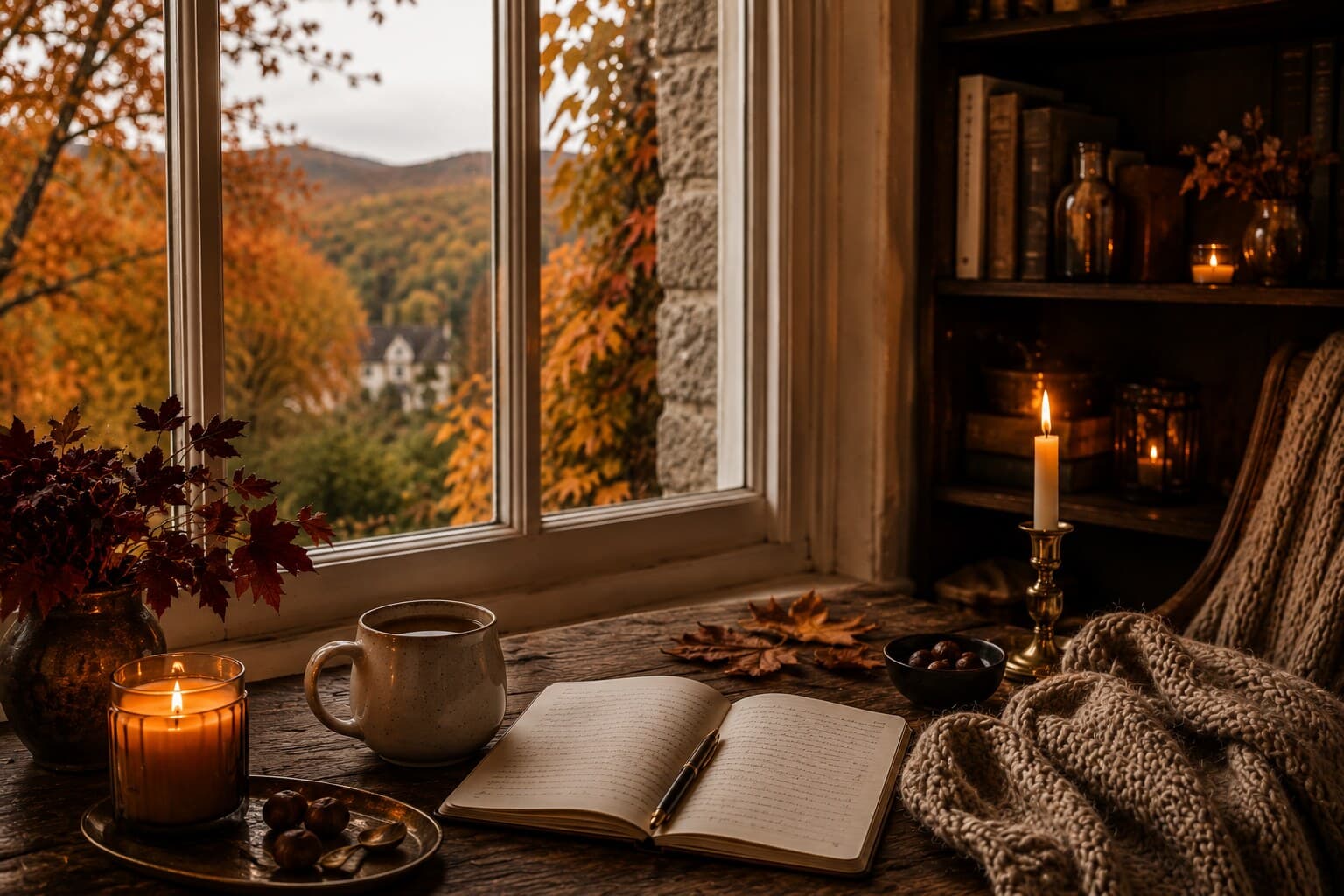
Autumn rarely enters all at once. It begins with one darker morning, the first cup of coffee that needs both hands around it and a coat taken from the cupboard before you were quite ready to admit summer had finished. The light changes. The house sounds different in the rain. Dinner starts wanting to be warmer.
I like this part: not the grand announcement of a new season, but the small negotiations that happen around it. The blanket that moves back to the sofa. The lamp switched on before five. The walk shortened because the weather has become persuasive. The sudden appeal of something baking while the windows cloud at the edges.
Slow autumn living begins there. It is a way of paying attention to the season and adjusting the rhythm of ordinary life with it. Not withdrawing from work, plans or ambition. Not arranging a flawless collection of knitted things. Simply noticing what the darker, cooler months ask for - more warmth, better transitions, food that steadies the day and occasional space in which nothing needs to be improved.
That last part matters. Autumn can easily become another project: a list of rituals to perform, rooms to restyle, recipes to master and weekends to fill with the correct kind of wholesome activity. I would rather it felt like relief. A season with enough character to meet us where we already live.
What is slow autumn living?
Slow autumn living is the practice of responding to the season with intention: noticing changes in light, weather and energy; creating simple rituals around home, food and rest; and choosing depth, comfort and attention over constant activity. It does not require a slower life in every area. It asks only that some parts of the day are allowed to feel unhurried and properly lived.
Let autumn be a real season, not a performance
The most convincing autumn days are rarely the most styled ones. They contain wet shoes by the door, a parcel you forgot was arriving, a mug gone lukewarm beside a laptop and a dinner changed because nobody wanted to go back out in the rain. The pleasure comes from responding well: dry socks, one lamp in the right corner, soup or toast or something warm from the oven, and the decision that the abandoned walk can wait.
This is why slow seasonal living works best when it begins with reality. Some weeks are crowded. Some mornings start in the dark and continue directly into meetings. A beautiful season has to survive contact with Tuesday.
Instead of asking how to make every day slower, ask where the day could feel less abrupt. Perhaps the first ten minutes happen without the news. Perhaps the light in the kitchen is warm rather than bright. Perhaps coming home has a sequence: coat away, shoes off, kettle on, lamp lit. Tiny transitions can change the emotional temperature of a day without requiring a new personality or an empty calendar.
Amberfell is built around that idea. Its comfort is not decorative. Rain alters plans. Bread is bought because people need feeding. Blankets are used. Fires require tending. The village feels warm because its people keep making practical decisions that create warmth for one another.
The same is true at home. Atmosphere is often just care made visible.
Make autumn mornings softer, not more complicated
There is a particular kind of ambition that appears on seasonal mornings. It involves waking early, lighting a candle, writing three perfect pages, taking a misty walk and producing breakfast before normal life is permitted to begin. Lovely, occasionally. A difficult standard for an ordinary Wednesday.
A slow autumn morning can be much smaller.
On a workday, it might mean preparing one thing the night before so morning has fewer sharp edges. Coffee ready to make. Clothes that do not require a negotiation. Breakfast within reach. Curtains opened before the main light goes on, just to see what sort of day has arrived.
At the weekend, there can be more room. Coffee taken back to bed. A newspaper opened properly rather than skimmed on a screen. Croissants from somewhere that knows what butter is for. The Apple, Oat & Brown Sugar Breakfast Crumble assembled the evening before and baked while the house wakes up. Not a morning routine designed for maximum output; a morning allowed to become itself.
The useful question is not, "What would the ideal autumn version of me do?" It is, "What would make this morning feel kinder?"
Sometimes the answer is breakfast. Sometimes it is eight quiet minutes. Sometimes it is cancelling the idea that every morning must be used well.
Essy's note
I am naturally someone who likes structure, organising and a good plan. Those things genuinely make my life calmer. But I have also noticed how quickly rest can become something else to optimise. If I start measuring the quality of a slow morning by how many rituals I completed, I have rather missed the point. My favourite mornings usually contain one lovely thing and enough space to notice it.
Let the house change by degrees
A home does not need a seasonal costume. It needs to work with the season outside it.
Autumn asks different things of a room. Somewhere to leave a wet coat. Light that feels good before the evening has officially begun. A blanket close enough to use without first dismantling a cushion arrangement. A place to read that does not depend on daylight. A bedside table that can hold both a book and a cup without becoming a still life.
Begin with function. Move a lamp before buying another one. Wash the blanket already in the cupboard. Clear the chair that catches afternoon light. Put the umbrella where it can dry without making the floor resentful. Bring matches close to the candles you actually light.
Then add atmosphere sparingly. Wood, wool, linen, paper, glass and a little aged metal already carry more seasonal character than a shelf full of objects announcing September. Scent can help, but it should belong to a real room: warm resin, tea, dry leaves, cedar, a trace of spice. The goal is not to make the house smell like an imaginary bakery operating inside a forest. It is to make coming home feel distinct from being elsewhere.
In Amberfell, Alder House changes slowly. The deep-green door stays the same. The old wood stays old. Autumn arrives through practical details: a wreath at the threshold, boots allowed to drip, the first blanket brought downstairs and the kitchen lamp switched on before the rest of the room has admitted it is dark.
That is enough. A season becomes believable through repetition, not volume.
Cook food that tells you what month it is
Seasonal food gives autumn a rhythm that decoration cannot. Apples at breakfast. Mushrooms and thyme under pastry. Scones broken open while still warm. Dark chocolate in a cup on an afternoon when the rain has removed every reason to be elsewhere.
The pleasure is partly anticipation. Certain foods become more appealing because they return at the right time. They do not need to be complicated, and they certainly do not all need to contain pumpkin.
Choose a small autumn repertoire rather than a performance menu. One breakfast you look forward to. One savoury bake that can stretch from lunch into supper. One thing to make when someone comes in wet. One drink that marks the point at which work has ended and evening begins.
Amberfell’s table follows the village. Apples and pears come through Vale Orchard. Holloway’s supplies the ordinary ingredients the orchard does not produce. March & Sons handles bread, croissants and the useful reassurance of a warm bakery window. Gruyère, maple, cacao and chocolate arrive through normal suppliers; the village does not become more romantic by pretending otherwise.
This continuity matters because slow living is not a fantasy of self-sufficiency. It is attention to sources, seasons and the people whose ordinary work keeps a table supplied.
There is room for pleasure here. Butter. Pastry. A proper hot chocolate. The satisfying sound of a tart crust when the first slice is cut. But comfort food works best when it feels like food, not decoration. No cream towers required.
Give weekends somewhere to breathe
A slow weekend is not simply a weekend with fewer plans. It has room between them.
That room might hold a walk taken without a step target, a market visited for dinner rather than content, a matinee followed by coffee, or a morning at home that does not immediately become preparation for the afternoon. It might hold friends, but not necessarily hosting. A long table is lovely; so is seeing someone for an hour and keeping the evening.
Weather helps make the decision. On a clear morning, go outside before the light changes its mind. Walk through trees, take the longer route home, notice what has altered since last week. When it rains, let the plan become smaller rather than treating the day as spoiled. Choose a bookshop, a museum, a cinema, a bakery table or the chair beside your own window.
The Sunday the Rain Stayed is one of Amberfell’s central ideas for exactly this reason: a cancelled walk does not create an empty day. It reveals a different one. Bread, a book and relief can be a perfectly complete itinerary.
The point is not to manufacture quaintness. It is to stop treating unallocated time as a problem that requires filling.
If every weekend ends with the feeling that you successfully completed autumn, the season may need less management.
Read, make and listen without turning it into progress
Autumn is well suited to quiet hobbies because the weather creates edges around the day. The room is darker. Going out requires more negotiation. Staying in begins to feel like a choice rather than a default.
Reading is the obvious companion, although even reading can acquire targets, streaks and the faint atmosphere of annual appraisal. The Margin in Amberfell has a better category: books for weather delays. A book does not need to improve you or prove that the afternoon was used wisely. It only needs to hold your attention for a while.
The same applies to making things. Write by hand. Cook something slowly enough to hear it change. Mend a button. Arrange photographs. Paint badly. Learn the part of a song that keeps returning to you. Work on a puzzle for three evenings and remain entirely unconcerned about when it will be finished.
Choose music that gives the room a rhythm without taking it over. The First Kettle at Alder House for a morning that needs easing into. Rain on Church Lane for reading while the window does most of the talking. The Fire After Four when the light has left early and the evening deserves a proper beginning.
Analogue does not have to mean nostalgic. It simply gives the hands something to do while the mind stops refreshing itself.
Organise autumn gently enough to enjoy it
There is a practical side to a softer season. Blankets need washing. Coats need checking. The darker evenings change how errands feel. Heating costs, travel plans, celebrations and year-end expenses begin moving towards the same part of the calendar.
Ignoring those things does not create slow living. It creates a Thursday on which everything becomes urgent at once.
This is where gentle organisation earns its place. A short Sunday reset. A seasonal savings pot. A list of appointments and purchases that are genuinely coming, rather than a vague promise to deal with them later. A few meals chosen before the week begins. Not because autumn must be efficient, but because practical life should not consume every quiet corner.
I think of organisation as making margin. The goal is not a perfect system. It is fewer avoidable interruptions. Coffee tastes better when you are not simultaneously remembering four things you forgot.
Keep the system proportional. One page can hold the week. One seasonal list can separate needs from lovely extras. One half-hour can restore the kitchen, calendar and laundry to a condition in which Monday feels possible. Stop before the reset becomes the weekend’s main event.
Beautifully Organised Living belongs inside the Amberfell world for this reason. A cosy life still contains passwords, grocery lists, budgets, reminders and recycling days. The quiet systems behind it are not a failure of romance. They are how the lamp is on, the bread is in and there is enough room left to sit down.
Choose your own autumn rhythm
There is no single correct collection of autumn rituals. A ritual only becomes meaningful through return. Choose too many and the season begins to resemble a course you have enrolled in by accident.
Start with three anchors.
One small daily return: choose something that helps the day change pace - light the lamp before dinner, take ten minutes with coffee before opening your phone, walk once around the block after work or put on one playlist while the kitchen is cleared.
One weekly pleasure: give yourself something with enough space around it to anticipate - breakfast back in bed, a Saturday bake, an afternoon film, a long walk, a reading hour or dinner made without rushing towards the next thing.
One practical kindness: do the small piece of organisation that protects the other two - prepare breakfast, clear the chair, check the calendar, put money into the seasonal pot or decide what can be left undone.
Keep those three for a few weeks. If they begin to feel natural, the season has found a rhythm. If they feel like obligations, choose smaller ones.
You do not need to become a slower person. You only need a few places in the week where speed is no longer in charge.
A Small Autumn Prompt
Complete these three lines without trying to make them impressive:
- Each day, I would like to return to…
- Once a week, I want to make room for…
- To protect that time, I can quietly prepare…
Frequently Asked Questions
What does slow autumn living mean?
Slow autumn living means responding to the season with greater attention. It can include softer morning and evening transitions, comforting seasonal food, a home adjusted for cooler weather, unhurried hobbies and practical routines that protect time for rest. It does not require withdrawing from work or making every day slow.
How can I practise slow autumn living when I am busy?
Choose one small transition rather than rebuilding the whole day. Prepare breakfast the night before, take ten minutes without your phone, light a lamp when work ends or protect one unhurried hour at the weekend. Slow living can exist in small, repeated parts of a busy life.
Is slow autumn living just cosy decorating?
No. A warm and comfortable home can support it, but the idea is broader than decoration. Slow autumn living is about attention, pace, seasonal food, rest, hobbies, relationships and the practical organisation that creates room to enjoy ordinary days.
What are some simple autumn rituals?
Useful rituals include morning coffee without a screen, breakfast back in bed, an after-work walk, a weekly bake, reading beside a rainy window, lighting the evening lamp before dinner or holding a short Sunday reset. Choose a few that suit your real life rather than copying a long checklist.
How can I make my home feel cosy for autumn without buying much?
Begin with what you already own. Move a lamp, wash and use an existing blanket, clear a comfortable chair, make space for wet coats and boots, bring matches near the candles you light and choose one subtle seasonal scent. Function and repeated use create more atmosphere than a large amount of seasonal decor.
Continue Into Amberfell
Amberfell is the fictional village in which these ideas become lived details. The season begins at Alder House, then moves through a bakery waking before the village, a bookshop with a shelf for weather delays, an orchard, a hall, a station and the people whose paths keep crossing between them.
Begin with the full Autumn in Amberfell edition if you want the world. Choose The Breakfast-in-Bed Ritual for a softer morning, How to Bring Amberfell Home for the material and atmosphere of the season, or The Rain-at-the-Window Reading Hour when the weather has already made the day’s decision.
If food is your way into a place, start with the Apple, Oat & Brown Sugar Breakfast Crumble and continue through the four recipes from the Amberfell table. If you want something to keep beside the next book you open, For Weather Delays Only waits in the Amberfell Cabinet.
There is no correct route through the village. Open the door that feels warmest from where you are standing.

Written by Esther
Esther is a photographer and storyteller, and the founder of Essy's Essentials - a seasonal home for stories, rituals, recipes and everyday luxuries.
More about Esther →