The Little Things · A Valentine’s Edit
The Table by the Window
A story from Hollowpine · The Little Things: A Valentine’s Edit
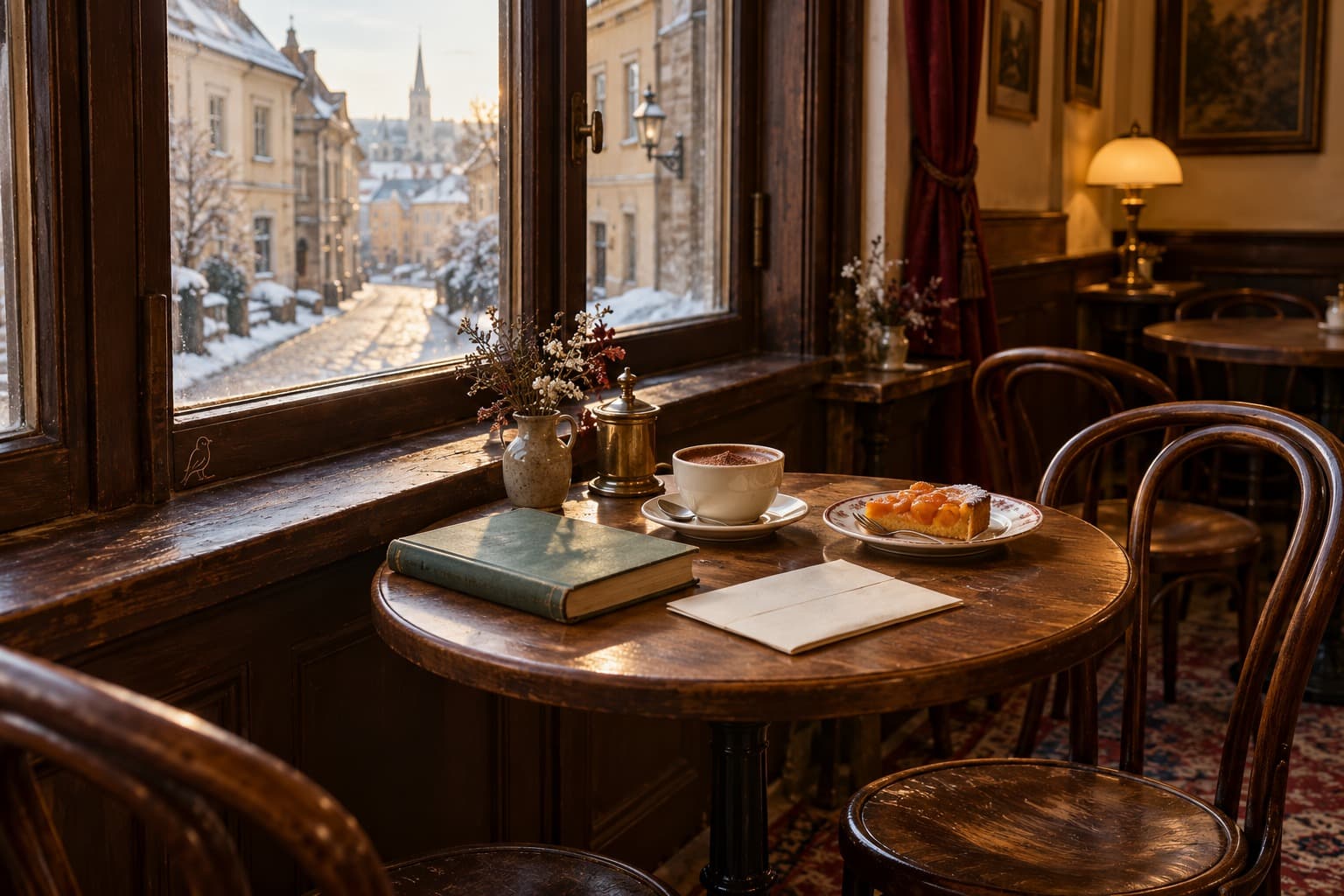
1. A Room of Her Own
Clara had packed three books for three nights, which seemed reasonable until she remembered that she had spent the previous six weeks reading the same eleven pages.
She put them in the suitcase anyway. They represented a woman she hoped to meet on holiday.
At the station in Hollowpine, the platform was edged with old snow. Beyond the roof of the waiting room, pine trees climbed a hillside, their lower branches carrying small white shelves. The air smelled faintly of woodsmoke and something sweet from the bakery across the road. A man in a green hat was trying to persuade a dachshund that the train had gone and there was no further business to conduct.
Clara checked her phone.
One message from work. Just a quick question.
She stood with her thumb above it. Then she put the phone in the pocket that fastened with a zip, which seemed an appropriate level of security for a person of her character.
Pension Linden was uphill, in a quieter street beyond the shops. Its front door was painted the colour of dark olives. There were two terracotta pots on the step, containing plants that appeared to have been told firmly to survive until April.
Before Clara could ring, the door opened.
‘You must be Clara. I’m Marta. Leave the case there a moment. The wheel will bring the street in.’
Marta handed her a cloth with the ease of someone who had welcomed hundreds of people and retained realistic expectations of their luggage.
Inside, a lamp lit a narrow table. There was a bowl of keys, a vase of bare branches and, beneath the radiator, a substantial grey cat with a white chest. He opened one eye at Clara’s arrival and closed it again.
‘Otto,’ Marta said. ‘He has already had lunch, regardless of what he tells you.’
‘I appreciate a clear handover.’
‘You work with people?’
‘That obvious?’
‘People who work alone usually ask about the Wi-Fi first.’
Clara smiled. ‘I was saving it.’
Her room was at the back, overlooking gardens and the long glass room behind Marta’s kitchen. There was a deep windowsill, a wool blanket folded over the bed, and a small armchair upholstered in a faded green that looked lovely against the cream walls. The radiator clicked softly.
Clara set down her bag. Nothing in the room required her opinion.
‘Breakfast from eight,’ Marta said. ‘Coffee earlier if you smell it. Supper tomorrow, if you’d like to join us. No need to decide now.’
‘Thank you.’
‘And you can put your shoes beside the radiator. They’ll be nicer in the morning.’
After Marta left, Clara took off her boots and sat in the chair in her socks.
For several minutes, she did absolutely nothing.
Then she rearranged the books on the bedside table by the order in which she intended to read them.
Progress, she thought, would presumably be gradual.
She had booked the trip on a Tuesday evening while eating pasta from a bowl balanced on a folder. There had been a photograph of the room, a description of breakfast, and a button that said Reserve. For once, she had pressed it before constructing a comparison spreadsheet.
Only afterwards had she noticed the dates.
Valentine’s weekend.
At forty-one, Clara was happy with many things about her life. She liked her home, her work when it stayed within reasonable boundaries, and the fact that she could eat olives directly from the jar without consulting anybody. She also liked romance. These positions had always seemed perfectly compatible to her.
Booking three nights alone in a small winter town did not become a tragedy because a particular Sunday happened to occur in the middle of it.
Still, she had briefly wondered whether every restaurant would be serving something called A Symphony for Two.
She had emailed Marta to ask about eating locally.
Marta’s reply had been reassuringly brief.
Vesper serves proper food. I can book you a table. There is also soup here.
Clara had felt, immediately, that she had chosen well.
That evening she went to Café Vesper.
Its windows glowed amber above the pavement. Inside, coats hung from wooden pegs and a brass lamp threw a circle of light across the counter. Someone was reading a newspaper with the concentration other people reserved for surgery. There was a piano at the back, closed, with a bowl of wrapped chocolates on top.
The woman behind the counter looked up.
‘Clara? Marta called. I’m Anja. The little table by the window is yours.’
The table had two chairs, one of them facing the room. Clara chose the other, with a view of the street and her own faint reflection in the glass.
She ordered mushroom soup, bread and a glass of red wine. When Anja asked if she wanted to keep the second place setting, Clara said no, thank you, and Anja removed it without commentary.
It was an excellent beginning.
Outside, someone stopped beneath a streetlamp to adjust a scarf. A bicycle went past, its basket carrying a bunch of tulips wrapped against the cold. Across the road, in a shop window, three small paper hearts turned slowly on a thread.
The soup came with bread so good that Clara abandoned any pretence of saving room.
Later, she ordered cake.
Back at Pension Linden, she found Otto installed beside her bag in the hall. He watched while she removed her boots, as if checking whether she had understood the procedure.
Upstairs, she opened the first book.
She read twenty-three pages.
2. Something Between the Pages
On Friday morning, sunlight reached the breakfast table before Clara did.
It lay in a pale rectangle across a linen cloth, touching the butter dish and the handle of a coffee pot. Beyond the glass, the garden was still white in places, but water dripped from the edge of the roof. A blackbird hopped along the wall, stopped, and tipped its head as though listening for a change of season.
Marta brought a croissant on a small plate.
‘Emil sent these. They’re best before you start being sensible.’
Clara broke off one end. The outside scattered across the plate in golden flakes; the centre was warm and soft. She poured coffee and put both hands around the cup.
There was a particular pleasure in the first sip when nobody was asking her anything.
‘Plans?’ Marta said, setting down a jar of apricot jam.
‘I thought I’d walk. Find a bookshop.’
‘Lena repairs books in the courtyard near the fountain. She has a secondhand shelf. You might lose some time there.’
‘I’ve brought some specifically for that purpose.’
Lena’s shop was behind a narrow passage, its door almost hidden by a climbing rose that had been reduced for winter to a disciplined tangle. Inside, the room smelled of paper, paste and the warm dust of a radiator. Rolls of book cloth stood upright in a basket. A heavy press occupied one end of the workbench.
Lena, wearing a blue apron, had a strip of fine paper balanced on a brush.
‘Come in. I’ll say hello properly when this stops being sticky.’
Clara browsed.
There were novels with softened corners, travel books about places where the currency had changed, and a slim volume on growing pears that seemed unusually confident about the reader’s soil.
She picked up a green hardback called A Summer in Bellwether. On its cover, a woman sat in a garden chair beneath a rather improbable quantity of roses.
It looked like a book in which people had lunch.
She opened it near the middle.
A folded sheet of cream paper slipped onto the floor.
‘Sorry,’ she said, bending to retrieve it.
‘Old receipt?’ Lena asked.
‘I don’t think so.’
The paper had been folded twice. A faint blue line ran across the top. Clara unfolded it carefully, expecting an inscription or perhaps a recipe.
Instead, there was a letter.
I thought of a better answer after you had gone.
When you asked whether I always came to Vesper on my own, I said yes. I should have said that I liked it, but that I had also liked finding you in the other chair.
You made a very poor case for being entitled to the last piece of apricot cake. I let you have half because you looked pleased when I laughed. You needn’t have pretended it was an equal division.
I kept thinking about the blue bird in the windowsill, and the picture of the pear trees above your shoulder. Such ordinary things to remember when I had meant to ask your surname.
I will be there again on the fourteenth, at four. The same table by the window. If you have no other plans, I would like you to come.
I promise not to bring the book this time.
At the bottom was a single letter, G, followed by a long descending stroke.
Clara read it again.
‘Oh,’ she said.
Lena set down her brush. ‘A good oh?’
‘Someone asking someone to meet them.’
‘Did they?’
‘I don’t know.’
They stood beside the workbench looking at the page, as if it might offer a postscript if given enough time.
‘Do you know whose book this was?’ Clara asked.
‘It came from the reading room at the community hall. They’re making space for a children’s shelf. Two boxes arrived on Tuesday.’
‘So it could have been there for years?’
‘Or a week. People put donations straight into the cupboard. I sort what they send.’
The letter had no date. On the back was nothing except the impression of the handwriting.
‘Would you mind if I bought the book?’ Clara asked. ‘And took this to Vesper? Perhaps Anja knows who it belongs to.’
‘Of course. If you find the owner, tell them I’m happy to return the book too.’
‘Even after selling it?’
‘We’ll survive. It’s three euros.’
Clara paid, tucked the letter back between the pages and stepped into the courtyard.
Above her, a little window had opened. Someone shook a cloth into the cold air. The fountain was running, a thin clear sound beneath the occasional scrape of a shovel.
She had intended to walk up to the pine path.
Instead, she went directly to Vesper.
The table by the window was empty. Clara sat down, ordered a coffee and tried to examine the windowsill without appearing to examine the windowsill.
This proved difficult. She moved the sugar bowl. Then the small vase containing a single pink tulip.
There, close to the corner, was a bird no larger than her thumbnail.
Its outline had been scratched into the wood and filled with blue paint. The beak was slightly too long. One wing rose at an optimistic angle.
Clara touched it with the tip of her finger.
‘That was there before I started,’ Anja said, arriving with the coffee. ‘People assume it’s a stain. Someone once offered to sand it out.’
‘Do you know anything about a picture of pear trees?’
Anja looked towards the wall, where a round mirror reflected the lamps.
‘There used to be something there. Before my time. Why?’
Clara showed her the letter.
Anja read it once, smiling at the unequal cake, then turned it over.
‘No date?’
‘Nothing.’
‘I took over eleven years ago. The mirror was already here. I can ask my aunt, but she’s away until next week.’
Clara looked again at the little blue bird.
‘It seems a shame for it to end in a book.’
‘Perhaps it didn’t.’
‘The letter did.’
‘Letters aren’t always told everything.’
Anja set a small almond biscuit beside the saucer and returned to the counter.
Clara opened the novel. She managed half a page before looking at the windowsill again.
She had come away to read. Technically, she was doing very well.
3. A Small Matter of Cake
‘If you’re looking for the bird’s other leg, it hasn’t got one.’
Clara looked up.
A man stood beside the next table holding a wooden drawer. He wore a dark jumper beneath a work jacket, and there was a pale line of dust on one sleeve. His hair was brown with a little grey at the temples. He looked amused, though not necessarily at her.
‘I wasn’t,’ Clara said. ‘But now you mention it.’
‘I spent a whole afternoon with that windowsill last month. One leg. No evidence of a second.’
‘You restored it?’
‘The sill, yes. The bird was beyond my qualifications.’
Anja appeared from behind the counter.
‘Julian, perfect. Clara is looking for the picture that used to hang there. Pear trees, apparently.’
Julian followed her finger towards the mirror.
‘The old orchard print? I’ve got the frame in the workshop.’
Clara sat up. ‘You have?’
‘Your aunt gave me three things to mend,’ he told Anja. ‘One of them was urgent. You can probably guess which one I still have.’
Anja took the drawer from him.
‘The print’s rolled up inside the frame,’ he added. ‘I couldn’t do much for it. Water damage along the bottom.’
‘Would it have a date?’ Clara asked.
‘Possibly. Why?’
Anja glanced at Clara, leaving the explanation to her.
‘I found a letter in a book. It mentions that picture and this table. I thought I might find the person who wrote it.’
‘Ah.’
‘It isn’t as peculiar as it sounds.’
‘I restore furniture. Last week someone asked me to identify a wardrobe from a description of how it smelled. Your expectations seem quite modest.’
With Clara’s permission, he read the letter. He did so standing beside the table, carefully holding the paper by its edges.
‘The cake division is suspicious,’ he said.
‘I thought so too.’
‘A person capable of that could be anywhere by now.’
Clara laughed. He looked at her then, properly, and she became briefly conscious of the fact that she was wearing the scarf she usually described as practical.
‘The workshop is up Mill Lane,’ he said. ‘I could find the print this afternoon. Around three?’
‘I don’t want to interrupt your work.’
‘It’s Friday. By three I’m usually avoiding the accounts. You’d be providing a service.’
After he left, Anja collected the empty cup.
‘Another?’
‘Please.’
‘And cake?’
Clara considered the counter.
‘Which one divides most fairly?’
‘None of them. People are the problem.’
She chose the hazelnut cake with coffee in the crumb. It arrived on a cream plate, with a fork that felt satisfyingly heavy. The first mouthful was soft and nutty, the icing only just sweet enough.
Her phone vibrated in her bag.
The quick question had become a slightly longer one. Clara read the preview and felt the familiar machinery start: who needed to speak to whom, which document would answer it, whether it would be easier to do the small thing herself.
She wrote, I’m away until Tuesday. Eva has the latest version and can decide.
Then she sent Eva a separate message saying, You don’t need to check with me.
The effort involved was disproportionate to the number of words.
She put the phone away and ate the rest of the cake slowly.
At three, Mill Lane was bright on one side and shadowed with old ice on the other. Clara stayed in the sun. The lane curved past a building with faded lettering over its door and ended in a yard where wooden boards leaned beneath a roof.
Julian’s workshop smelled of beeswax, timber and coffee that had been left on a hot plate slightly too long. There were chairs at different stages of undress, a large table under a cloth, and neat jars of screws. The room was much warmer than Clara expected.
‘Mind the stool,’ Julian said. ‘It has opinions about being sat on.’
‘Does everything here have a warning?’
‘Only the things that look finished.’
He had laid the frame on a workbench. Beside it lay a print beneath two clean weights.
It showed pear trees in snow on a hillside above Hollowpine. Beyond them were the town’s roofs and the faint suggestion of a railway line. Even through the staining, Clara could see the low winter light.
‘That’s lovely.’
‘It was a railway poster. They made a series of places you could reach for a day out. This was the unpopular season.’
‘Why unpopular?’
‘People preferred the version with blossom. Understandably. The railway was selling optimism.’
At the bottom, small lettering read: Hollowpine. Winter Journeys. 1996.
‘So the letter can’t be older than that,’ Clara said.
‘Unless we’ve uncovered something much more complicated.’
He turned the frame over. A small label was attached to the back.
Lent by G. Adler. Winter exhibition, February 1998.
‘G,’ Clara said.
Julian leaned closer. ‘It might be the same person.’
‘Adler. Do you know anyone?’
‘Not well. I moved here six years ago. There’s an Adler on the list for the community garden, I think. We could ask at the hall tomorrow. They have a seed swap in the morning.’
‘In February?’
‘A lot of gardening here takes place indoors, through discussion.’
He looked at the label again.
‘Or Anja’s aunt might know. I can send her a photograph of the frame.’
‘Yes. The frame.’ Clara folded the letter back into the book. ‘I’d rather not send somebody’s private words around the village.’
He nodded and took a photograph of the label.
There was a comfortable pause while he returned the poster to its protective paper. Clara looked at a chair whose newly repaired arm was a different colour from the rest.
‘Will you make that match?’
‘As closely as I can. Enough that your eye stops landing on it. You’ll still see it if you look.’
‘Wouldn’t it be easier to replace both arms?’
‘Much. But then I’d be throwing away a perfectly good arm because the other one had an accident.’
He ran a thumb along the join. His hands were broad, with a small cut near one knuckle.
‘My father has a dining chair with a repair like that,’ Clara said. ‘I used to think the darker bit was meant to be there.’
‘After enough years, it is.’
She stayed while he put the frame away. They spoke about her train journey, about the dachshund at the station, who turned out to be named Minister, and about the unexpected seriousness of choosing a good armchair.
‘What do you do?’ he asked.
‘I manage a team. Mostly projects, planning, keeping things moving.’
‘Do you like it?’
Clara was accustomed to explaining what the job involved. The simpler question took longer.
‘Often, yes. I like people being good at something and realising it. I like making a difficult thing work.’ She glanced at the chair. ‘Occasionally I would like the difficult thing to remain fixed for more than an afternoon.’
‘Wood is better at that than people.’
‘I suspected as much.’
He unplugged a lamp, then hesitated.
‘Are you going back towards the square?’
‘Eventually.’
‘I’m finished. There’s a slightly longer way with less ice.’
Clara looked out at the dry yard.
‘How much less?’
‘Hardly any ice at all. A remarkable route.’
They walked past a row of gardens where the snow had begun to shrink away from the walls. A woman was bringing washing inside, each sheet briefly filling with light before she folded it. Julian carried a paper bag from a shop they passed; he had promised to bring Marta a replacement catch for a cupboard.
At Pension Linden, Marta received it with pleasure.
‘You’ll stay for supper?’ she asked him.
‘If you have enough.’
‘There’s soup. It expands.’
Clara went upstairs to leave her book. In the mirror above the chest of drawers, she saw that her cheeks were pink from the cold.
She changed her jumper anyway.
Supper was in the glass room, where plants stood along the windows and a radiator gave off determined heat. Marta had put a folded piece of card under the troublesome table leg. Ruth, a guest from the next street who came when she felt like company, tested it with her palm and pronounced it adequate.
There were bowls of bean soup, bread, a dish of olives, and baked apples afterwards. Felix arrived late with an explanation involving a piano key and a woman who insisted it sounded blue.
‘Did it?’ Clara asked.
‘More beige, I thought.’
Julian sat opposite her. Occasionally their eyes met over something Ruth said, and Clara had the pleasant, slightly distracting sense of sharing a second conversation beneath the first.
Later, when everyone was putting on coats or taking plates to the kitchen, he came to stand beside her.
‘The hall opens at ten tomorrow. If you still want to investigate.’
‘I do.’
‘Meet at Vesper? Half past nine?’
‘For the investigation.’
‘Of course. We’ll need coffee. It’s careful work.’
When he had gone, Clara carried two bowls into the kitchen.
Marta accepted them without asking anything at all.
Clara found this considerably more noticeable than a question.
4. The First Warm Window
Saturday began with a decision about earrings.
Clara held two pairs in her hand and regarded herself with mild disappointment. She had travelled a considerable distance to be free of unnecessary decisions and had now introduced one before breakfast.
She chose the small gold hoops.
At Vesper, Julian was already at the window table, though he stood when she came in and moved to the chair facing the room.
‘You had the other one yesterday,’ he said.
‘You noticed?’
‘There are only two. I’ve a good chance of remembering.’
Anja brought coffee and a croissant for Clara. Julian had ordered bread and an egg, which arrived with a tiny knitted hat.
Clara looked at it.
‘Is that standard?’
‘Only when Anja likes you.’
‘They keep the eggs warm,’ Anja said. ‘I refuse to defend them.’
The morning light was stronger than the day before. It reached across the table and warmed the cuff of Clara’s jumper. Beyond the glass, meltwater threaded down the gutter. A man passed carrying a tray of small plants, their leaves trembling with every step.
Clara turned her wrist in the sunlight.
‘You can actually feel it.’
‘Another week and someone will put a chair outside.’
‘Will it be warm enough?’
‘No. But the chair will make a statement.’
They sat longer than they needed to. Julian told her about the flat above his workshop, where the kitchen was excellent and the bathroom had been described by the estate agent as efficient.
‘I can brush my teeth and open the window without changing position.’
‘Luxury.’
‘Depends on the weather.’
He asked about her home. She described the lamp beside her sofa, the shelf she had put up herself and then quietly had corrected, the coffee cups she used so often that the others were almost decorative.
‘And do you eat breakfast there?’
‘Sometimes standing up.’
‘Why?’
‘Efficiency, presumably. Though I couldn’t tell you what I’ve achieved with the saved minutes.’
He did not tell her to slow down. He passed her the jam.
At the community hall, the seed swap was taking place around three trestle tables. There were paper envelopes labelled in handwriting of varying confidence. A woman with a purple pencil behind her ear was explaining that a courgette plant could be a burden if you lacked boundaries.
Julian asked about G. Adler.
‘Greta?’ the woman said. ‘She’s coming later. Half past eleven, usually.’
Clara felt an absurd lift of anticipation.
‘Does she come every week?’
‘On the Saturdays we’re here. Is something wrong?’
‘No. I think I might have found something of hers in a book. I’d like to ask her privately.’
‘Then stay for tea. She’ll find you.’
They had nearly an hour.
Outside, Julian looked towards the hillside.
‘Do you want to see the pear trees?’
‘The ones in the picture?’
‘They’re still there. Most of them. It’s fifteen minutes up.’
The path began behind the hall. Snow remained beneath the hedge, but the centre was clear, damp earth showing through last autumn’s leaves. Clara’s boots made a quiet sucking sound in the softer places.
At the first bend she stopped to remove her scarf.
‘Too warm?’ Julian asked.
‘I appear to have dressed for a small expedition.’
‘There’s a bench at the top. Very demanding terrain.’
As they climbed, the town opened behind them. Pension Linden’s glass room caught the sun. The railway line curved away between bare trees. Clara recognised the viewpoint from the print before they reached it.
The pear trees were old and widely spaced, their trunks silver where the light found them. At the foot of one, tiny green shoots stood in a patch of thawed ground.
‘Snowdrops,’ Julian said. ‘They’re early on this side.’
A few white heads were beginning to loosen from their green casings.
Clara crouched to look. She could feel the warmth of the sun on the back of her coat while the air beside the ground remained cold.
‘This,’ she said, ‘is my favourite bit.’
‘The orchard?’
‘When you can tell something’s changing, but nobody’s started insisting you wear linen yet.’
Julian laughed.
They sat on the bench, which was dry except for one dark patch. Below, someone opened the hall door and carried out a cardboard box. A bell rang somewhere across the roofs.
‘How long are you here?’ Julian asked.
‘Until tomorrow afternoon. The four-sixteen.’
He nodded, looking down at the station.
Clara wished, unexpectedly, that she had not given him the exact minute.
‘And you?’ she said. ‘Do you ever leave?’
‘Frequently. I work for a place near the city two days a month. And I have a sister who believes living somewhere small means I need regular exposure to shops.’
‘Does she take you shopping?’
‘She takes my jacket shopping. I’m mainly there to carry it.’
Clara glanced at the worn cuff of his coat.
‘I like it.’
‘That will be difficult news for her.’
A breeze moved through the bare branches. Clara folded her scarf over her knees.
She wanted to ask whether there was someone else in his life, and disliked the sudden return to the mental gymnastics of finding out. At work she could ask a room full of people why a substantial amount of money had been spent without approval. Here she was considering a question about his kitchen as an indirect route to his relationship status.
She looked at him.
‘Is there anyone who might object to you spending your Saturday chasing a letter with me?’
He turned towards her. A smile began slowly.
‘No.’
‘Good.’
‘My sister might object to the jacket. Otherwise, no.’
Clara laughed, relieved.
‘And you?’ he asked.
‘Nobody.’
For a moment they sat without speaking. His hand rested on the bench between them. Clara put hers beside it, close enough that their little fingers touched.
Julian looked down, then back at her. He moved his hand over hers.
It was such a small thing that she had time to feel all of it: the warmth of his palm, the roughness near his thumb, the ridiculous pleasure of sitting beside someone who had understood her.
They stayed until the church clock reached eleven.
On the way down, he held her hand through the icy stretch and continued holding it after the path had cleared.
At the hall, the woman with the pencil looked up.
‘Greta’s not coming after all. Hugo called. Their kitchen tap’s leaking.’
Clara’s disappointment must have shown.
‘They’re fine,’ the woman added. ‘It’s only a tap. But he said she was underneath the sink and giving instructions.’
‘Can you give her my number?’ Clara asked. ‘Tell her it’s about a letter in a green book. She can call if she wants it back.’
She wrote her name and number on the back of an unused seed envelope.
Outside, Julian said, ‘We could take a look at the tap.’
Clara considered it, then shook her head.
‘She hasn’t asked us to. I’m already arriving in her life with a love letter she may have forgotten. Plumbing might be excessive.’
‘Fair point.’
They walked back towards the square. A little girl in red boots was carefully stepping over every crack between the paving stones. Clara found herself matching the rhythm for three steps before she noticed.
‘What now?’ Julian asked.
She looked towards Vesper, where Anja was turning the sign to Lunch.
‘Are you hungry?’
‘Yes.’
‘Then perhaps we could have lunch without pretending it’s necessary for historical research.’
‘I’d like that.’
They shared a small table at the back because the window was occupied. Clara discovered that she did not particularly mind.
5. The Letter That Stayed
Greta called at half past three.
Clara was in the green armchair at Pension Linden, reading her purchased novel at last. So far, someone had inherited a house and two people had disagreed politely about asparagus. It was meeting expectations.
‘You found a letter?’ said the voice on the phone.
‘Yes. In a copy of A Summer in Bellwether.’
There was a silence, then a small laugh.
‘Of course. That book.’
‘Is it yours?’
‘Unless somebody else had the same idea and equally poor follow-through.’
Clara smiled.
‘I haven’t shown it to many people. Only Lena, where I found it, and Anja and Julian, who helped me find you.’
‘That’s all right. Was it folded twice?’
‘Yes.’
‘And did I make a fuss about the cake?’
‘A small one.’
‘Then it’s certainly mine.’
They arranged to meet at Vesper at five. Greta said she would be wearing a red coat.
‘It’s quite a strong red. You won’t need to inspect anyone.’
Clara sent Julian a message. They had exchanged numbers after lunch, both managing to behave as though this were entirely routine.
She called. Vesper at five. She mentioned the cake before I did.
His reply came a minute later.
Strong evidence. Would you like company?
Clara wrote yes before finding a reason to make the answer longer.
At five, the lamps were on and the street outside had turned blue. Clara had ordered hot chocolate. It came in a broad cup with a spoon, dark and thick enough to leave a soft line where she stirred it. Julian sat beside her rather than opposite, so there would be space for Greta.
When the door opened, Clara understood the warning about the coat.
Greta was in her late sixties, with silver hair cut just below her ears and a red that made the room seem briefly more colourful. A man followed her carrying a bag of tools.
‘Only a washer,’ he told Anja, in the tone of a person concluding a long public inquiry.
‘Eventually,’ Greta said.
They approached the table.
‘Clara? I’m Greta. This is Hugo. He insisted on coming because he thinks there might be cake.’
Hugo looked at the book on the table.
‘That looks familiar.’
Clara slid the folded letter towards Greta.
For a moment, Greta did not open it. She rested her fingers on the paper, looking at the crease. Then she unfolded it and began to read.
Clara watched the changing expression on her face: recognition, amusement, something softer at the corners of her mouth.
‘Well,’ Greta said at last. ‘I was rather good.’
‘May I?’ Hugo asked.
She passed it to him.
He read slowly, holding it a little farther away than Greta had. When he reached the part about the cake, he looked up.
‘That is not how I remember it.’
‘It’s a contemporary account.’
‘By an interested party.’
‘You gave me the pointed end. All the apricots were on your piece.’
‘You said you preferred the pastry.’
‘I was trying to appear undemanding. It was a brief experiment.’
Julian laughed. Anja brought two more cups and a plate of small biscuits, then left them to it.
‘So you’re—’ Clara began, and stopped.
‘Yes,’ Greta said. ‘Twenty-eight years married this autumn. But he’s never seen that before.’
Hugo was still reading the last lines.
‘Why didn’t you send it?’ Clara asked.
Greta leaned back.
‘To begin with, I didn’t know where to send it. He had told me he was here to redraw the walking maps. There was an office at the old railway building, and I thought I could leave it there. Then I spent several days deciding whether that would be charming or alarming.’
‘Charming,’ Hugo said.
‘You know that now. You weren’t available for consultation then.’
She took a biscuit.
‘We had met here at the end of January. The café was full. I had this book, and he asked if the other chair was free. We started talking about the poster. I had lent it for a little exhibition.’
‘Your name was on the frame,’ Clara said. ‘That’s how we found you.’
‘Was it? I’d forgotten. I bought it when they closed the ticket office shop. I loved the trees in winter. Everyone wanted the blossom one.’
Julian glanced at Clara.
‘He told me he made maps,’ Greta continued. ‘I told him I worked with textiles at the museum. We spoke for nearly two hours and somehow failed to exchange the most useful details.’
‘You were reading,’ Hugo said. ‘I thought you were being polite.’
‘I put the book away.’
‘I know that now too.’
Clara took a sip of hot chocolate. Beside her, Julian’s knee touched hers beneath the table. Neither of them moved.
‘Then?’ she asked.
‘I wrote the letter on a sheet from my work notebook. I kept it in the novel so it wouldn’t get creased in my bag. By the twelfth, I had decided to take it to the office. I came here first, to build up some courage. And there he was.’
Hugo folded his hands around his cup.
‘I had a meeting near the station. Afterwards I walked past the café. She wasn’t here, so I went round the block. Then I tried the river path. Then I bought a newspaper I already had.’
‘He was at the table when I arrived,’ Greta said. ‘With two newspapers.’
‘It looked well-informed.’
‘It looked suspicious.’
She smiled at him, and Clara could see the younger woman from the letter in the way she lifted one eyebrow.
‘I sat down,’ Greta said. ‘And we managed, eventually, to ask each other the right things. Where we lived. Whether we would like to have dinner. Surnames. Those were helpful.’
‘So you never needed the letter.’
‘I meant to show him. Then it seemed like something I could show him another time. I finished the book, put it on the shelf, and there it stayed.’
‘Until now?’
‘Until last month. We moved the bookcase to paint the room. I made a pile for the community hall. I should have checked them, but Hugo had put all the furniture in the middle and I wanted to reach the kettle.’
The explanation was so ordinary that Clara felt a sudden, unexpected tenderness towards the book. It had spent years on a shelf while the people inside its hidden letter got on with their lives.
‘And the blue bird?’ Julian asked.
Greta looked at the windowsill.
‘It was there when we met. Hugo said it was a kingfisher. I said the beak was too long even for that.’
‘I said the artist had ambition.’
‘You said you could do better.’
‘Also true.’
Anja, passing with a tray, stopped to look.
‘My cousin did it when she was nine,’ she said. ‘My aunt was furious. Then she painted it blue. She said if it was going to be there, she might as well be able to see it.’
For a moment everyone considered the small bird, its singular leg and excessive beak.
‘Please tell your aunt I’m glad she kept it,’ Greta said.
Anja nodded and continued towards the counter.
Clara pushed the green novel across the table.
‘Lena said you could have this back as well.’
Greta touched the cover.
‘Have you finished it?’
‘Not yet.’
‘Then you must keep it. Bring it back when you’re done, if you like. There’s a scene with a dinner party I remember enjoying.’
‘Are you sure?’
‘Very. But I’ll keep the letter.’
Hugo cleared his throat.
‘I was rather hoping I might have it.’
Greta looked at him. Her expression changed again, more quietly this time.
‘Well,’ she said. ‘It is addressed to you.’
She folded the paper along its old creases and placed it in his hand.
He put it in the inside pocket of his jacket, carefully, behind his glasses case.
Nobody said anything for a little while.
Then Greta turned to Clara and Julian.
‘And how long have you two known each other?’
‘Since yesterday,’ Clara said.
Greta looked from one to the other, taking in the shared side of the table.
‘Ah.’
‘It was an efficient investigation,’ Julian said.
‘Clearly.’
By the time they left, the streetlamps shone on wet paving and the last blue had gone from the sky. Hugo carried the tools. Greta carried nothing, walking with one gloved hand tucked into his arm.
At the corner, she turned back.
‘The fourteenth at four,’ she called to Hugo, who was already beside her. ‘You’re terribly late.’
‘Tomorrow, then,’ he said. ‘I’ll book.’
Clara watched them go.
Julian stood close enough that their sleeves touched.
‘Are you pleased?’ he asked.
‘Very.’
‘Even without a scandal?’
‘Especially.’
He took her hand.
They walked slowly towards Pension Linden. At the gate, Clara turned to say goodnight and found that she did not want to begin with that word.
Julian looked at her mouth, then back at her eyes.
‘May I kiss you?’
‘Yes,’ she said. ‘That would be a very good next step.’
He smiled, and she closed her eyes before she could hear herself turn the rest of the moment into a project plan.
His hand was warm against her cheek. The kiss was gentle at first, then less tentative when she caught the front of his coat and moved closer.
Somewhere beyond the gate, water dropped from a branch into a flowerpot.
When they stepped apart, Clara was smiling so much that she had to look down for a moment.
‘Breakfast?’ he asked.
‘Vesper?’
‘Half past nine?’
‘Yes.’
Inside, Otto stood on the hall table beside the bowl of keys.
‘I’m aware,’ Clara told him, though she could not have said of what.
Upstairs, she took off her earrings and set them beside the green book.
6. The Table by the Window
On Sunday morning, Clara woke before the alarm.
For a few seconds she lay still, watching a narrow stripe of light on the wall. A bird was making an ambitious amount of noise in the garden. Somewhere below, Marta opened a cupboard and the new catch clicked shut.
Clara stretched beneath the duvet.
She had enjoyed this room before Julian. She would have enjoyed this morning if he had been busy, or if he had turned out to be one of those men who explained coffee to women holding coffee. The thought pleased her, then made her laugh at herself for conducting an internal review before getting out of bed.
She put the kettle on.
There was time for a cup by the window before she needed to dress. She sat in the green chair, feet tucked under her, and read another chapter of the novel.
In the garden, the snow had pulled back from a strip of dark soil. The glass room shone. On a neighbouring windowsill, someone had placed a pot of small yellow narcissi.
Clara read until the tea was gone.
Downstairs, Marta was putting a cloth over a bowl of dough.
‘I’m going out for breakfast,’ Clara said.
‘I know. Anja asked if I wanted anything from the bakery.’
‘Does everyone communicate about everything here?’
‘Mostly bread.’
Marta wiped her hands.
‘You can leave the case when you check out. And use the sitting room until your train.’
‘Thank you. I’ve loved it here.’
‘I’m glad.’ She glanced at the book under Clara’s arm. ‘You can always come back.’
Clara put on her coat, making no promises she had not yet considered.
The morning was clear. On the main street, the florist had propped the door open with a bucket of tulips. Someone was chalking a heart beside the bakery’s list of breads. Minister the dachshund was inspecting a drain with official concern.
At Vesper, the window table was free.
Clara took her usual chair and set the novel beside her. The little bird was bright where the sun touched the blue paint. She traced the edge of its wing once, then left it alone.
Anja brought coffee.
‘He’s on his way. Had to wait for the bread.’
Clara smiled. ‘Apparently there’s a network.’
‘You should see us when it snows.’
A croissant followed, warm enough to release a little steam when Clara pulled it apart. She put a piece on her tongue and closed her eyes briefly.
When she opened them, Julian was standing beside the other chair.
‘Is this seat free?’
‘That depends. How do you feel about sharing pastry?’
‘We should establish terms.’
He bent to kiss her, a little awkwardly because of the table, and caught the edge of the sugar bowl with his coat. Clara steadied it. They both laughed.
It was even nicer than she had imagined on the walk over.
He sat down and put a small paper bag between them.
‘Emil had these. I thought you might want something for the train.’
Inside was a square of hazelnut cake wrapped in greaseproof paper.
‘You remembered.’
‘You were quite persuasive about it on Friday.’
Clara looked at the bag, unexpectedly touched by its small, practical shape.
‘Thank you.’
They ate. They talked about the book, about Greta’s letter, about whether Julian would ever finish Anja’s aunt’s frame now that it had acquired historical importance.
Then Clara rested her cup on the saucer.
‘I would like to see you again.’
Julian’s expression softened.
‘I would like that too.’
‘And I don’t mean in a vague, lovely-weekend sort of way.’
‘I’m glad.’
He took out his phone, then paused.
‘Is it terrible to look at calendars on a Sunday?’
‘In this particular case, I’ll allow it.’
He would be near her city in just under two weeks, delivering a restored desk. Clara was free that Saturday. They chose dinner, then lunch instead, because neither of them wanted the day to begin with waiting until evening.
She knew a small place with good food and a table near the window.
‘Naturally,’ he said.
They exchanged addresses. Julian saved hers and showed her that he had spelled her surname correctly. It was a tiny, silly reassurance, and she appreciated it.
Outside, a woman went past with a bouquet almost as wide as her coat. Behind her, two friends stopped to compare the contents of bakery bags.
The room filled gradually. Ruth arrived with a book and ordered one of Anja’s eggs. A couple near the door argued amiably about whether they had time for a second coffee. Nobody seemed to be having quite the same Valentine’s Day.
Clara’s hand rested on the table. Julian covered it with his.
They stayed until the sun had moved beyond her cuff.
Later, she packed the room at Pension Linden. Three books went back into the case, followed by the fourth. She had finished none of them, though this seemed less a failure than it might once have done.
At Lena’s shop, which opened for a few hours on Sunday, she left a note explaining that the letter had found its intended reader. She included no photograph and none of its words. Lena would enjoy the story when Clara told her in person another time.
Then she bought two postcards: one of the town in snow, the other of the pear orchard in blossom.
Back at the pension, she sat in the glass room and wrote to her friend Sophie, who had told her to book the trip in the first place.
Excellent coffee. Very good bed. Bought another book despite already having three. You would approve of the cake. More when I’m home.
She considered adding something about Julian, then smiled and left it for a conversation.
On the second card, she wrote the date and a few things she wanted to remember: the first warm patch of sun at Vesper, the noise of meltwater, the hot chocolate on Saturday, Greta placing the letter in Hugo’s hand.
She tucked it into her novel.
At half past three, Julian arrived to walk her to the station. Marta gave Clara a paper bag containing two small biscuits, as though the train journey might otherwise become an ordeal. Otto remained in the green velvet chair, conserving his feelings.
Outside, the air was beginning to cool. Julian took the suitcase over the rougher paving and handed it back when the path smoothed out. They walked close together.
As they passed Vesper, Clara looked through the window.
Greta was at the little table, taking off her gloves. Hugo stood beside the chair opposite, looking at his watch with exaggerated seriousness.
Anja was carrying a plate towards them. On it were two pieces of apricot cake.
‘Sensible,’ Julian said.
Clara smiled and kept walking.
At the station, the platform held a few people and the mild restlessness of departures. A young man balanced flowers on top of his suitcase. Someone opened a packet of crisps. Beyond the tracks, the pine trees were already in shade.
Julian stood in front of her.
‘Saturday after next,’ he said.
‘One o’clock.’
‘I’ll be there.’
She straightened a fold in his scarf, mostly because she wanted to touch him.
‘I’ll send you the name of the restaurant.’
‘And I’ll tell you when I’ve booked the train.’
There was no need to make the moment bigger. She kissed him, holding the lapel of his familiar coat, and let herself feel sorry to leave.
When the train came, he lifted her case onto the step. She found a seat by the window and waved. He stood with his hands in his pockets, smiling at her until the platform began to slide away.
Clara leaned back.
For a while she watched the roofs pass, then the gardens, then the dark branches of the orchard above the town. Sunlight still caught the highest ones.
She took out the green book and laid the bag of cake beside it.
Her phone lit up.
Train booked for Saturday. I’ll try not to bring two newspapers.
She laughed and typed back.
Good. I’ve already chosen my chair.
Then she opened the novel at the place where the letter had been.
There was enough light to read, and quite a long way home.
The end.