A story from Hollowpine
Water in the Gutters
The first Saturday without a dinner to prepare brings thawing snow, a returned book and time for coffee. The final story of The Winter Table.
Set at Pension Linden
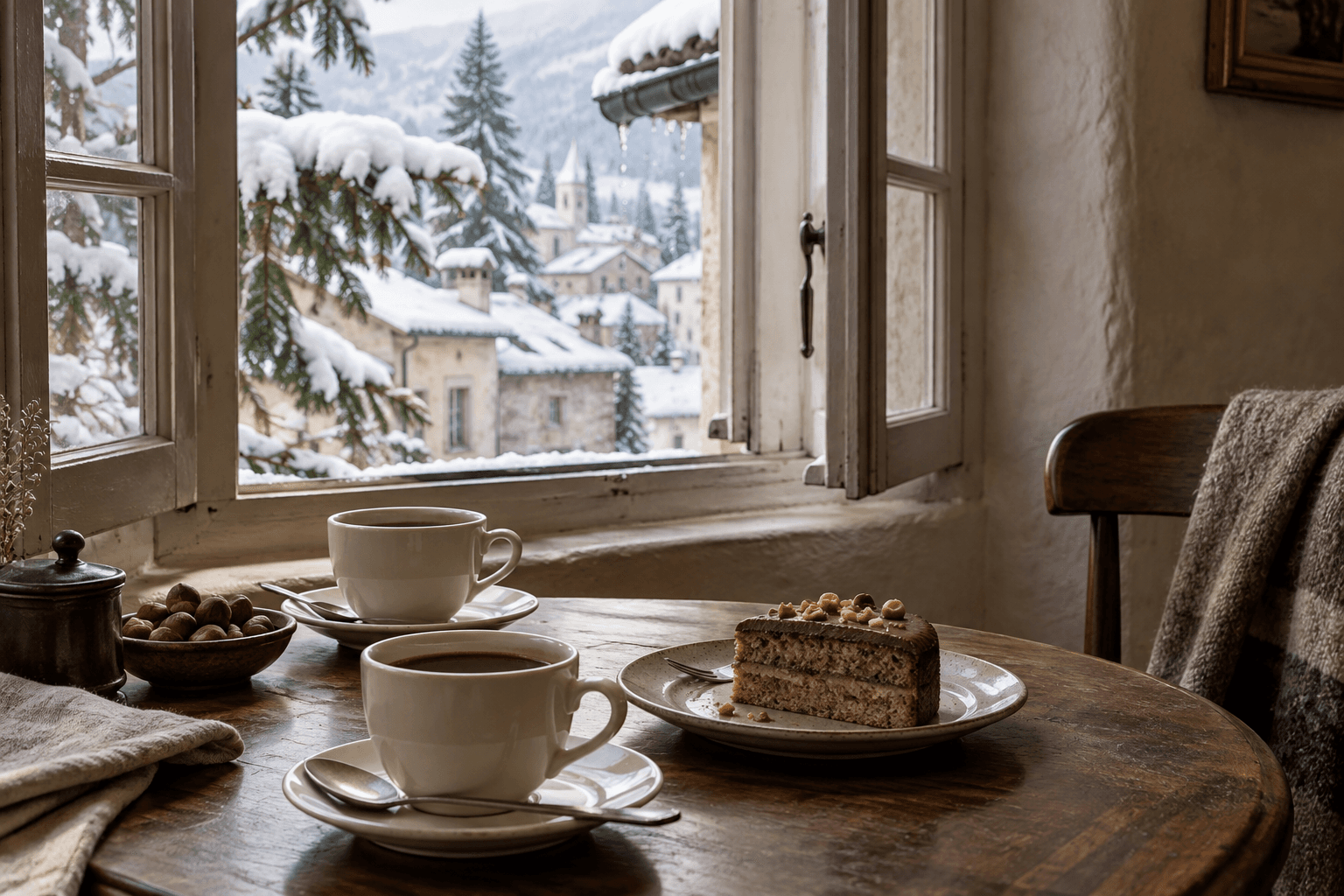
On the first Saturday without dinner to prepare, Marta woke early and thought, for a moment, that she had forgotten something.
The feeling was so familiar that she began making a list before opening her eyes.
Potatoes. Bread. The tablecloth.
Then she remembered.
She turned onto her other side.
Otto, who had been sitting beside the bed awaiting a more useful response, touched the duvet with one paw.
“Not those things,” she told him. “I haven't forgotten you.”
Downstairs, the kitchen was cold enough to make the first coffee particularly welcome. Beyond the window, the garden looked untidy in the way gardens do when snow begins returning everything it has borrowed. A leaf rake lay beside the fence. The edge of a terracotta pot emerged from a shrinking white mound. Dark patches of earth showed beneath the geraniums' outdoor stand.
Water fell from the gutter onto the lid of the bin.
Marta listened for a while, then went outside in her coat and moved the bin six inches to the left.
The improvement was immediate.
She laughed at herself, standing in the damp garden with a cooling cup of coffee, delighted by something she could have done days ago.
When she came back in, she took the cup through to the winter garden.
There was no tablecloth. She had washed and folded it after the last dinner, putting it into the cupboard with the others. Without it, the marks in the tabletop were visible: a pale ring, a shallow scratch, a darker patch where somebody had once set something hot down without thinking.
She liked the table better this way for the morning.
The repaired lampshade stood on the sideboard. She had finally stitched the loose edge on Wednesday, sitting upstairs with the radio on and discovering that the job she had avoided for weeks took rather less time than she had spent moving it out of the way.
The lamp was still off. There was enough daylight.
Marta opened her notebook. The six-Saturday card lay between the pages, just before the soup. She had written a few things on the back: *less bread than Emil thinks; water jug in the middle; don't sit by the kitchen door*.
Underneath, in smaller writing, she added *cake before soup was perfectly all right*.
She would not be showing him that part.
The front bell rang just as she was deciding whether to have breakfast properly or continue calling coffee breakfast. Lena stood outside with a paperback in her hand.
“I was passing.”
“That book has been very busy.”
“I've finished it this time.”
Marta took it. There was a small paper bookmark inside, cut from a scrap of blue bookcloth and folded over a piece of card.
“For you,” Lena said. “Since you've been using receipts.”
“Receipts are effective.”
“They make it difficult to return things to the shop.”
Marta invited her in, but Lena was meeting Ruth at Café Vesper.
“We haven't chosen a table,” she said. “I'm trying not to worry.”
“That sounds wise.”
Lena smiled and went down the street. Marta watched her pause to let a man with a pram past the remaining ridge of snow, then disappear around the corner.
Back in the kitchen, her phone held a message from Felix. He was away for two days the following week and could look at the piano in the pension's upstairs sitting room after that, if she still wanted him to. It was an ordinary message, clear enough to answer in one sentence.
She answered it in one sentence.
Then she cut bread, made toast and carried everything into the winter garden on a tray. Otto followed her, considered the window and resumed his place in the velvet chair. The geraniums had begun producing small bright leaves at the tips of their stems.
Marta read until the toast was cold.
At noon she walked to the bakery. There were fewer people about than she expected. A child in a red coat was stamping at the edge of a puddle while an adult negotiated the difference between waterproof and invincible. Above the station, snow remained in the dark folds of the hill. It would be winter for a while yet.
Emil stood behind the counter tying a paper bag.
“Day off?” he asked.
“From you, apparently.”
“How is it?”
“Too early to say.”
He grinned and reached for the loaf she usually bought. On the counter beside him was a small hazelnut and coffee cake, the same pale glaze catching the light.
“I made two,” he said. “One's for an order. Would you like a piece of this one?”
Marta looked at it. There was a time when he would simply have wrapped half and added it to the bag.
“Yes,” she said. “Two pieces.”
“Someone coming?”
“I thought you might like coffee after you close.”
Emil put down the knife.
“Today?”
“Today. If you want to.”
“I could.”
“Bring yourself. I've got everything else.”
He cut the pieces and wrapped them. Marta paid for the bread and, after a brief argument which he lost, the cake.
At home she put two plates on the bare table. She did not look in the fridge to see whether she could turn coffee into lunch, or lunch into an early supper. There was bread if they wanted it. There was the cake.
She opened the top of the window for a few minutes while the room was empty. The air that came in smelled of wet earth and pine. Somewhere nearby, a door closed, followed by the uneven rattle of a bicycle being wheeled across paving stones.
When Emil arrived, he had nothing in his hands.
“You remembered,” Marta said.
“It felt wrong all the way here.”
She closed the window and made coffee. He sat at the table and tested it with one finger, as he had on the afternoon of the soup.
“I can fix this leg,” he said. “If you'd like me to.”
“Another day.”
“All right.”
Marta brought the tray in. Outside, a small sheet of snow slipped from the shed roof and landed with a soft, heavy sound. Emil turned to look. Otto opened his eyes, established that the incident did not affect the radiator and went back to sleep.
They ate the cake. Emil told her about the order, and she told him about a guest who had asked whether the pine trees stayed green in winter. He made a joke she should have expected and didn't, and she laughed with her fork still in her hand.
When the light began to soften, Marta switched on the lamp she had repaired.
Neither of them had anywhere particular to be.

Written by Esther
Esther is a photographer and storyteller, and the founder of Essy's Essentials - a seasonal home for stories, rituals, recipes and everyday luxuries.
More about Esther →