A story from Amberfell
The Light in the Kitchen Window
One small lamp, a wet village lane and the first evening Alder House began to feel less like somewhere Esther was staying and more like somewhere she was expected home.
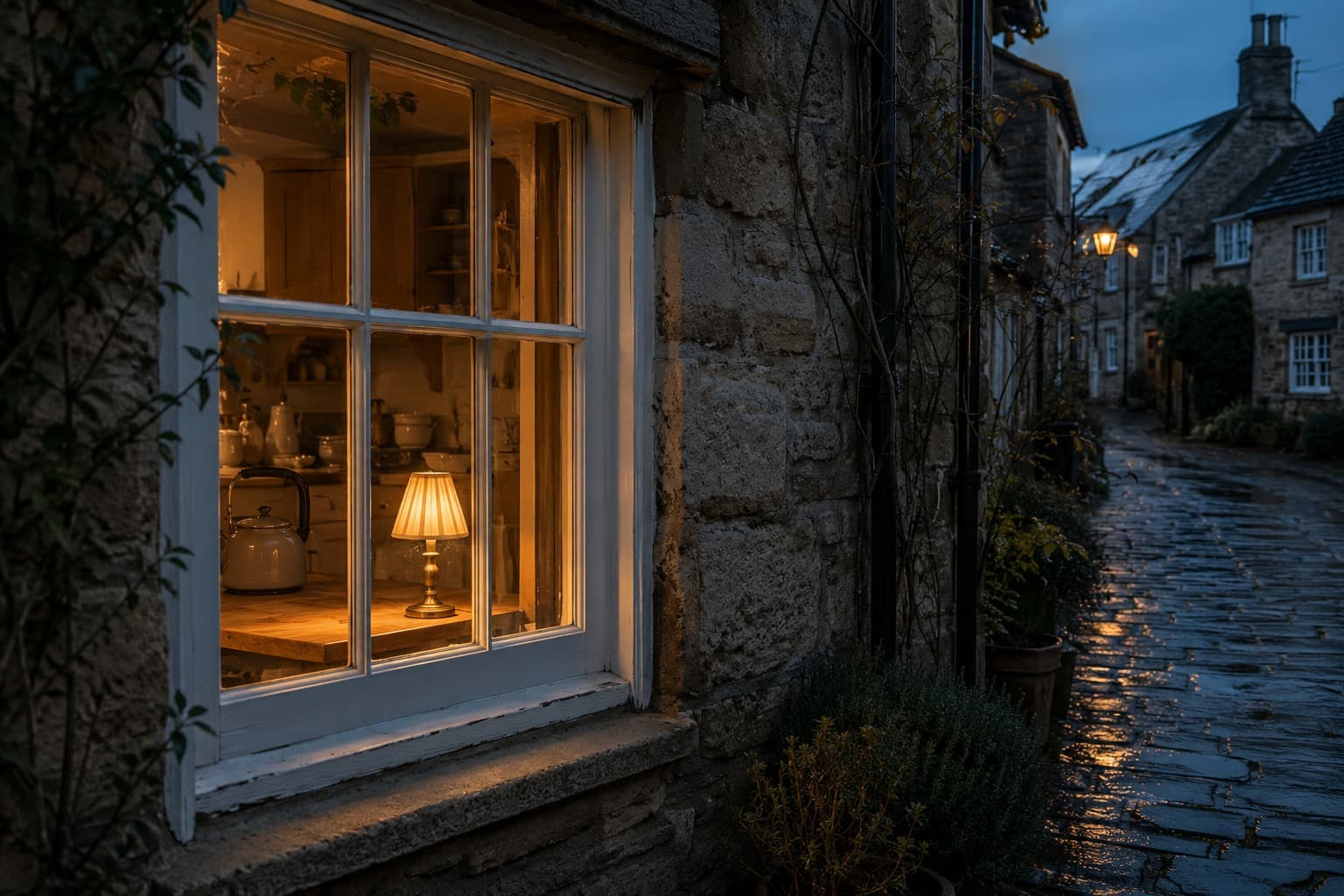
“The large light is for cooking. The small one is for coming home.”
By half past four, the rain had returned.
Esther was standing beneath the narrow awning of the Amberfell bookshop with a paper-wrapped novel under one arm and a loaf she had not intended to buy under the other.
She had gone down to the village for one book.
This had seemed modest enough.
Then the baker had put a warm loaf into her hands because, according to him, rain after four required bread. The woman at the little grocer's had added two pears to her bag and told her they would be ready by Thursday. Someone outside the post office had asked whether Alder House was behaving itself.
Esther had said that it was.
The woman had looked relieved, though not surprised.
Now the bookshop owner was turning the sign on the door from OPEN to GONE HOME BEFORE THE WEATHER GETS IDEAS.
"You have ten minutes before it becomes proper rain," he said.
"What is this?" Esther asked, looking at the silver threads already crossing the lane.
"An introduction."
He locked the door and disappeared uphill beneath an umbrella the colour of red wine.
Esther pulled up the collar of her coat and started towards Alder House.
Amberfell did not switch on all at once.
First came the lamps above the bakery counter, turning the windows the colour of toast. Then a light appeared in the flat over the chemist, followed by another behind the curtains of the house opposite the church. At the end of a side lane, someone lit a room painted deep blue. For a second Esther saw a table, a bowl of apples and a person leaning close to read a letter.
Then the curtain closed and the room became a warm square again.
The rain gathered on the shoulders of her coat. Water moved along the gutters and found every low place in the old stone pavement. Her boots made a soft, damp sound with each step.
She had been in Amberfell for less than a day, but the lane back to Alder House already looked different in the evening. Hedges had become dark walls. Garden gates appeared later than she expected. The church tower vanished behind rain and then returned one turn farther on, as if it had moved while she was not looking.
At the fork beside the old pear tree, Esther stopped.
The handwritten directions in the hall had been very clear when she read them in daylight.
Take the lane past the church. Keep the wall on your left. At the pear tree, choose the road that looks less useful.
Both roads now looked equally unhelpful.
She shifted the bread beneath her arm and tried to remember whether Alder House had three chimneys or four.
That was when she saw the window.
It stood beyond the hedge at the end of the left-hand lane: one rectangle of amber light set into the blue-grey evening. Through the rain, Esther could just make out the edge of a wooden table, the curve of a kettle and the soft pleats of a very small lamp on the kitchen sill.
The rest of the house was dark.
The small lamp was enough.
Before that moment, Alder House had been the place where Esther's bag was. It was where she had slept, where a tray had appeared outside the bedroom door and where a wooden sheep seemed unwilling to face in one direction for long.
Seen from the wet lane, it looked like somewhere she was expected.
Esther took the left-hand road.
By the time she reached the back door, rain was running from her sleeves. Beside the step stood the green boots Ruth had mentioned that morning. The left one had been turned upside down, presumably as a warning.
Inside, the kitchen smelled of thyme, warm bread and the faint mineral damp of old stone after rain.
No one was there.
The lamp on the sill was smaller than it had appeared from the lane. It had a cream pleated shade, a brass stem and the solemn air of something usually found on a bedside table. Beneath it lay a folded note.
The large light is for cooking.
The small one is for coming home.
Soup in the blue pot.
Ruth
Esther read it twice.
Then she made the mistake of switching on the ceiling light.
The whole kitchen arrived at once: the scrubbed table, the drying rack, the copper pans, the basket of onions and the bag she had left open on a chair. The room looked practical and slightly offended.
She switched it off again.
Under the little lamp, everything returned to its proper importance.
The loaf looked generous. The blue pot looked promising. The rain on the window became something to listen to rather than something she had failed to avoid.
Esther hung her coat by the back door and put her wet boots beside Ruth's unreliable pair. She warmed the soup, cut two thick slices of bread and carried both to the table.
Outside, the window had been a single square of light.
From inside, it was a mirror with a village behind it.
Esther could see herself at the table, her hair still damp around her face, one hand curled around the bowl. Beyond her reflection, other kitchen windows glowed along the lane. Some were bright and busy. Some held only one shaded lamp. In one, a person crossed the room carrying a stack of plates. In another, a cat sat on the sill with the fixed expression of someone supervising dinner.
The woman in the navy raincoat passed with the small white dog Esther had seen that morning.
The dog stopped outside Alder House and looked directly at the kitchen window.
Esther lifted her hand.
The woman waved back. The dog considered this, sneezed once and continued down the lane.
For the first time that day, Esther understood that the light was not only for the person coming home.
It also belonged, a little, to whoever was still outside.
She ate the soup slowly. The bread left flour on the table. Her new book stayed wrapped beside the pears, waiting without complaint. At six, the church clock sounded through the rain. At seven, the blue room near the post office went dark. At a quarter past, a cyclist turned into the lane and lifted one hand towards the window as he passed.
Esther left the little lamp on.
She washed the bowl. She folded Ruth's note and placed it beneath the sugar jar. She opened the bookshop parcel and read the first page standing at the counter, then the second sitting at the table.
By eight, Alder House no longer felt like a house she had borrowed.
It felt like a light she had recognised from the road.
Later, when the rain softened and the lane held no more footsteps, Esther carried her book upstairs. From the landing window she could see the kitchen glow falling across the wet stones by the back door.
The large light was for cooking.
The small one was for coming home.
And on a wet evening in Amberfell, it did not seem to matter whose home it was.

Written by Esther
Esther is a photographer and storyteller, and the founder of Essy's Essentials - a seasonal home for stories, rituals, recipes and everyday luxuries.
·
More about Esther →