Home Rituals & Atmosphere
Dolce Far Niente: The Sweetness of Doing Nothing in a World That Optimises Everything
On the Italian art of doing nothing, finding happiness in small moments and learning to rest without feeling guilty.
“A beautifully organised life should leave room for moments that are not organised at all.”
Happiness, I've come to think, rarely lives in the big things. It hides in the details — the way steam curls off a coffee cup, the particular gold of a Tuesday afternoon, the pause between one task and the next before you've already reached for the next one.
The first time I heard the phrase dolce far niente, I was somewhere far too ordinary for it — a train platform, waiting, phone in hand, already drafting the next three things I needed to do. Someone nearby said it lightly, almost as a joke, and I wrote it down on the back of a receipt because it sounded like something worth keeping.
Il dolce far niente. The sweetness of doing nothing. Not the absence of a plan. Not a gap in the calendar waiting to be filled. A pleasure in its own right — deliberate, unhurried, and entirely unapologetic.
I have spent a long time building a life that runs well. Lists that get finished. A home that holds together. A calendar that, for the most part, does what I ask of it. And somewhere in all of that good, sensible structure, I forgot to leave any of it empty.
This is an essay about what happened when I started leaving it empty on purpose.
What Il Dolce Far Niente Actually Means
The full phrase is il dolce far niente, usually shortened in conversation to just dolce far niente. Translated literally, it means something close to 'the sweetness of doing nothing' — though anyone who has actually tried it will tell you the translation undersells it slightly.
It is not apathy. It is not laziness, and it is not the kind of scrolling-on-the-sofa non-activity that leaves you more tired than when you started. Dolce far niente is closer to a small, conscious pleasure — the decision to let a moment be exactly what it is, without turning it into a task, a habit, or a photograph.
In practice, it looks unremarkable. A lunch that runs long because nobody is checking the time. An afternoon spent sitting outside with no particular view in mind, watching people pass rather than working out what to do next. The ten minutes after dinner where the plates stay exactly where they are because the conversation is more interesting than the washing-up. A glass of something ice-cold, drunk slowly, for no reason other than that it is nice.
None of it needs justifying. That, I think, is the entire point.
The Italian Art of Doing Nothing
What strikes me most about dolce far niente is how unbothered it is by outcomes. Italian long lunches are not a productivity hack in disguise — nobody is claiming that a two-hour lunch makes the following two hours more efficient, and the whole idea would probably fall apart under that kind of scrutiny anyway.
It is simply a culture that has, in places, protected the idea that a pleasant hour is worth having for its own sake. Sitting outside with nowhere to be. Watching the street rather than a screen. Letting a glass of limoncello go from ice-cold to merely cold because you were too busy talking to drink it quickly.
I don't think this needs importing wholesale, or treating as some superior foreign lifestyle to imitate correctly. I think it needs noticing — as a genuinely different relationship with time than the one most of us default to, where every hour quietly answers to some version of 'and what did you actually get done today.'
When Even Rest Becomes Something to Optimise
Here is where I have to be honest about my own complicity. I love structure. I love a beautifully organised week, a home that runs on rhythms rather than crisis, a life where the essentials are handled cleanly enough that there's room left over for everything else.
The trouble is what I have historically done with that room left over. I fill it. Every single time. A newly freed-up evening doesn't stay free — it becomes the evening I finally start the thing I've been meaning to start. A quiet weekend becomes the weekend I reorganise the airing cupboard. Even rest, if I'm not careful, gets scheduled, tracked, and quietly assessed for how well I did it.
If I must optimise something, let it occasionally be the temperature of the limoncello.
I'm only half joking. There is a real difference between caring about the small details that make an ordinary moment nicer — the right glass, properly cold, a good book within reach — and turning that same moment into another project with a success metric attached.
A Life That Leaves Room for the Unplanned
That's the sentence I keep circling back to. Structure was never supposed to be the goal. It was supposed to be the thing that made space — for the long lunch, the unhurried afternoon, the evening where nothing gets crossed off a list because nothing was written down on it in the first place.
Somewhere along the way, a lot of us — myself very much included — started treating that space as another task to complete, as if an empty hour were a problem to be solved rather than the entire reward for everything that came before it.
Dolce far niente, done properly, refuses that swap. It insists that the empty hour was the point all along.
How to Rest Without Feeling Guilty
I don't think guilt about resting responds especially well to advice, so I'll offer an observation instead of instructions. The guilt tends to show up loudest right at the start — in the first five minutes of sitting down, before a book or a coffee or a view has had the chance to actually hold your attention. That's usually the moment worth sitting through rather than escaping.
It helps, a little, to stop asking what the rest is 'for'. It isn't for anything. It doesn't need to recharge you for the next task, repair you for tomorrow, or earn its place by making you more useful later. The moment it needs a reason is the moment it stops being dolce far niente and starts being one more thing to manage.
And it helps to remember that doing nothing well is still, in its own quiet way, a skill — one that gets easier with practice, not one you're supposed to arrive at already fluent in.
Dolce Far Niente and the Trouble with Slow Living Online
There is, of course, an entire corner of the internet built around slow living — and I say that with real affection, because I read plenty of it myself. But the trap is worth naming honestly: slow living has, in places, become just as achievement-oriented as the busyness it was meant to replace. The perfectly styled morning routine. The correctly sourced ceramic mug. The seven-step ritual for doing 'nothing' properly.
Dolce far niente doesn't have steps. It doesn't photograph particularly well, and if it does, that was never why you were doing it. The moment slowness becomes something to perform, or optimise, or get right, it has quietly turned back into the very thing it was supposed to be resting from.
Finding Happiness in the Small, Unremarkable Moments
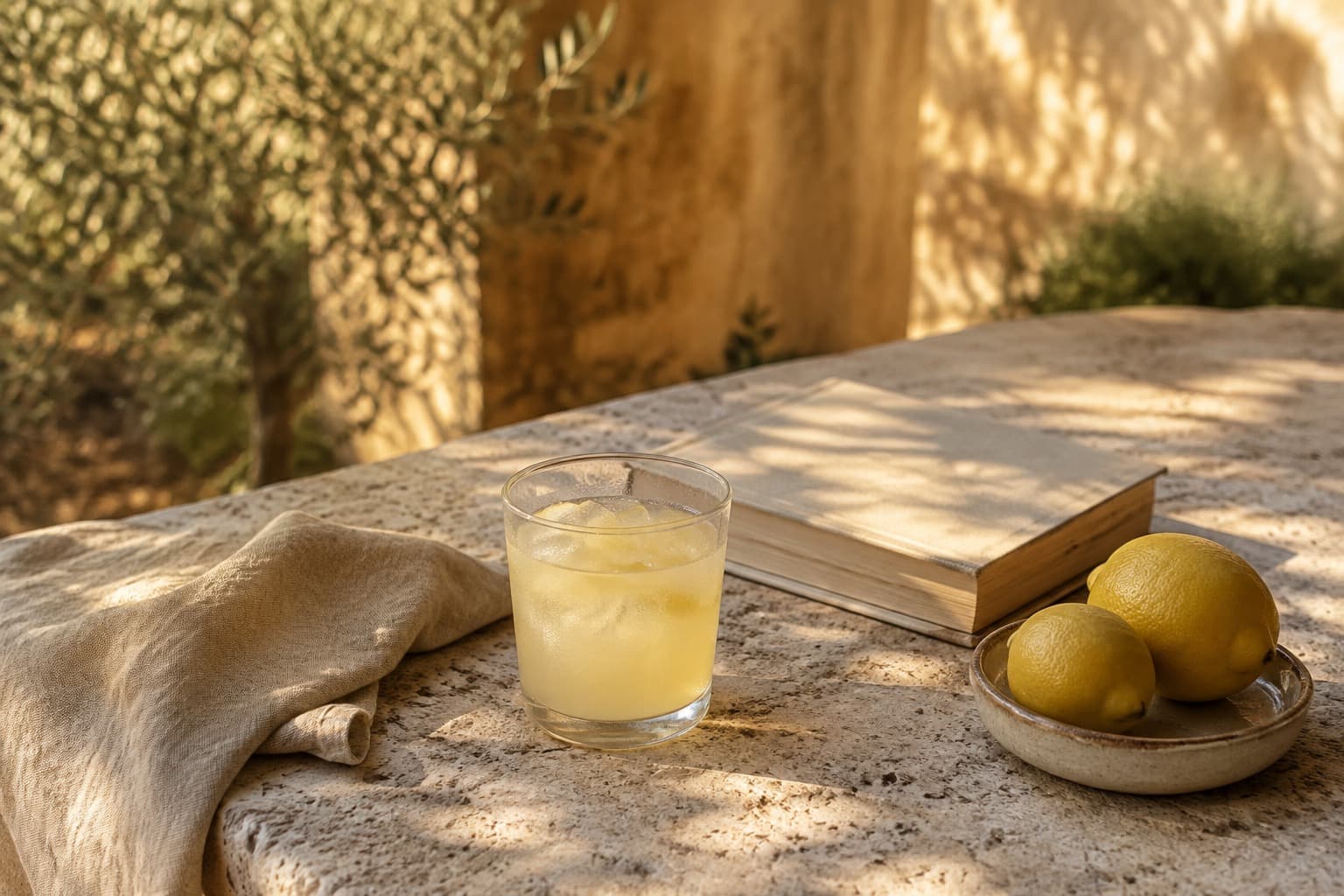
If I try to describe what actually makes me happy on an ordinary day, it is rarely the big things. It's the condensation on a cold glass in the afternoon heat. Two lemons in a bowl, for no better reason than that they were nice to look at. A book left open, spine up, because I meant to come back to it and genuinely might. The particular quality of light that comes through leaves onto old stone late in the day. A napkin left crumpled on a table because nobody rushed to fold it.
None of this is a checklist. I'm not suggesting a bowl of lemons will fix anything. I'm only pointing out that the sweetness of doing nothing tends to live in details this small — which is, I think, exactly why it's so easy to optimise our way straight past them.
Frequently Asked Questions
What does dolce far niente mean?
Dolce far niente — usually written in full as il dolce far niente — is an Italian phrase that translates roughly to 'the sweetness of doing nothing'. It describes the pleasure of unstructured, unhurried time: a long lunch, an idle afternoon, a moment with nothing scheduled and nowhere to be.
Is dolce far niente the same as laziness?
No. Laziness usually comes with avoidance or guilt attached; dolce far niente is a conscious, unapologetic choice to let a moment be unproductive on purpose. It has less to do with avoiding something and more to do with deciding that an empty hour is allowed to be enough on its own.
How does dolce far niente relate to slow living?
They overlap, but dolce far niente is smaller and less structured than most slow-living advice. Where slow living can turn into its own set of rituals and routines to get right, dolce far niente resists having steps at all — it's simply the sweetness of an unplanned moment, not a lifestyle to perfect.
How can I enjoy doing nothing without feeling guilty?
Start by not asking what the rest is 'for'. Guilt tends to fade once you stop expecting the moment to justify itself by recharging you for something else. It also helps to treat it as a skill rather than a talent — something that gets more comfortable with practice, not something you're supposed to already be good at.
“Perhaps dolce far niente is not another habit to master, but a moment in which we finally stop trying to master our lives.”
I don't think I'll ever fully give up structure, and I don't think I should. A well-organised life is still, most days, a genuinely good thing to have. But I have started leaving deliberate gaps in it — hours with nothing assigned to them, evenings I refuse to improve.
That's really all the sweetness of doing nothing has ever asked of me. Not a new routine, not a better way to rest — just permission to let an hour be exactly as sweet, and exactly as empty, as it wants to be.

Written by Esther
Esther is a photographer and storyteller, and the founder of Essy's Essentials - a seasonal home for stories, rituals, recipes and everyday luxuries.
More about Esther →